


- Home
- Hair medicine
- Traction alopecia
- Scalp pain
Scalp pain from hairstyles: when to worry
Pain is the first sign that a hairstyle is pulling too much. When it is a warning, when it is an alarm and which signs call for medical help the same day.
 Rúben BritoAuthor
 Dr Michelle CampagnoliClinical review · OM no. 69467
In this article
Anyone who has had tight braids or spent the day with a high ponytail knows the feeling: when you let your hair down, the root hurts, the scalp is tender to the touch and, sometimes, there is a headache. Many people think this is normal, especially in the first days after having braids put in. It is not.
Pain is the first sign that the hairstyle is pulling too much. Ignoring it, repeatedly, is the road to traction alopecia. And there is another important point: not all scalp pain comes from the hairstyle. Some causes, such as giant cell arteritis in people over 50, need medical attention the same day.
Three ideas to remember.
Fica por baixo do resumo, se existir uma segunda foto.
Why a hairstyle hurts
External traction headache
The International Classification of Headache Disorders (ICHD-3) recognises a distinct type of headache, external traction headache, formerly called "ponytail headache". Its characteristics are:
- appears only during prolonged traction on the scalp (ponytail, bun, braids, extensions, headbands);
- is more intense where the hair is pulled, although it can spread across the head;
- goes away within an hour of removing the traction.
The pain results from the stretching of the soft tissues and nerves of the scalp, which is very rich in nerve endings. It does not cause damage in itself, but it is a warning: the traction is excessive.
The inflammation around the follicles
When the tension continues for days or weeks, as with braids and extensions, the follicles begin to become inflamed. At that point the pain no longer goes away when you let your hair down: the scalp is sore and warm, with red dots or small spots around the hairs, especially at the margins. This is the early stage of traction alopecia, still reversible. See Traction alopecia: what it is and how to recognise it.
Pain as a predictor of risk
The review by Billero and Miteva (2018) states that, in one of the studies cited, only about 19% of people with traction alopecia said they had never had pain during or after having their hair styled. Specialists sum up the message in one sentence: tolerating the pain of a hairstyle is risking hair loss.
Pain that warns and pain that alarms
| Condition | What it means | What to do |
|---|---|---|
| Mild discomfort that goes away within minutes to an hour after letting your hair down | External traction headache: the hairstyle is too tight | Wear wider, lower hairstyles; alternate |
| Pain when braiding or having extensions put in, lasting more than a day or two | Excessive tension, risk of inflammation | Ask for the ones that hurt to be undone; do not "put up with it" |
| Sore scalp with red dots, spots or pus at the margins | Inflammation of the follicles (early stage of traction alopecia or folliculitis) | Undo the hairstyle; consultation in the next few days |
| Intense itching, burning, redness after having extensions put in with glue or tape | Possible contact dermatitis (allergy or irritation) | Remove; seek advice |
| Pain that persists for weeks after giving up the hairstyles, with thinner hair or shiny skin | Chronic inflammation, possible scarring | Consultation |
| Over 50, new pain at the temples, scalp tender to combing, jaw pain when chewing, changes in vision | Suspected giant cell arteritis | Urgent medical help, the same day |
| Severe pain in a band, on one side only, followed by blisters | Possible shingles (herpes zoster) | Consultation the same day or the next |
| Sudden, very severe headache, fever with a stiff neck, weakness, confusion | It can be a neurological emergency | 112 |
A well-done hairstyle should not hurt. If it hurts, it is too tight.
When the pain is not from the hairstyle
The scalp can hurt for many other reasons. If the pain appeared unrelated to hairstyles, or does not go away when you let your hair down, consider these possibilities.
Giant cell arteritis (temporal arteritis)
It is an inflammation of the arteries, especially at the temples, which almost exclusively affects people over 50. The signs include a new headache, usually at the temples, a scalp that is tender to the touch (for example, when combing or resting your head on the pillow), jaw pain when chewing or speaking, changes in vision, a mild fever and tiredness. Without prompt treatment it can cause permanent loss of vision. If you have these symptoms, seek medical help the same day (Mackie et al., 2020).
Shingles (herpes zoster)
Pain, burning or tingling on one side of the head only, in a band, followed a few days later by red patches and blisters. When it reaches the forehead or the area around the eye, it requires prompt assessment. Antiviral treatment works best in the first days.
Folliculitis and infections
Painful spots around the follicles, caused by bacteria, fungi (tinea) or irritation. See Round patch in the hair: when it is worth assessing on tinea.
Scarring alopecias
Lichen planopilaris, frontal fibrosing alopecia and folliculitis decalvans can cause pain, burning and itching, with progressive hair loss. They need early diagnosis and treatment.
Trichodynia
This is the name given to the sensation of pain, burning or discomfort on the scalp, often described as "the roots of my hair hurt", frequently associated with phases of hair loss (telogen effluvium, pattern hair loss) and with stress or anxiety (Rebora et al., 1996). The skin looks normal. It is not dangerous, but it is uncomfortable and deserves an assessment of the cause of the hair loss.
Others
Tension headache and migraine can make the scalp tender to the touch. Seborrhoeic dermatitis, psoriasis and sunburn also cause discomfort.
What to do when a hairstyle hurts
At the time
- Let your hair down or take out the braids and extensions that hurt. Do not wait for it to "settle".
- Gently massage the scalp with your fingertips.
- Avoid heat and chemicals on the sore area.
- Do not use painkillers to be able to keep the hairstyle in. They relieve the pain, but not the traction that causes it.
In the following days
- Wear your hair loose or in wide, low hairstyles.
- Wash with a gentle shampoo and lukewarm water.
- Watch for spots, pus, crusts or hair falling out at the margins.
For the future
- Ask for braids and extensions that are wider, lighter and do not pull on the margins.
- Alternate the position of the ponytail and the parting.
- Use soft, metal-free hair ties and avoid tight clips.
- Respect the timings: braids two to three months at most; extensions six to eight weeks before a break.
See the complete guide in Braids and extensions without damaging your hair.
When to seek help
If you are over 50 and have these symptoms, contact SNS 24 (808 24 24 24), your doctor or go to an emergency department the same day. If you have a sudden, very severe headache, fever with a stiff neck, weakness, difficulty speaking or confusion, call 112.
Consultation in the next few days
- Pain, burning or tingling on one side only, with or without blisters.
- Spots, pus or crusts on the scalp.
- Reaction to extension glues or adhesives.
Hair Medicine consultation
- Persistent pain after giving up traction hairstyles.
- Thinner hair at the temples, front hairline or nape.
- Burning or discomfort on the scalp associated with hair loss (trichodynia).
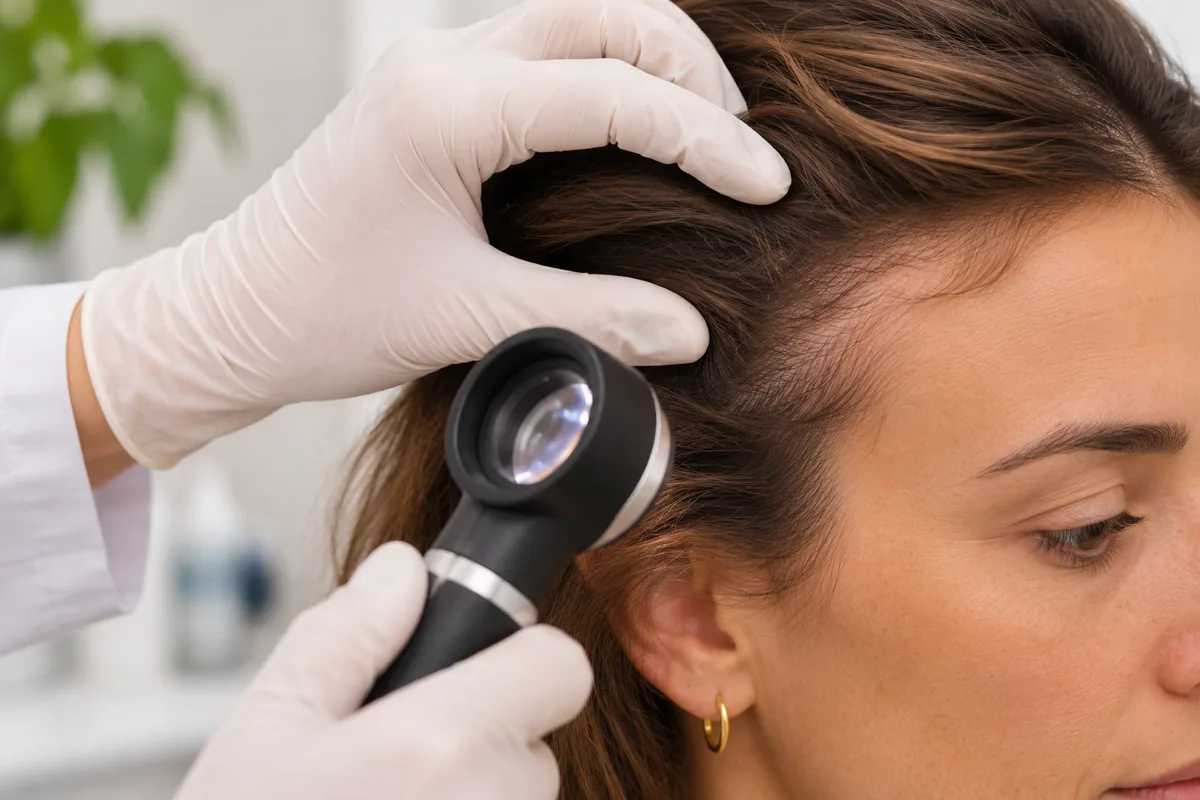
At Luxmed, the Hair Medicine consultation assesses the scalp with trichoscopy, identifies signs of inflammation or traction and agrees with you a plan to ease the pain and protect the hair.
Talk to us
The assessment is a conversation, with no obligation. Tell us what concerns you and our team will reply.
Telephone 214 044 241 · info@luxmed.pt
This article is for information only and does not replace a medical consultation. In case of urgent symptoms, call 112.
Frequently asked questions
Is it normal for the scalp to hurt after braiding?
It should not be considered normal. Pain indicates excessive tension and a risk to the follicles.
Why does my head hurt when I wear a ponytail?
Traction stretches the tissues and nerves of the scalp. This is external traction headache, which goes away within an hour of letting your hair down.
Why do the roots of my hair hurt when I change position?
When hair stays in the same position for a long time and is then changed, the follicles are pulled in another direction. Brief discomfort is common; persistent pain, with hair loss, deserves assessment.
Can scalp pain be a sign of hair loss?
It can. Trichodynia, a sensation of pain or burning without visible changes, often accompanies phases of hair loss.
I am over 50 and my scalp hurts when I comb my hair. Should I worry?
If it is a new pain, especially with pain at the temples, in the jaw when chewing or changes in vision, seek medical help the same day to rule out giant cell arteritis.
Can I take a painkiller to put up with the braids?
It is not a good idea. Pain is the warning that the hairstyle is doing harm; the painkiller hides the warning, but not the damage.
My scalp burns after having extensions put in with glue. What should I do?
Remove the extensions and seek assessment. It may be an allergy or irritation to the glue.
Scientific references 7
- Headache Classification Committee of the International Headache Society. The International Classification of Headache Disorders, 3rd edition (ICHD-3). 4.6.2 External-traction headache. Cephalalgia. 2018;38(1):1-211. ichd-3.org Guideline
- Billero V, Miteva M. Traction alopecia: the root of the problem. Clin Cosmet Investig Dermatol. 2018;11:149-159. Artigo
- Hensel O, et al. Primary headache attributed to external compression or traction to the head: a narrative review. Brain Behav. 2025. Artigo
- NI Direct / NHS. Giant cell arteritis: symptoms and urgent care. nidirect.gov.uk Site
- Mackie SL, Dejaco C, Appenzeller S, et al. British Society for Rheumatology guideline on diagnosis and treatment of giant cell arteritis. Rheumatology (Oxford). 2020;59(3):e1-e23. Guideline
- Rebora A, Semino MT, Guarrera M. Trichodynia. Dermatology. 1996;192(3):292-293. Artigo
- Haskin A, Aguh C. All hairstyles are not created equal. J Am Acad Dermatol. 2016;75(3):606-611. Artigo
Keep exploring