


Marionette lines: why the face looks sad
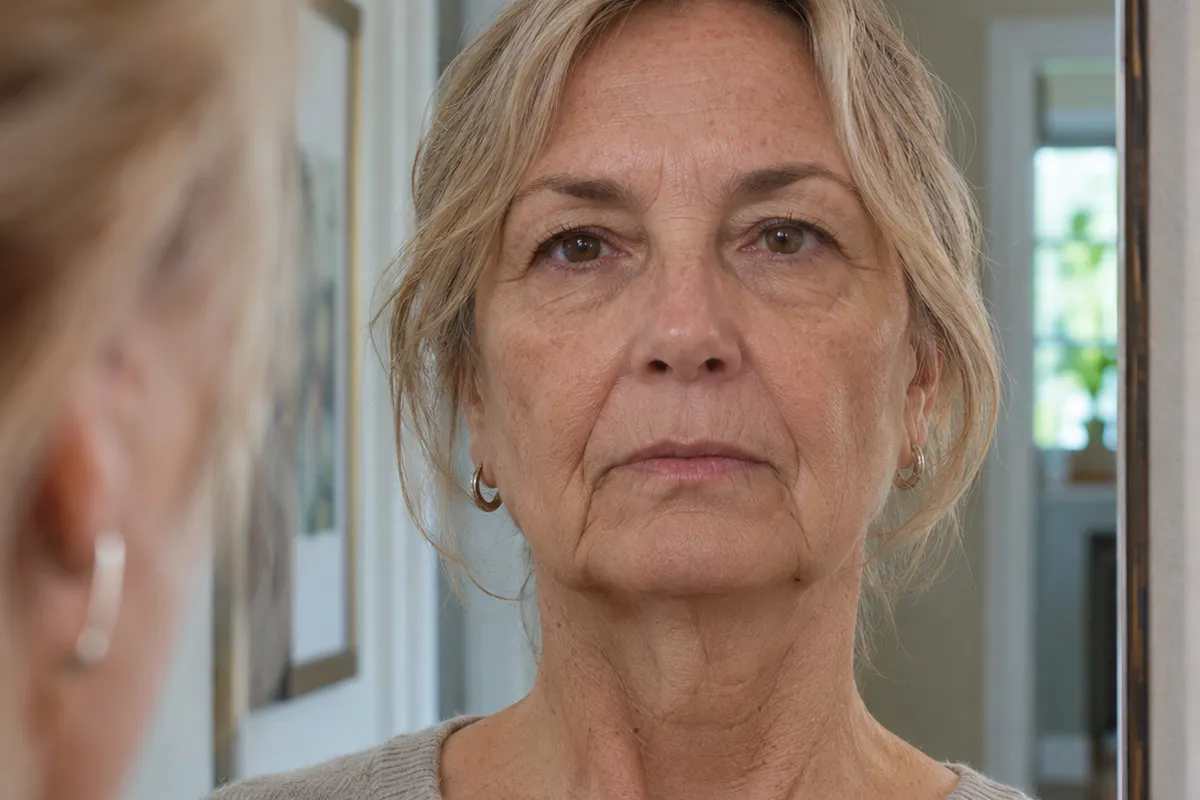
Marionette lines run down from the corners of the mouth towards the chin and give the face a sad, tired or angry look, even at rest.
 Luxmed TeamAuthor
 Dr Michelle CampagnoliClinical review · OM no. 69467
In this article
Marionette lines are the folds that run down from the corners of the mouth towards the chin. The name comes from wooden puppets with a hinged mouth. When they appear, the corners of the mouth tend to turn down and the face takes on a sad, tired or angry look, even at rest. It is one of the complaints that weighs most on how others perceive our state of mind.
Three ideas to remember.
What happens with age
Fat changes position
Facial fat is not a uniform layer. It is organised into compartments separated by thin membranes, and each one ages in its own way (Rohrich and Pessa, 2007). Over the years:
- the cheek compartments lose volume and descend;
- the fat near the lower jaw accumulates above the jawline, forming the ‘jowls’;
- between these areas, the skin is left without support and forms a fold.
Bone resorbs
The lower jaw loses bone in specific areas with age, especially in front of the angle of the jaw. This removes support from the tissues and accentuates the descent of the corners of the mouth (Mendelson and Wong, 2012).
A muscle pulls downwards
The depressor anguli oris muscle, on each side of the chin, pulls the corners of the mouth downwards. With the loss of surrounding support, its action becomes more visible, and the corners also turn down at rest.
Skin loses firmness
Collagen and elastic fibres decrease, especially with the sun, and the skin folds more easily (Fisher et al., 2002).
What speeds it up
- Smoking: in identical twins, smokers had more marked nasolabial folds and more laxity in the jaw (Okada et al., 2013).
- Marked or rapid weight loss.
- Unprotected sun exposure.
- Genetics, which determines bone structure and skin thickness.
- Tooth loss, which reduces support for the lower part of the face.
Stages of marionette lines
| Stage | How to recognise it |
|---|---|
| Mild | Fine shadow from the corner of the mouth, visible mainly in certain light |
| Moderate | Clear fold at rest and slightly drooping corners of the mouth |
| Marked | Deep fold down to the chin, drooping corners of the mouth and visible ‘jowls’ |
Why treating is not just ‘filling the fold’
Because marionette lines have several causes, filling only the fold often gives a heavy, unnatural result. Treatment usually includes:
- support, with hyaluronic acid in the corners of the mouth, the chin and, sometimes, the jawline;
- muscle balance, with small doses of botulinum toxin in the muscle that pulls the corners downwards;
- skin quality and firmness, with biostimulators or technologies such as focused ultrasound.
There are articles dedicated to the non-surgical options (Drooping mouth corners: what can be done without surgery) and to combining filler with toxin (Marionette lines: filler and toxin together).
At Luxmed Clinic
At Luxmed, we assess marionette lines in the context of the whole lower third of the face: volume, bone, muscle and skin. Only then can we soften the sad look without leaving the area heavy.
Talk to us
The assessment is a conversation, with no obligation. Tell us what concerns you and our team will reply.
This article is for information purposes and does not replace a consultation. The results of any treatment vary from person to person.
Frequently asked questions
Are marionette lines the same as nasolabial folds?
No. The nasolabial fold runs from the nose to the corners of the mouth. Marionette lines run down from the corners of the mouth towards the chin.
From what age do they appear?
In general, from the age of 40, earlier in people with marked weight loss, who smoke or who have a lot of sun exposure.
Do facial exercises help?
There is no solid evidence that they correct marionette lines.
Do creams solve it?
They may slightly improve the skin, but they do not restore the volume or support that is missing.
When is surgery the answer?
When there is a lot of laxity and excess skin in the jaw, a surgical lift can give a result that non-surgical treatments cannot.
Scientific references 4
- Fisher GJ, Kang S, Varani J, et al. Mechanisms of photoaging and chronological skin aging. Arch Dermatol. 2002;138(11):1462-1470. Artigo
- Mendelson B, Wong CH. Changes in the facial skeleton with aging: implications and clinical applications in facial rejuvenation. Aesthetic Plast Surg. 2012;36(4):753-760. Artigo
- Okada HC, Alleyne B, Varghai K, Kinder K, Guyuron B. Facial changes caused by smoking: a comparison between smoking and nonsmoking identical twins. Plast Reconstr Surg. 2013;132(5):1085-1092. Artigo
- Rohrich RJ, Pessa JE. The fat compartments of the face: anatomy and clinical implications for cosmetic surgery. Plast Reconstr Surg. 2007;119(7):2219-2227. Artigo
Editing and development: Rúben Brito · Operial Development
Keep exploring