


- Home
- Facial aesthetics
- Drooping eyelid after toxin
- Drooping eyelid after botulinum toxin
Drooping eyelid after botulinum toxin: why it happens
One of the best-known complications of botulinum toxin is a drooping eyelid or brow. It is temporary, but uncomfortable and visible.
 Luxmed TeamAuthor
 Dr Michelle CampagnoliClinical review · OM no. 69467
In this article
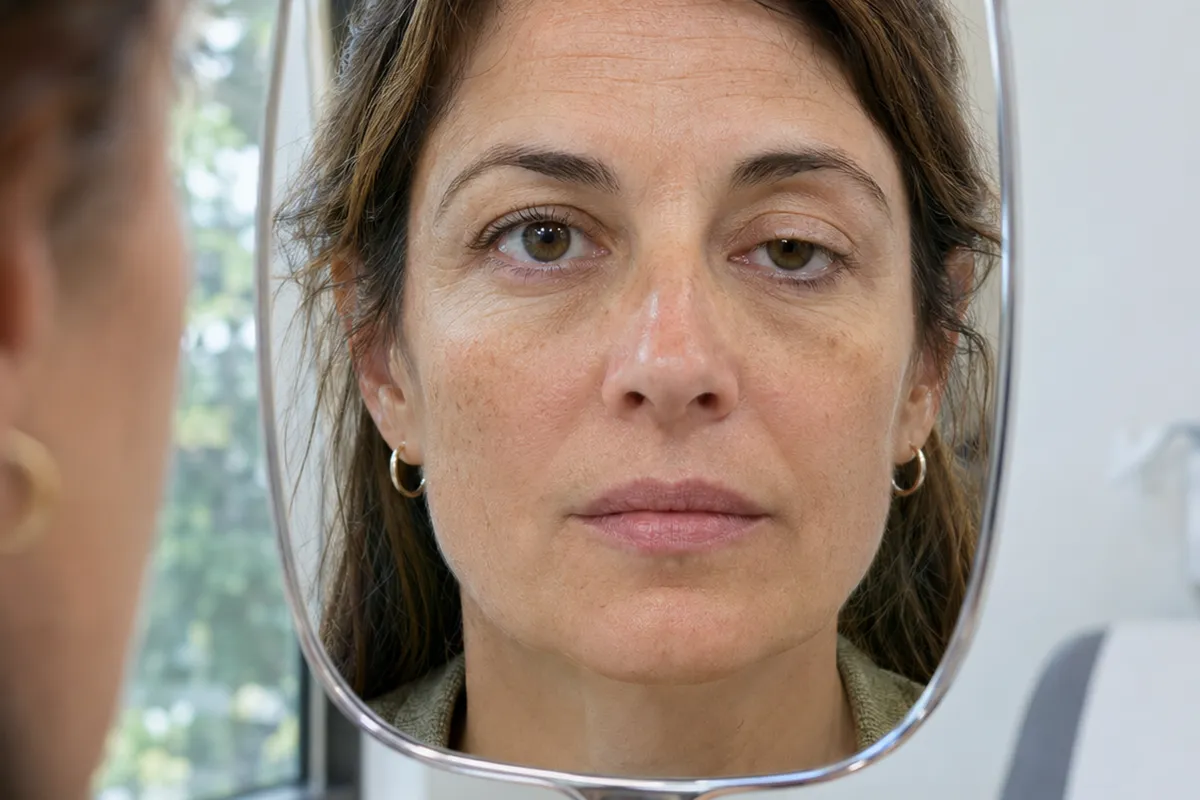
One of the best-known complications of botulinum toxin is a drooping eyelid or brow. It occurs when the toxin affects a muscle it should not, either because it spreads from the injection point or because it was injected too close to the muscle. It is temporary, but uncomfortable and visible.
Three ideas to remember.
Two different problems
| Drooping eyelid | Drooping eyebrow | |
|---|---|---|
| Cause | The toxin reaches the muscle that lifts the eyelid | Toxin in the forehead weakens the muscle that lifts the brow too much |
| Treatment of the glabella and forehead | More commonly associated with the glabella | More commonly associated with the forehead |
| Usual duration | 3 to 4 weeks | About 6 weeks |
Why it happens
A practical review of this complication identifies the following (King, 2016):
- Technique-related factors: injection points too close to the brow or eye socket, depth, volume and dilution.
- Dose-related factors: high doses in the forehead or glabella.
- Individual factors: heavy brows, age, using the forehead to compensate for heavy eyelids, previous surgery and pre-existing ptosis.
- After treatment: massage, heat or pressure on the area during the first few hours.
In a registry study cited in that review, the frequency was 5.4%, largely attributed to inexperienced injectors; with experience, it is estimated to be below 1%.
At Luxmed Clinic
At Luxmed, we assess the position of the brows and eyelids before every botulinum toxin treatment and adjust injection points and doses to reduce this risk.
Talk to us
The assessment is a conversation, with no obligation. Tell us what concerns you and our team will reply.
This article is for information only and does not replace a consultation. The results of any treatment vary from person to person. Botulinum toxin is a prescription-only medicine and should only be administered by doctors.
Frequently asked questions
Is it permanent?
No. It resolves when the effect of the toxin wears off in that muscle.
Does it affect vision?
It may slightly restrict the upper visual field while it lasts.
Can it happen even with a skilled injector?
Yes, but it is uncommon.
Will it happen again?
Not necessarily. The technique can be adjusted.
Scientific references 1
- King M. Management of ptosis. J Clin Aesthet Dermatol. 2016;9(12):E1-E4. Artigo
Editing and development: Rúben Brito · Operial Development
Keep exploring