


- Home
- Hair medicine
- Postpartum hair loss
- Postpartum hair loss
Hair loss after childbirth: what is normal
When postpartum hair loss starts and ends, why it happens, what can make it worse and which signs indicate that something else lies behind it.
 Rúben BritoAuthor
 Dr Michelle CampagnoliClinical review · OM no. 69467
In this article
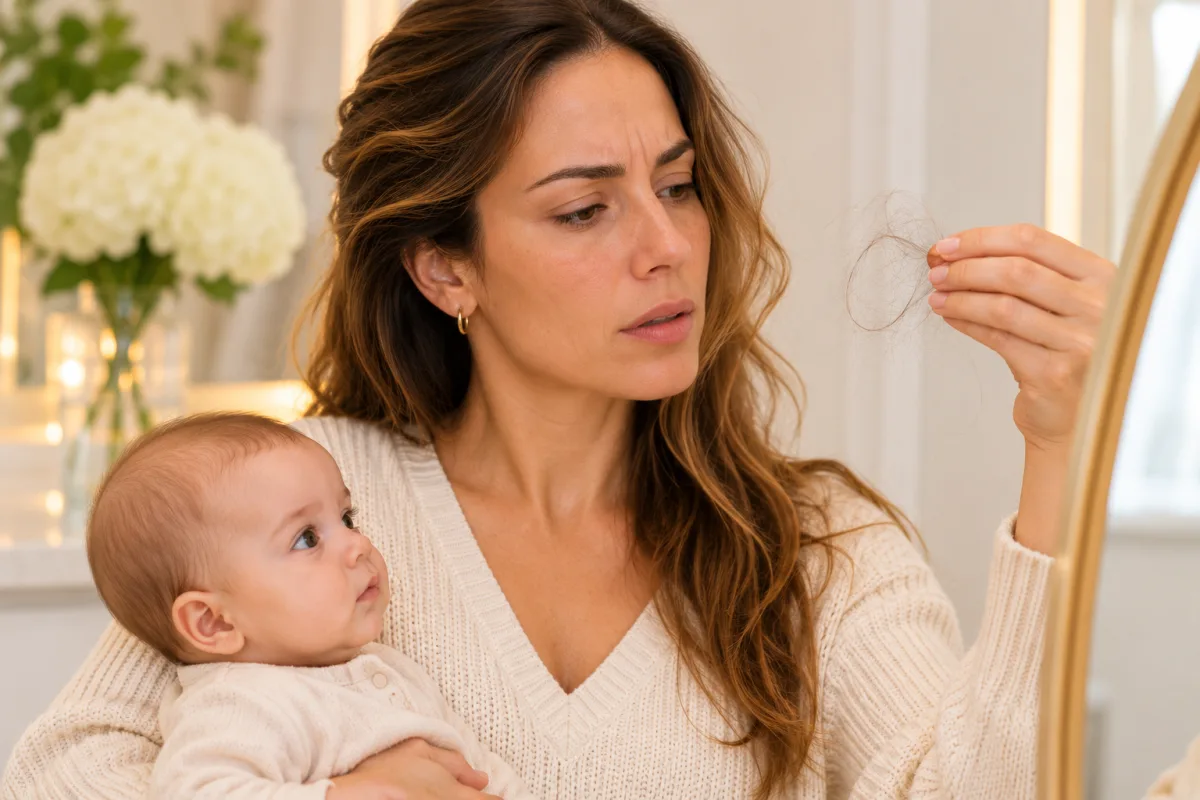
If your hair started falling out in clumps two or three months after giving birth, you are experiencing one of the most common postpartum situations. In one study, more than 9 in 10 mothers reported hair loss in the first year. It has a name, postpartum telogen effluvium, and it usually resolves on its own.
On average, it starts at around 3 months, peaks at 5 and ends at around 8 months after birth. Hair grows back, but it takes time to recover its volume. What matters is knowing what can make the hair loss worse and which signs indicate that something else lies behind it.
Three ideas to remember.
Fica por baixo do resumo, se existir uma segunda foto.
Why it happens
During pregnancy, hormonal changes mean that more hairs than usual stay in the growth phase. That is why many pregnant women notice fuller hair with less shedding.
After birth, hormones fall rapidly. The hairs that had been "held back" all enter the resting phase at the same time, which lasts about 3 months, and at the end they fall out. That is why hair loss does not appear straight away, but weeks to months later.
Under normal conditions, about 85% to 90% of hairs are in the growth phase and 10% to 15% in the resting phase. In telogen effluvium, the percentage in the resting phase can reach 30% or more. The hair is not "weakening": the cycle is adjusting all at once.
Other postpartum factors may add up: blood loss at birth, iron deficiency, nights of poor sleep, irregular eating and stress.
When it starts and when it ends
A Japanese study of 331 mothers, questioned 10 to 18 months after giving birth, described the average progression (Hirose et al., 2023):
| Stage | When, on average |
|---|---|
| Onset of hair loss | 2.9 months after birth |
| Peak | 5.1 months |
| End of increased hair loss | 8.1 months |
In that study, 91.8% of mothers reported hair loss. The duration of breastfeeding and premature birth were associated with more marked hair loss. This is an association, not a causal relationship, and it is no reason to change your breastfeeding plan.
After hair loss, regrowth
Hair grows about 1 cm a month. That is why, when hair loss stops, short hairs appear first, especially along the front hairline and at the temples, like a spiky "fringe". It is a good sign. Recovery of full volume may take another 6 to 12 months.
What can worsen or prolong hair loss
| Factor | Why it matters | What to do |
|---|---|---|
| Iron deficiency | Pregnancy and blood loss at birth deplete reserves. Low ferritin is associated with hair loss in women (Treister-Goltzman et al., 2022) | Ask for a full blood count and ferritin if hair loss is heavy or there is tiredness and pallor |
| Postpartum thyroiditis | It affects about 5% to 10% of women. It may start with an overactive thyroid phase between the 1st and 4th month and progress to an underactive thyroid between the 4th and 8th (American Thyroid Association) | Ask for TSH if there is marked tiredness, palpitations, or changes in weight or mood |
| Irregular eating and little protein | Needs increase during breastfeeding | Protein at every meal; see Iron and vitamins after birth |
| Lack of sleep and stress | Known triggers of telogen effluvium | Share the nights when possible; ask for help |
| Tight hairstyles | Tight ponytails and buns, common with a baby in your arms, cause traction | Loose hairstyles, soft hair ties |
When hair loss reveals something else
Postpartum effluvium can make visible an androgenetic alopecia that was starting. In a study of 200 women assessed for postpartum hair loss, only 9.5% had effluvium alone: most also had signs of androgenetic or traction alopecia on trichoscopy (Galal et al., 2024). The study was carried out in a dermatology clinic, where the more marked cases end up, but it shows why it is worth getting assessed when hair loss does not improve.
What you can do
- Knowing it is temporary. In the great majority of mothers, hair loss slows on its own over the first year.
- Eat well and drink water. Protein, iron and a varied diet, especially if you are breastfeeding.
- Keep taking the vitamins that your doctor or obstetrician recommended, without adding "hair" supplements on your own.
- Treat your hair gently: comb with a wide-bristle brush, avoid excessive heat and tight hairstyles.
- A shorter or layered cut can disguise the loss of volume while the hair recovers.
- Wash as normal. Washing does not increase hair loss; it only releases hairs that were already going to fall.
Treatments during breastfeeding
In pure telogen effluvium, treatment is generally not needed. If there is an associated androgenetic alopecia, some treatments should wait until the end of breastfeeding, and others may be considered case by case. The decision is always medical. See Breastfeeding and hair: what you can do and what to avoid.
What is not normal
When to seek a medical assessment
Ask for an assessment if hair loss lasts longer than 6 to 9 months, if there are no signs of regrowth, if you notice any of the signs in the list above, or if the hair loss is affecting you emotionally. Tiredness, low mood and anxiety after childbirth also deserve their own attention: talk to your GP or obstetrician.
At Luxmed, the Hair Medicine consultation assesses whether it is only postpartum effluvium or whether another cause is involved, with trichoscopy and, when indicated, blood tests.
Talk to us
The assessment is a conversation, with no obligation. Tell us what concerns you and our team will reply.
Telephone 214 044 241 · info@luxmed.pt
This article is for information only and does not replace the care of your doctor or obstetrician.
Frequently asked questions
How long does postpartum hair loss last?
On average, it starts at around 3 months after birth and ends at around 8. Volume recovers over the following months.
Will I have less hair for good?
In isolated postpartum effluvium, no: the follicles remain active and the hair grows back. If hair loss does not recover, there may be another cause, such as androgenetic alopecia.
Does breastfeeding make more hair fall out?
One study found an association between the duration of breastfeeding and the intensity of hair loss, but did not prove causation. The benefits of breastfeeding remain.
Will the hair loss happen again in the next pregnancy?
It is common for it to recur, because the hormonal mechanism is the same.
Do anti-hair-loss shampoos help after birth?
They can improve the look of the hair, but they do not change the cycle of the effluvium, which resolves on its own.
Which tests should I have?
If hair loss is heavy or prolonged: a full blood count, ferritin and thyroid function are the most useful. More in Blood tests for hair loss: what to ask for.
Scientific references 5
- Hirose A, Terauchi M, Odai T et al. Investigation of exacerbating factors for postpartum hair loss: a questionnaire-based cross-sectional study. Int J Womens Dermatol. 2023. Resumo
- Galal SA, El-Sayed SK, Henidy MMH. Postpartum telogen effluvium unmasking additional latent hair loss disorders. J Clin Aesthet Dermatol. 2024;17(5):15-22. Artigo
- Treister-Goltzman Y, Yarza S, Peleg R. Iron deficiency and nonscarring alopecia in women: systematic review and meta-analysis. Skin Appendage Disord. 2022;8(2):83-92. Artigo
- American Thyroid Association. Postpartum thyroiditis. Artigo
- DermNet. Telogen effluvium. Artigo
Keep exploring