


- Home
- Body aesthetics
- Keloid or hypertrophic scar
Keloid or hypertrophic scar: how to tell them apart and when to see a doctor
A raised, firm, red scar? Find out how keloids and hypertrophic scars differ, which factors raise the risk and what treatments exist.
 Rúben BritoAuthor
 Dr Michelle CampagnoliClinical review · OM no. 69467
In this article
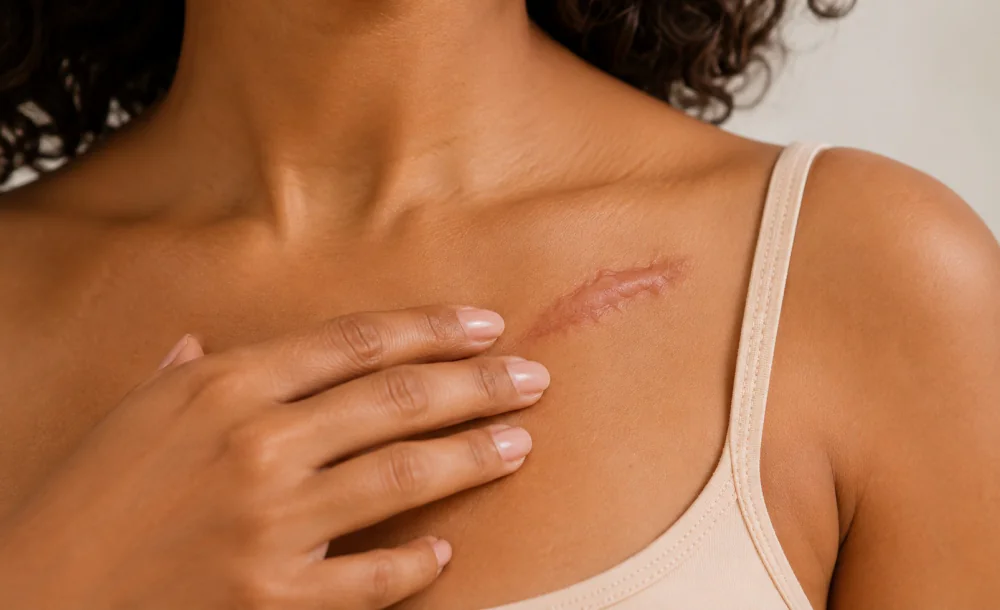
When a wound heals, the body produces collagen to close the skin. In some people this process goes beyond what is needed and forms a raised, firm and sometimes red scar, with itching or pain. It may be a hypertrophic scar or a keloid.
At first glance they look alike, but they behave differently: a hypertrophic scar tends to improve with time, whereas a keloid tends to keep growing and to come back after it is removed (Berman et al., 2017). That is why telling the two apart matters before any treatment.
Three ideas to remember.
Fica por baixo do resumo, se existir uma segunda foto.
How to tell the difference
| Feature | Hypertrophic scar | Keloid |
|---|---|---|
| Boundaries | stays within the boundaries of the original wound | extends beyond the boundaries and invades the surrounding skin |
| When it appears | in the first weeks after the wound | may appear weeks or months later, sometimes after a minimal injury |
| Course | tends to flatten and fade in 1 to 2 years | rarely regresses; may keep growing |
| After surgical removal | may improve | often comes back if the surgery is not combined with another treatment |
| Typical areas | joints, areas of tension, burns | earlobe, chest, shoulders, upper back |
| Symptoms | itching, sometimes pain | itching and pain more frequent and more intense |
In practice it is not always easy to tell them apart, especially in the first months. Some specialists consider that the two are part of a spectrum of the same inflammatory skin disease (Ogawa, 2017).
Why they form
Normal healing goes through an inflammation phase, a collagen production phase and a remodelling phase that can last more than a year. In hypertrophic scars and keloids, inflammation in the deep layer of the skin (the dermis) is prolonged and collagen production becomes uncontrolled (Ogawa, 2017).
Risk factors
For hypertrophic scars (Berman et al., 2017, Ogawa et al., 2019):
- wounds in areas of tension or movement, such as the chest, shoulders or joints;
- deep burns;
- infection or delayed healing;
- wounds that do not follow the natural lines of the skin.
For keloids (Berman et al., 2017, Ogawa et al., 2019):
- darker skin;
- family history of keloids;
- age between adolescence and 30 years;
- areas such as the earlobe, chest and shoulders;
- injuries such as piercings, acne, vaccinations, surgery or small cuts;
- pregnancy, which can make existing keloids grow.
Anyone who has already had a keloid is more likely to develop others.
Prevention: what helps after a wound or surgery
If you tend to form raised scars, prevention starts as soon as the wound closes (Ogawa et al., 2019, Gold et al., 2014, Mustoe et al., 2002):
- Silicone gel or sheets: the most recommended preventive measure. It is used for several months, from the moment the skin has closed. The evidence is of limited quality, but international guidelines still regard it as first line (Gold et al., 2014, O'Brien and Jones, 2013).
- Reduce tension on the scar: suitable adhesive tapes in the first weeks, and avoiding movements that stretch the area.
- Sun protection: prevents the scar from darkening.
- Pressure: in extensive burns, compression garments for months.
- Avoid new injuries in people with a history of keloids: think twice before piercings, tattoos or non-essential cosmetic surgery in risk areas.
Treatments
Treatment depends on the type of scar, its size, its age and the symptoms. Several options are often combined (Berman et al., 2017, Ogawa et al., 2019, Gold et al., 2014).
| Treatment | What for | Notes |
|---|---|---|
| Silicone gel or sheets | recent scars, prevention | daily use for months |
| Corticosteroid injections into the scar | persistent keloids and hypertrophic scars; first-line treatment | reduce volume, itching and pain; several sessions are usually needed; may cause thinning or lightening of the skin |
| Cryosurgery | small keloids | may lighten the skin, especially in darker skin |
| Vascular laser | redness and volume | works better on recent scars |
| Other medicines injected into the scar | keloids that do not respond to corticosteroids | some are used outside the approved indication (off-label); a medical decision |
| Surgery | large keloids, hypertrophic scars that limit movement | with a keloid, surgery alone has a high recurrence rate; it should be combined with a corticosteroid or superficial radiotherapy (Berman et al., 2017, Ogawa et al., 2019) |
| Superficial radiotherapy | after keloid surgery | reduces recurrence; reserved for selected cases |
Realistic expectations
- No treatment makes a scar disappear completely. The aim is to make it flatter, paler, softer and free of symptoms.
- Hypertrophic scars usually respond better than keloids.
- Keloids can come back even after good results, and follow-up is important (Berman et al., 2017).
- Results vary from person to person.
When to see a doctor
See a doctor without delay if a raised scar or lesion bleeds, ulcerates, quickly changes colour or shape, or appears with no previous wound. Rarely, a skin cancer can look like a scar and must be ruled out.
If you have any doubts, call SNS 24 (808 24 24 24). If you develop an infection with a high fever, redness that spreads quickly or signs of a severe allergic reaction after a treatment, call 112.
At Luxmed Clinic
At the consultation, we assess the scar, your history and your risk factors, to work out whether it is a hypertrophic scar or a keloid and what the best approach is.
From there, we propose a plan tailored to you, with realistic expectations and based on what the scientific evidence supports. When necessary, we coordinate with dermatology or plastic surgery. If you have an acne scar, see also Acne scars: what types exist and what to expect from treatment.
Talk to us
The assessment is a conversation, with no obligation. Tell us what concerns you and our team will reply.
This article is for information only and does not replace a medical assessment. Results vary from person to person.
Frequently asked questions
What is the difference between a keloid and a hypertrophic scar?
A hypertrophic scar stays within the edges of the wound and tends to improve with time. A keloid goes beyond those edges, rarely regresses and often comes back after it is removed.
Does a keloid go away on its own?
Rarely. Unlike a hypertrophic scar, it tends to persist or keep growing.
Can a keloid be removed with surgery?
It can, but surgery on its own has a high recurrence rate. In general, it is combined with corticosteroid injections or superficial radiotherapy.
Does silicone really work?
It is the most recommended preventive measure, although the quality of the studies is limited. It works better on recent scars and with prolonged daily use.
I have keloids. Can I get a piercing or a tattoo?
The risk of forming a new keloid is higher. Talk to a doctor first, especially if it is on the earlobe, chest or shoulders.
Can a scar turn into cancer?
It is very rare. But a lesion that changes, bleeds or ulcerates should be assessed to rule out other causes.
Scientific references 6
- Berman B, Maderal A, Raphael B. Keloids and hypertrophic scars: pathophysiology, classification, and treatment. Dermatol Surg. 2017;43(Suppl 1):S3-S18. doi:10.1097/dss.0000000000000819 Artigo
- Ogawa R. Keloid and hypertrophic scars are the result of chronic inflammation in the reticular dermis. Int J Mol Sci. 2017;18(3):606. doi:10.3390/ijms18030606 Artigo
- Ogawa R, Akita S, Akaishi S, et al. Diagnosis and treatment of keloids and hypertrophic scars: Japan Scar Workshop Consensus Document 2018. Burns Trauma. 2019;7:39. doi:10.1186/s41038-019-0175-y Artigo
- Gold MH, Berman B, Clementoni MT, et al. Updated international clinical recommendations on scar management: part 1, evaluating the evidence. Dermatol Surg. 2014;40(8):817-824. Artigo
- O'Brien L, Jones DJ. Silicone gel sheeting for preventing and treating hypertrophic and keloid scars. Cochrane Database Syst Rev. 2013;(9):CD003826. Artigo
- Mustoe TA, Cooter RD, Gold MH, et al. International clinical recommendations on scar management. Plast Reconstr Surg. 2002;110(2):560-571. doi:10.1097/00006534-200208000-00031 Artigo
Keep exploring