


- Home
- Facial aesthetics
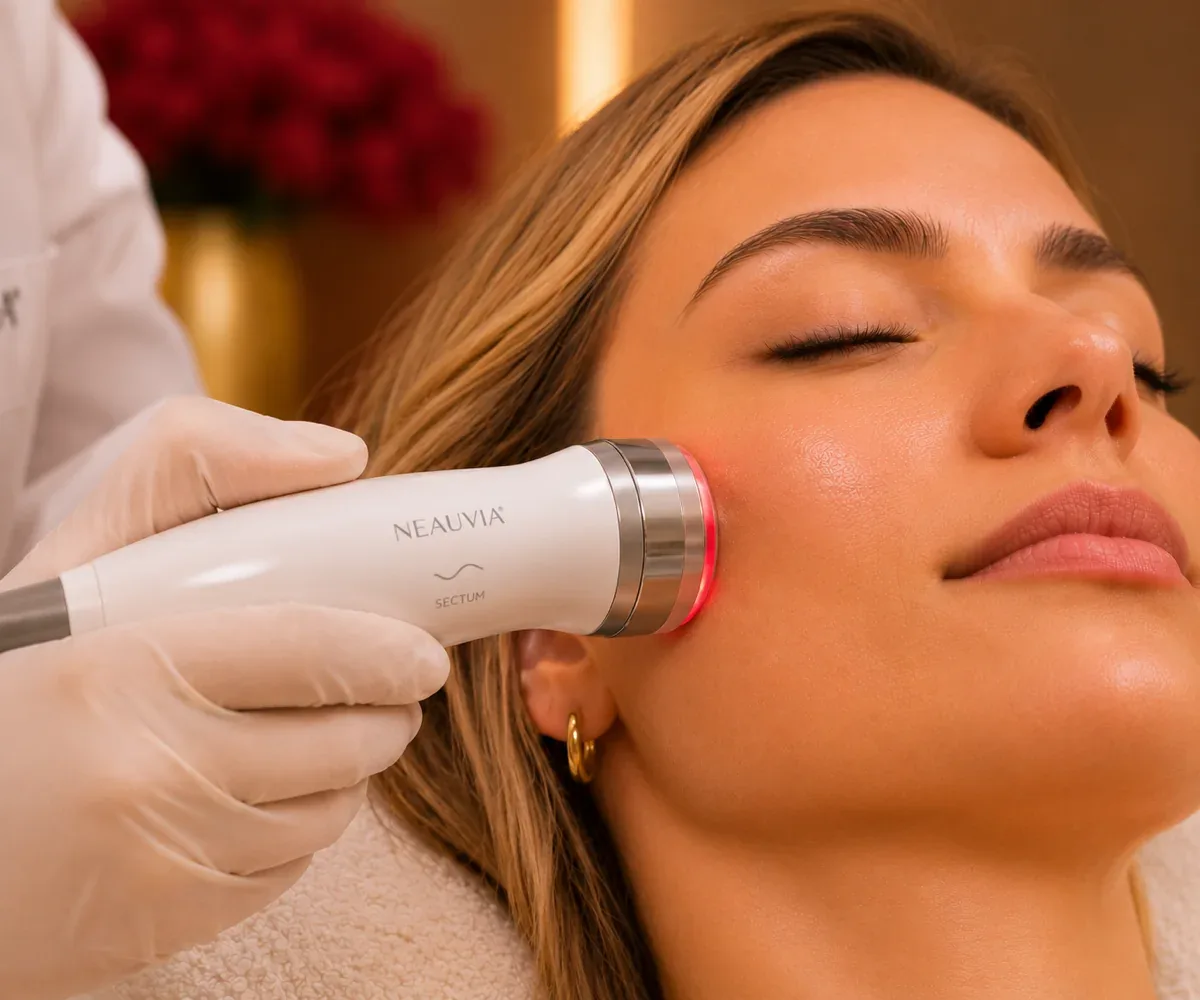
- Sectum radiofrequency Neauvia
- Facial radiofrequency: contraindications
Facial radiofrequency: contraindications
Facial radiofrequency is well tolerated, but it uses electrical current and heat. Find out who should not have it, which situations require adjustments, the possible effects and when to contact the clinic.
 Luxmed TeamAuthor
 Dr Michelle CampagnoliClinical review · OM no. 69467
In this article
Facial radiofrequency is one of the safest and best-tolerated aesthetic treatments. However, it uses electrical current and heat, and there are situations in which it should not be performed or the technique needs to be adapted. This article outlines the absolute and relative contraindications to radiofrequency, the possible side effects and the warning signs that warrant contacting the clinic.
Three ideas to remember.
Absolute contraindications
| Condition | Why |
|---|---|
| Pacemaker, defibrillator or neurostimulator | The electrical current may interfere with the device |
| Pregnancy | Lack of safety data |
| Metal implants in the treatment area | They may concentrate heat |
| Active infection, active herpes or wounds in the treatment area | Risk of aggravating or spreading the condition |
| Skin cancer or suspicious lesions in the area | They require their own assessment and treatment |
Relative contraindications and situations requiring assessment
| Condition | What is done |
|---|---|
| Breastfeeding | Assess on a case-by-case basis; many clinics prefer to postpone treatment |
| Recent hyaluronic acid fillers | Wait a few weeks and adjust the treatment area |
| Recently placed lifting threads | Wait for the area to stabilise; avoid the paths of any metal threads |
| Dental implants or orthodontic braces | They generally do not prevent treatment, but the area must be assessed |
| Diabetes or altered sensation | Care is needed because heat perception may be impaired |
| Autoimmune skin diseases | Assessment by a doctor |
| Isotretinoin use in recent months | Assessment is required; the skin may be more fragile |
| Recent peel, laser treatment or microneedling | Wait for the skin to recover |
| Active rosacea | Heat may worsen the redness |
| Tendency to develop keloids | Precaution |
The different types of radiofrequency have specific characteristics: with monopolar radiofrequency, the current passes through the body to a return pad, whereas bipolar and multipolar radiofrequency confine the current to the area between the electrodes. This affects some precautions relating to implants (Beasley and Weiss, 2014).
Possible side effects
| Effect | Frequency | Duration |
|---|---|---|
| Redness and warmth | Frequent | Hours |
| Mild oedema | Occasional | A few hours to 1 day |
| Tenderness | Occasional | 1 to 2 days |
| Minor burns or blisters | Rare | Days to weeks |
| Pigmentation after a burn | Rare | Weeks to months |
In a multicentre study of monopolar radiofrequency around the eyes, the burn rate was 0.36% (Fitzpatrick et al., 2003). More recent devices have temperature controls, which help reduce this risk.
When to contact the clinic
At Luxmed Clinic
At Luxmed in Algés, near Lisbon, we review your medical history, implants and recent treatments before any radiofrequency session.
Talk to us
The assessment is a conversation, with no obligation. Tell us what concerns you and our team will reply.
This article is for information purposes and is not a substitute for a consultation. If a complication occurs, seek medical assessment.
Frequently asked questions
Can I have radiofrequency if I have had Botox?
Yes; an interval of a few days to two weeks after botulinum toxin treatment is generally recommended.
Does radiofrequency break down hyaluronic acid?
Under normal treatment conditions, there is no evidence that it does, but as a precaution, we wait a few weeks after a filler treatment.
Can I have it if I have dental implants?
Generally, yes, following a prior assessment.
What about PDO threads?
Yes, once the area has stabilised.
Scientific references 3
- Beasley KL, Weiss RA. Radiofrequency in cosmetic dermatology. Dermatol Clin. 2014;32(1):79-90. doi:10.1016/j.det.2013.09.010 Revisão
- Fitzpatrick R, Geronemus R, Goldberg D, et al. Multicenter study of noninvasive radiofrequency for periorbital tissue tightening. Lasers Surg Med. 2003;33(4):232-242. doi:10.1002/lsm.10225 Artigo
- Alster TS, Tanzi EL. Improvement of neck and cheek laxity with a nonablative radiofrequency device: a lifting experience. Dermatol Surg. 2004;30(4 Pt 1):503-507. doi:10.1111/j.1524-4725.2004.30164.x Artigo
Editing and development: Rúben Brito · Operial Development
Keep exploring