
Algés, Oeiras Mon to Fri · 09:00 to 13:00 and 14:00 to 19:00 · Sat · 09:00 to 14:00
WhatsApp Book a consultation

Aesthetic gynaecology

Urine leaks after childbirthThe bladder also goes through childbirth: what is expected, what improves with time and what is worth treating

Many women notice, after childbirth, that urine leaks when coughing, laughing or picking up the baby, or that the urge to pass urine comes suddenly and with little warning. This is postpartum urinary incontinence. It is frequent in the first weeks and, in many women, improves as the body recovers, but it does not go away in all of them, and breastfeeding, tiredness and the return to exercise can change the picture. Here we explain how the bladder recovers over time, what can be expected at each stage, when to ask for help and what the clinic can offer, starting with pelvic floor training and with honesty about what the evidence shows.

Reviewed by Dr Michelle Campagnoli, clinical director

  • 1 in 3women have urine leakage in the first 3 months after childbirth
  • 1assessment consultation, always first
  • 70 €assessment booked through the website
A woman in a colourful headscarf touches a piece of cotton cloth at a textile stall in a market

How to recognise it

Could it be postpartum urine leakage?

After childbirth the bladder can show signs in more than one way: leakage on exertion, a sudden urge, frequent visits or difficulty emptying. What matters is when it started, how it is progressing and whether there are other symptoms.

Tick what you recognise0/7

Tick the signs you recognise in your case. This is not a diagnosis, it is only meant to give you an idea.

Are you unable to pass urine or can only pass a little, leaving you with a full, sore bladder, do you have blood in the urine, burning when passing urine with fever or lower back pain, does urine run continuously without effort or urge, do you lose stools or wind without control, do you feel a “ball” or heaviness in the vagina, or have heavy bleeding, fever or foul-smelling discharge? You need a prompt assessment and should not wait for the “3 months”. Out of hours, call SNS 24: 808 24 24 24.

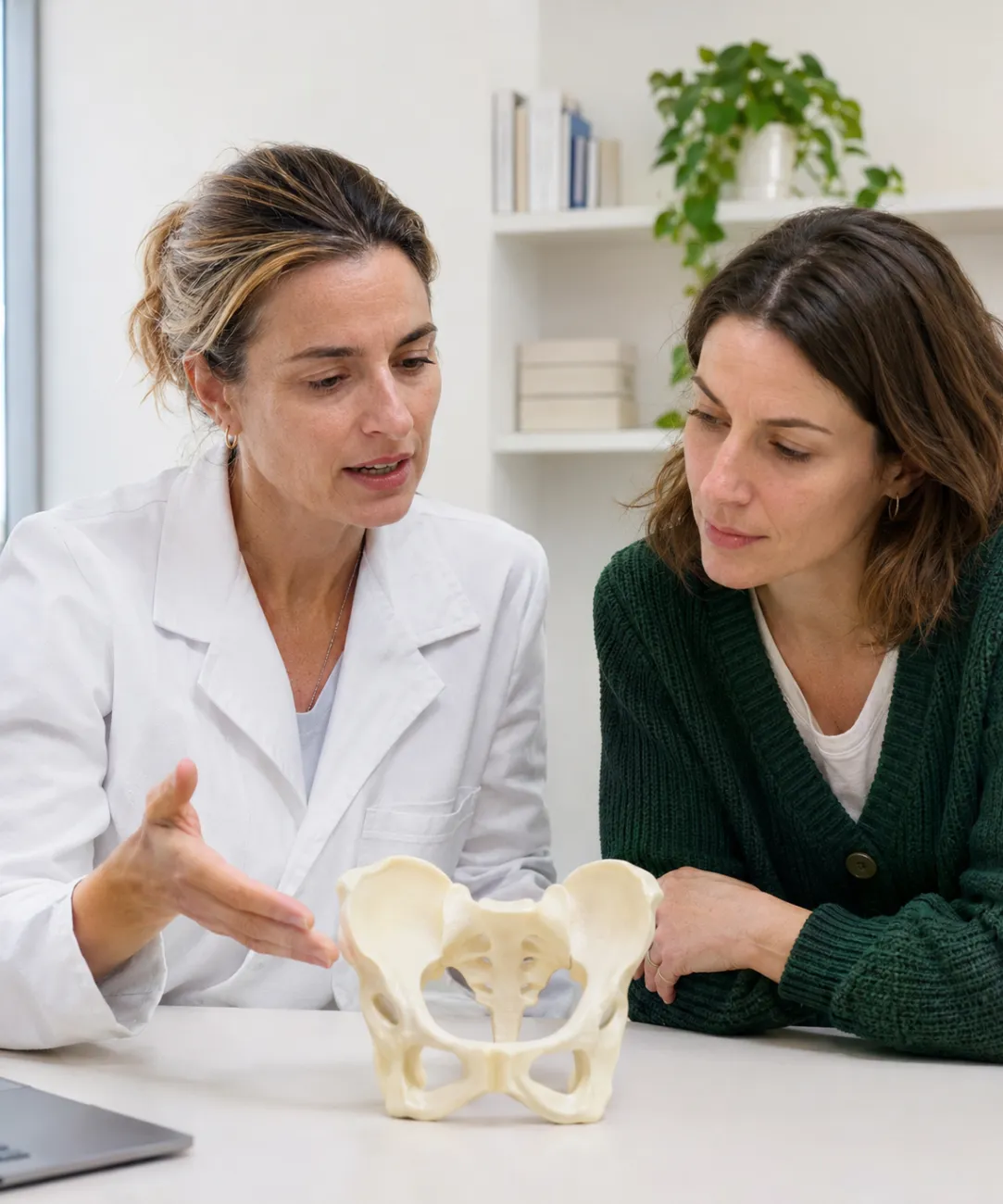
A doctor in a white coat explains a model of the pelvis on the table to a patient in a green sweater
Photograph of a consultation. The dots mark what the doctor assesses; the image does not show the intimate area.

Why it happens

What may lie behind urine leakage after childbirth

No single cause explains all cases: recovery from the birth, the hormones of breastfeeding, the abdominal wall and the bladder itself all count, and the weight of each changes over time. Choose a situation to see how it applies.

The recovery time

In pregnancy and birth the muscles, nerves and tissues that support the urethra and bladder are stretched, and need weeks to months to recover. In a review of studies, about one in three women had leakage in the first 3 months, and most of it was occasional; weekly leakage was about 12% and daily about 3%.

What weighs on it

Thinking that, if it has not improved in the first few weeks, it is because it has “stayed like this” and there is no point doing anything.

What helps

Pelvic floor training from early on, at the pace of recovery, and reviewing the leakage at the postpartum consultation.


Normal or to be assessed

Normal recovery or something to assess

There is leakage that goes with recovery and other leakage that calls for its own assessment, and it is not always easy to tell them apart on your own. That is what the consultation clarifies.

  • How it shows. A few drops when coughing, laughing or lifting the baby, which have been decreasing since the birth, without pain or burning.

  • When it happens. Mainly in the first weeks, improving over the first months. If it continues at 3 months, it is time to ask for an assessment.

  • What the clinic does. The doctor listens to what is going on, assesses the pelvic floor, the perineum and the abdominal wall and confirms the type of leakage.

  • At home. Gentle pelvic floor training, contracting before exertion, looking after the bowel and noting the leakage for a few days.

Are you unable to pass urine, do you have a full and sore bladder, high fever, heavy bleeding, or have you suddenly lost control of urine with weakness in the legs? Call 112 or go to the emergency department. If you have blood in the urine, burning when passing urine or any doubts, out of hours you can call SNS 24: 808 24 24 24.

Book an assessment consultation

What can help

Treatments for urine leakage after childbirth

The first line is training the pelvic floor muscles, preferably guided by pelvic physiotherapy and for at least 3 months. It can start early, is compatible with breastfeeding and, after childbirth, reduced the chances of leakage by about 37% in the trials gathered in a 2025 review. When there is diastasis, the doctor may add graded abdominal exercises. For dryness and burning linked to breastfeeding there are moisturisers and lubricants and, in selected cases, low-dose vaginal oestrogen prescribed by a doctor, for which there are still few studies in the postpartum period and no demonstrated effect on the bladder. If none of this is enough, there are the pessary, urogynaecology and surgery, which are discussed with a specialist. The treatments below are additional options, assessed case by case and without promising results, with limited evidence for urine leakage.

Book an assessment consultation
Dr Michelle Campagnoli, clinical director of Clínica Luxmed

First step

Assessment consultation

The doctor listens to what you are experiencing, examines your case and explains the suitable options. No treatment begins without this consultation.

May be considered when

you want to understand the cause and decide on the best path, with time and without commitment.

Book an assessment consultation
Private treatment room, with the device on an elegant trolley and a patient resting covered with a towel

Technology

Sectum, Neauvia radiofrequency (NRose Protocol)

Low-intensity radiofrequency that seeks to stimulate the collagen of the intimate tissues. For urine leakage the evidence is still insufficient, and there are no specific studies for the recent postpartum period or for breastfeeding. It does not replace pelvic floor training.

May be considered when

the leakage persists after well-done pelvic floor training, recovery from the birth is complete, the doctor has assessed whether breastfeeding or a new pregnancy in the near future rules it out, and the decision is yours.

Find out more
The doctor preparing the laser device, with the protective glasses in the foreground

Technology

Fractional CO2 laser

Laser energy applied to the vaginal mucosa, intended to improve the supporting tissue. For urine leakage the results are inconsistent and the FDA warned in 2018 about burns, scarring and pain with these devices, which it has not approved for incontinence.

May be considered when

first-line options have been done, recovery from the birth is complete, the mucosa is not irritated or healing and the doctor has explained the benefits and risks.

Find out more

What the journey looks like

From the first consultation to the plan for this phase

No treatment starts without an assessment consultation with the doctor. The path depends on how long ago the baby was born and what else is happening, and you can bring the baby with you.

  1. 01At the clinic

    Assessment consultation

    The doctor listens to how and when the leakage happens and for how long, asks about the birth, breastfeeding, sleep and bowel, and lets you speak in private and without rushing. If you need to stop to breastfeed, just say so.

  2. 02At the clinic

    Examination and urine test

    The perineum and the scar are examined, the strength of the pelvic floor is assessed, along with whether there is prolapse and whether the abdominal muscles are separated, and a urine test is requested to rule out infection. If there are doubts about emptying, the urine left in the bladder is measured.

  3. 03At home and in physiotherapy

    Diary and training

    A 3-day diary shows what you drink, when you pass urine and when you leak. Pelvic floor training starts, for at least 3 months, and dryness and constipation are treated if present. If there is diastasis, abdominal training is added.

  4. 04Over time

    Reassessing and deciding

    It is reassessed after a few months. If the leakage continues, or if there is prolapse, difficulty emptying or anal sphincter injury, you are referred to urogynaecology, and only then are other options discussed.

Day to day

What helps in these first weeks and months

Simple care that fits into the routine of someone looking after a baby, alongside the plan the doctor recommends.

You do not have to wait for weaning

You can treat it now, even while breastfeeding

Many women put off talking about leakage for lack of time, out of embarrassment or because they think it will pass when they finish breastfeeding. Pelvic floor training does not depend on breastfeeding and can start now. Talk about the leakage at the check-up, even if it seems small.

Short contractions, several times a day

Small sets fit into the routine with the baby and train the pelvic floor without requiring time of your own.

In practice: contract as if to hold back urine, hold for a few seconds and relax fully, for example during feeds. If you are not sure you are contracting the right muscles, ask for confirmation.

Contracting before lifting the baby

It protects the urethra at the moments when the pressure in the abdomen rises.

In practice: contract the pelvic floor before lifting the baby, the car seat or the pushchair, and before coughing or sneezing.

Drinking normally and taking it easy on the bowel

Very concentrated urine irritates the bladder, and constipation overloads the pelvic floor.

In practice: drink water throughout the day, eat fibre and rest your feet on a small stool at the toilet, without straining.

Noting for 3 days

It helps the doctor understand what type of leakage you have and measure improvement.

In practice: note the time and amount of each visit to the toilet, the leakage and what you were doing, and whether you felt a sudden urge.

Dr Michelle Campagnoli, clinical director of Clínica Luxmed

Who will look after you

An assessment carried out by the doctor

At Luxmed, the first step is always an assessment consultation with Dr Michelle Campagnoli. She is the one who listens to what is going on, assesses the pelvic floor, the perineum and the abdominal wall after the birth, rules out other causes and designs the plan with you, in private and without rushing, working with pelvic physiotherapy or urogynaecology when needed. You can bring the baby.

  • Physical examination and medical historyA conversation about the leakage, the birth and breastfeeding, examination of the perineum and pelvic floor and a urine test when needed.
  • A plan tailored to youPelvic floor training first; additional treatments only if appropriate, with the evidence explained.
  • No obligationThe cost of any treatment is confirmed only after the assessment.
Book an assessment consultation

Book a consultation

Book your consultation

Choose how you prefer to get in touch. We will arrange the assessment consultation with Dr Michelle Campagnoli.

Booking through the website100€70€Assessment consultationExclusive price for those who book the assessment through the website. Outside the website, the price is 100 €.

New Life Miraflores, Algés · Office Center, R. Santa Teresa do Menino Jesus n.º 6, 9.º C, 1495-048

Your details are used only for this contact. Any treatment depends on a prior medical assessment.

Request an appointmentIt takes less than a minute.
Speciality
You do not need to go into detail. The doctor will talk to you during the consultation.
Request received. Our team will contact you as soon as possible.
What is postpartum urinary incontinence and is it normal?

It is the involuntary loss of urine after childbirth, usually when coughing, laughing or exerting yourself, sometimes with a sudden urge. It is frequent: in a review of studies, about 33% of women had leakage in the first 3 months, but only about 12% weekly and 3% every day. Being common does not mean it should be accepted without assessment, because it has treatment.

Does urine leakage after childbirth go away on its own?

In many women it improves over the first months, as the pelvic floor recovers. But not all: in a 12-year cohort, more than three quarters of the women with leakage at 3 months still had it 12 years later. So, if it continues at 3 months, it is worth seeking assessment and starting training rather than waiting.

Is the bladder different after childbirth?

It can be, for a while. Some women notice a stronger sudden urge, more trips to the bathroom, a weaker stream or the feeling of not emptying. Not all of this is “stress” leakage and some causes have different treatment, such as a urinary infection. Difficulty passing urine right after the birth, with a full and sore bladder, is rare but needs a prompt assessment.

Does breastfeeding make urine leakage worse?

It is not known for certain. During breastfeeding oestrogen is low, which can leave the mucosa drier and the bladder more sensitive, and the name “genitourinary syndrome of lactation” was proposed in 2026 for this set of changes. But the idea is recent, with few studies, and not all leakage should be attributed to breastfeeding. There is no need to wait for weaning to treat it.

Can I use vaginal oestrogen while breastfeeding?

It may be an option for dryness and burning, prescribed and monitored by a doctor, who assesses your case. A 2026 review found only 3 studies, with 85 women in total, in which the cream improved the atrophy score but no difference in bladder function was seen. It is therefore not a treatment for urine leakage. If you have or have had breast cancer, speak to your oncologist first.

Does abdominal diastasis explain urine leakage?

It may be linked, but does not explain it alone. In a study of women attending urogynaecology consultations, more than half had diastasis and it was associated with more stress leakage. In an ultrasound study, however, women with stress leakage did not have a greater separation than those without leakage. When in doubt, the pelvic floor and the belly are assessed and both are trained, without promising that one solves the other.

What exercises should I do and when can I start?

Gentle pelvic floor contractions can start in the first days, if there is no pain or indication to the contrary, gradually increasing the duration and number. In a Cochrane review, training, especially supervised and regular, prevented and treated urine leakage after childbirth. After a caesarean or extensive tears, check with the team looking after you.

Do vaginal laser or radiofrequency solve leakage after childbirth?

There is not enough evidence. A review of sham-controlled trials found a modest, short-lived benefit, inconsistent with the CO2 laser and insufficient for radiofrequency, and those studies were not done in the recent postpartum period. The FDA warned in 2018 that it has not approved these devices for incontinence and that they can cause burns, scarring and pain. They do not replace pelvic floor training, and the decision is always explained and shared with you.

Can leakage appear only months or years after childbirth?

It can. Some women with no leakage in the first months notice it when they return to exercise, when they stop breastfeeding, after another pregnancy or, years later, with the menopause, because the pelvic floor has been under strain and closure of the urethra weakens with age. Appearing later does not mean it is unrelated to the birth, and training continues to help.

When should I book a consultation?

Talk about the leakage at the postpartum check-up. Book a consultation if you still have leakage at 3 months, if the leakage stops you from exercising or doing your routine, if you feel a sudden urge, a weak stream or heaviness or a “ball” in the vagina. With blood in the urine, burning when passing urine or doubts, call SNS 24 (808 24 24 24). If you cannot pass urine, have a high fever, heavy bleeding or have suddenly lost control of urine with weakness in the legs, call 112.

We could not find that question. Ask us on WhatsApp

Scientific references

This page is based on the sources below and was reviewed by Dr. Michelle Campagnoli. Last updated on .

  1. Thom DH, Rortveit G. Prevalence of postpartum urinary incontinence: a systematic review. Acta Obstetricia et Gynecologica Scandinavica 89(12):1511-1522, 2010.
  2. MacArthur C, Wilson D, Herbison P, Lancashire RJ, Hagen S, Toozs-Hobson P, et al. Urinary incontinence persisting after childbirth: extent, delivery history, and effects in a 12-year longitudinal cohort study. BJOG 123(6):1022-1029, 2016.
  3. Woodley SJ, Lawrenson P, Boyle R, Cody JD, Mørkved S, Kernohan A, Hay-Smith EJC. Pelvic floor muscle training for preventing and treating urinary and faecal incontinence in antenatal and postnatal women. Cochrane Database of Systematic Reviews 2020(5):CD007471, 2020.
  4. Beamish NF, Davenport MH, Ali MU, Gervais MJ, Sjwed TN, Bains G, et al. Impact of postpartum exercise on pelvic floor disorders and diastasis recti abdominis: a systematic review and meta-analysis. British Journal of Sports Medicine 59(8):562-575, 2025.
  5. Spitznagle TM, Leong FC, Van Dillen LR. Prevalence of diastasis recti abdominis in a urogynecological patient population. International Urogynecology Journal 18(3):321-328, 2007.
  6. Braga A, Galli L, Caccia G, Amato G, Papadia A, Torella M, et al. Is diastasis recti abdominis rehabilitation after childbirth able to prevent the onset of stress urinary incontinence? A case-control study. Medicina (Kaunas) 59(12):2182, 2023.
  7. Waheed A, Taithongchai A, Robinson D. The use of topical vaginal estrogens in postpartum women: a systematic review. Acta Obstetricia et Gynecologica Scandinavica 105(7):1405-1410, 2026.
  8. Orozco Fernández R, Gil-Antuñano SP. Genitourinary syndrome of lactation: an underrecognized postpartum condition affecting women's vulvovaginal, urinary and sexual health. Women's Health (London) 22:17455057261490606, 2026.
  9. Hickman LC, Yao M, Propst K. Protracted postpartum urinary retention: incidence, risk factors, and natural history of a rare postpartum urinary retention subtype. Urogynecology (Philadelphia) 28(12):887-893, 2022.
  10. Buurman MB, Lagro-Janssen AL. Women's perception of postpartum pelvic floor dysfunction and their help-seeking behaviour: a qualitative interview study. Scandinavian Journal of Caring Sciences 27(2):406-413, 2013.
  11. National Institute for Health and Care Excellence (NICE). Postnatal care (NG194). NICE guideline NG194, 2021.
  12. National Institute for Health and Care Excellence (NICE). Pelvic floor dysfunction: prevention and non-surgical management (NG210). NICE guideline NG210, 2021.
  13. National Institute for Health and Care Excellence (NICE). Urinary incontinence and pelvic organ prolapse in women: management (NG123). NICE guideline NG123, 2019.
  14. American College of Obstetricians and Gynecologists. Physical activity and exercise during pregnancy and the postpartum period: ACOG Committee Opinion No. 804. Obstetrics & Gynecology 135(4):e178-e188, 2020.
  15. Lukanović D, Shah G, Matjašič M, Phillips C. The use of energy-based devices for the treatment of stress urinary incontinence: a systematic review and meta-analysis of the randomised sham-controlled trials. International Urogynecology Journal 37:2779-2790, 2026.
  16. National Institute for Health and Care Excellence (NICE). Transvaginal laser therapy for stress urinary incontinence (HealthTech guidance HTG581, antes IPG696). NICE HealthTech guidance HTG581, 2021.
  17. Medsafe (Nova Zelândia), a retransmitir o alerta da U.S. FDA. Safety Information: energy-based devices used for vaginal 'rejuvenation' or vaginal cosmetic procedures (relays the USFDA safety communication of July 2018). Medsafe, New Zealand Medicines and Medical Devices Safety Authority, 2018.
CallAssistantAvailableBook