Algés, Oeiras Mon to Fri · 09:00 to 13:00 and 14:00 to 19:00 · Sat · 09:00 to 14:00
WhatsApp Book a consultation

Aesthetic gynaecology

Stitches and an uneven scar after childbirthWhen the area of the birth stitches hurts, pulls or has healed irregularly

“Birth stitches” is the name many women give to the suture of a tear (laceration) of the perineum or of an episiotomy, the small cut sometimes made to help the baby be born. In the first weeks, some discomfort is expected, but there are signs of infection or of the stitches opening that should not wait. Months later, some women are left with a harder, raised scar that pulls or continues to hurt, especially during sex. Here we explain what is usual at each stage, what is assessed, what helps (starting with wound care, pelvic floor physiotherapy and lubrication) and what the consultation can clarify, with honesty about what the evidence shows.

Reviewed by Dr Michelle Campagnoli, clinical director

  • 13%of the women in a study of 106 still reported perineal pain 3 months after childbirth
  • 1assessment consultation, always first
  • 70 €assessment booked through the website
Red-haired woman in a denim jacket sitting on a bus with a look of discomfort

How to recognise it

Is it normal or is it worth having the stitches assessed?

In the first weeks some discomfort in the area of the stitches is usual. What matters is whether the pain is gradually decreasing, whether the wound is closing well and, months later, how the scar has turned out and how it feels.

Tick what you recognise0/7

Tick the signs you recognise in your case. This is not a diagnosis, it is only meant to give you an idea.

Do you have fever or chills, increasing pain, redness and swelling, pus or foul-smelling discharge, have the stitches opened, do you have very heavy bleeding, are you unable to pass urine, do you lose stools or wind through the vagina or have you lost control of your stools? Do not wait for the next appointment: contact the maternity unit or your doctor now (an open wound calls for same-day examination). Out of hours, call SNS 24: 808 24 24 24.

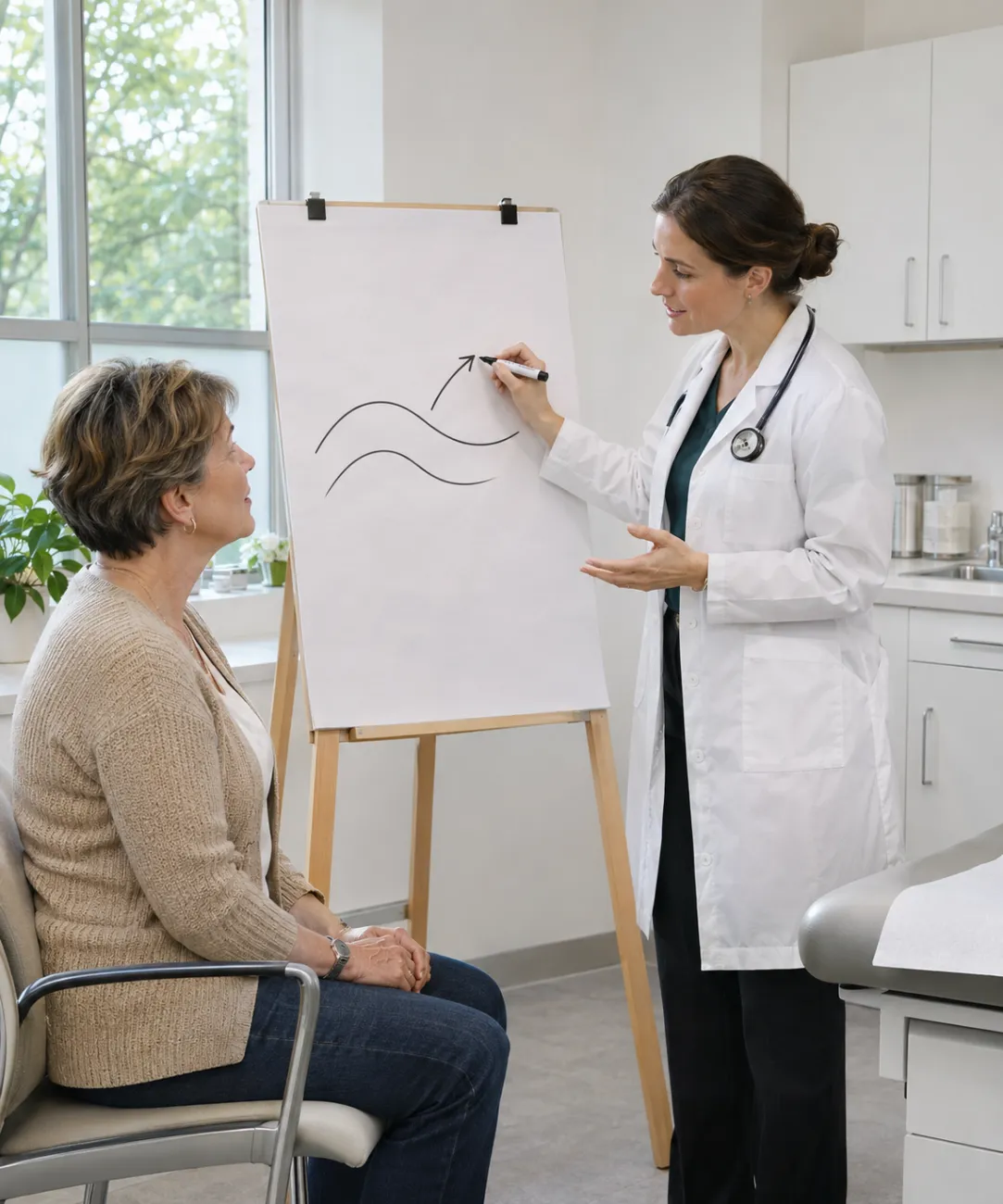
A doctor in a white coat draws a diagram on a sheet on an easel for a seated patient
Photograph of a consultation. The dots mark what the doctor assesses; the image does not show the intimate area.

Why it happens

What may lie behind stitches that hurt or an irregular scar

Healing an area as used and as sensitive as the perineum is demanding, and pain after stitches rarely has a single cause. Choose a situation to see how it applies.

The type of injury from the birth

Tears range from 1st to 4th degree, depending on depth, and an episiotomy is a cut made on purpose. In the NICE guidelines, an episiotomy, a tear, a ventouse or forceps birth, an infection or opening of the wound and a birth experienced as traumatic are factors in persistent perineal pain. In one clinical study, episiotomy was the only factor associated with a scar that was tender to the touch.

What weighs on it

Thinking that, if the birth “went well”, the scar cannot hurt.

What helps

Telling the doctor at the consultation the type of injury and birth you had; if you have the birth record to hand, bringing it.


Normal or to be assessed

Expected healing or something to assess

Not all pain after stitches is the same. Distinguishing what is expected from what calls for assessment avoids both needless alarm and delay with what cannot wait.

  • How it shows. Discomfort that decreases from week to week, the wound closing and the area less sensitive to touch.

  • When it happens. In the first weeks, with peaks when sitting, passing urine or opening the bowels. The stitches usually heal within a month; in a prospective cohort, pain was still present in about half of the women after one month and in 1 in 4 after two.

  • What the clinic does. It listens, explains what is expected and checks that the wound is closing as it should.

  • At home. Gentle hygiene, pain relief as directed, wrapped ice and pelvic floor exercises.

Do you have a high fever with chills and intense malaise, very heavy bleeding, shortness of breath or chest pain? Call 112 or go to the emergency department. If you have open stitches, pus, a bad smell or increasing pain, contact the maternity unit or your doctor on the same day; out of hours you can call SNS 24: 808 24 24 24.

Book an assessment consultation

What can help

What to do about stitches that hurt or an irregular scar

The first line is not a device: it is care of the wound while it heals (gentle hygiene, pain relief, examination if there are doubts), pelvic floor physiotherapy and lubrication during sex. Once the wound is completely closed, scar massage, taught by a physiotherapist or a doctor, is common practice, although what is published on perineal massage mainly concerns pregnancy and birth, and the evidence for an already formed scar is scarce. If the mucosa is thin and dry (for example, during breastfeeding), the dryness and the mucosa are treated. When a scar continues to hurt months later, despite this, it is discussed with a specialist, case by case, whether there is anything that can be corrected.

Book an assessment consultation
Dr Michelle Campagnoli, clinical director of Clínica Luxmed

First step

Assessment consultation

The doctor listens to what you are experiencing, examines your case and explains the suitable options. No treatment begins without this consultation.

you want to understand the cause and decide on the best path, with time and without commitment.

Book an assessment consultation

What the journey looks like

From the first consultation to the plan tailored to you

No treatment starts without an assessment consultation with the doctor. We almost always start with what is simplest and least invasive.

  1. 01At the clinic

    Assessment consultation

    The doctor listens to how the birth went, what injury you had, how it healed and what bothers you today: pain, pulling, pain during sex, dryness, the appearance of the scar. She asks about breastfeeding, contraception and bladder and bowel function, in private and without rushing.

  2. 02At the clinic

    Examination of the area

    The scar and mucosa are observed and the spot that hurts is identified, gently. The tension of the pelvic floor muscles is assessed and infection, adhesions or other causes are ruled out. If there are warning signs, you are referred immediately.

  3. 03At home and in physiotherapy

    Care, lubrication and physiotherapy

    Care of the area, lubrication and hydration, the gradual resumption of sex and, when justified, pelvic floor physiotherapy are guided. Scar massage is only taught when the wound is completely closed and the doctor authorises it.

  4. 04Over time

    Reassessing and deciding

    Pain and the scar are reassessed. If it does not improve, or if there are warning signs, a sphincter injury or another cause, the doctor explains the other routes and refers you to gynaecology, urogynaecology or the team that attended the birth.

Day to day

What helps while you wait for the consultation

Simple care to soothe the area and support healing, alongside the plan the doctor recommends.

You do not have to put up with it in silence

Pain after stitches is not the price of being a mother

It is very frequent, but it is not something you have to accept without speaking. Many women stay silent about pain during sex or a scar that bothers them out of embarrassment, tiredness or because they think it is normal. In a specialist clinic, an approach directed at the cause improved most women, and the earlier it is assessed, the simpler it usually is.

Gentle hygiene and patting dry

It keeps the area clean without irritating it, which protects the wound from infection.

In practice: wash with lukewarm water after going to the bathroom, dry with gentle pats (without rubbing), change pads often and wash your hands before and after.

Relieving pressure and pain

Less pressure and cold soothe the area; controlled pain helps you move and open your bowels without tension.

In practice: use ice wrapped in a cloth (never on bare skin), support a clean pad against the area when opening your bowels and take the painkiller the doctor recommends, compatible with breastfeeding.

Training the pelvic floor carefully

The exercises support healing and the recovery of strength and relaxation.

In practice: gentle contractions followed by complete relaxation, without forcing or holding your breath; if it hurts or you have doubts, ask for guidance.

Water-based lubricant

It reduces friction and pain during penetration, especially with the dry mucosa of breastfeeding.

In practice: use it freely, without waiting for the pain to appear, and resume sex slowly and when you feel ready, with medical approval.

Dr Michelle Campagnoli, clinical director of Clínica Luxmed

Who will look after you

An assessment carried out by the doctor

At Luxmed, the first step is always an assessment consultation with Dr Michelle Campagnoli. She is the one who listens to how the birth went, examines the scar and the mucosa, rules out other causes and designs the plan with you, in private and without rushing, working with pelvic physiotherapy or with the team that attended your birth when needed.

  • Physical examination and medical historyA conversation about the birth and the pain, examination of the scar, mucosa and pelvic floor and ruling out infection or other causes.
  • A plan tailored to youFirst care and physiotherapy; any intervention only if appropriate, with the evidence explained.
  • No obligationThe cost of any treatment is confirmed only after the assessment.
Book an assessment consultation

Book a consultation

Book your consultation

Choose how you prefer to get in touch. We will arrange the assessment consultation with Dr Michelle Campagnoli.

Booking through the website100€70€Assessment consultationExclusive price for those who book the assessment through the website. Outside the website, the price is 100 €.

New Life Miraflores, Algés · Office Center, R. Santa Teresa do Menino Jesus n.º 6, 9.º C, 1495-048

Your details are used only for this contact. Any treatment depends on a prior medical assessment.

Request an appointmentIt takes less than a minute.
Speciality
You do not need to go into detail. The doctor will talk to you during the consultation.
Request received. Our team will contact you as soon as possible.
What are birth stitches and how long do they take to heal?

“Birth stitches” are the suture of a tear (laceration) of the perineum or of an episiotomy, the cut sometimes made to help the baby be born. The stitches used are usually dissolvable, so they do not need to be removed, and the NHS says they should heal within about a month. How the wound heals and how long it takes vary with the depth of the injury and from woman to woman.

Do birth stitches hurt? How long is normal?

Some discomfort is expected. In a prospective cohort of 106 women, 78% reported pain at 15 days, 50% at 1 month, 25% at 2 months and 13% at 3 months, generally of mild to moderate intensity. The NHS considers that pain lasting beyond 2 to 3 weeks should be checked, and NICE recommends assessing pain that does not resolve or gets worse. So pain that does not decrease deserves examination, not resignation.

How do I know if my birth stitches are infected?

Watch for: increasing pain, redness, swelling or warmth in the area, pus or a discharge with an unpleasant smell, fever or chills and a feeling of being unwell. NICE recommends seeking help without delay for perineal pain, fever or foul-smelling discharge, and infection or opening of the wound are relatively uncommon, but the diagnosis may come late if only the outward appearance is looked at. If in doubt, ask for an examination.

What if my birth stitches open?

It happens, and it is not your fault. A wound that opens, partly or completely, should be examined by the team that followed you or by a doctor, preferably on the same day, because an infection may need treating, the area may need cleaning or a decision may be needed on whether to suture again. In the meantime, keep the area clean and dry and do not try to close it yourself.

Can the scar after birth stitches be irregular? Will it go away?

It can. Some women develop raised, hardened or itchy scar tissue, and others are left with folds, a small excess of skin or a sensitive spot. Part of it improves with time and care, and part persists. What decides whether it is worth treating is not the appearance but the discomfort: pain, pulling, pain during sex or the impact on confidence.

Does scar massage help?

It is a common practice, taught by physiotherapists and doctors, when the wound is completely closed and there is an indication for it. What published research studies is mainly perineal massage in pregnancy and during birth, and for an already formed scar the evidence is scarce. That is why we do not sell it as a cure: it is a tool, to be used with guidance, that does not replace assessment of the cause of the pain.

Do devices (laser, radiofrequency) correct a birth stitch scar?

We have not found controlled trials of these devices in birth stitch scars. The FDA warned in 2018 that it has not approved them for menopausal symptoms, urinary incontinence or sexual function and that they can cause burns, scarring and pain during sex. That is why, in this situation, the clinic’s focus is assessment and first-line measures, and any intervention is discussed with the evidence in front of us.

It hurts during sex because of the scar. Is it normal? When does it go away?

It is very frequent: the NHS says that pain during sex is common in the first months after a tear or an episiotomy. In a study of 857 women, between 40% and 69% (depending on the type of injury) reported pain during sex at 12 months, and even those who had a mild tear or none often report this pain. The causes can be the scar, the dry mucosa (especially while breastfeeding), tense muscles or several at once, and treatment directed at the cause improved most of the women in the study. If the pain persists, ask for an assessment: you do not need to endure it.

When is correcting the scar considered?

Only after the wound has completely healed and first-line measures have been tried, and if the scar continues to cause pain or limitation. Whatever can be corrected is then discussed with a specialist, case by case, with the benefits and risks of each route. Before that, other causes must be ruled out, such as tense muscles, atrophic mucosa or a lump that deserves to be seen.

When should I book a consultation?

Book a consultation if the pain does not improve or gets worse, if the scar pulls, is hardened or very sensitive, if it hurts during penetration, if you have dryness, or if there is loss of stools or wind. If you have fever, redness and swelling, pus, a bad smell, open stitches or heavy bleeding, contact the maternity unit or your doctor now, or call SNS 24 (808 24 24 24). If you have a high fever with intense malaise, very heavy bleeding, shortness of breath or chest pain, call 112.

We could not find that question. Ask us on WhatsApp

Scientific references

This page is based on the sources below and was reviewed by Dr. Michelle Campagnoli. Last updated on .

  1. National Institute for Health and Care Excellence (NICE). Postnatal care (NG194). NICE guideline NG194, 2021.
  2. NHS. Episiotomy and perineal tears. (NHS (Reino Unido), acedido 2026-11-11)
  3. Wiseman O, Rafferty AM, Stockley J, Murrells T, Bick D. Infection and wound breakdown in spontaneous second-degree perineal tears: An exploratory mixed methods study. Birth 46(1):80-89, 2019.
  4. Golmann D, Hedström J, Epstein E, Bergman I. Risk factors associated with deep perineal wound dehiscence after second-degree perineal tears or episiotomy. Acta Obstetricia et Gynecologica Scandinavica, 2026.
  5. Perú Biurrun G, Gonzalo Orden JM, Gonzalez-Diaz E. Postpartum perineal pain: temporal evolution, anatomical distribution and functional impact during the first 90 days. Journal of Gynecology Obstetrics and Human Reproduction 55:103270, 2026.
  6. Ram-Weiner M, Hayman-Mendelson A, Allouche-Kam H, Lev-Sagie A. Postpartum dyspareunia: clinical evaluation, causes, and treatment outcomes. The Journal of Sexual Medicine 20(3):324-331, 2023.
  7. Risløkken J, Macedo MD, Bø K, Ellström Engh M, Siafarikas F. The severity of second-degree perineal tears and dyspareunia during one year postpartum: A prospective cohort study. Acta Obstetricia et Gynecologica Scandinavica 104:968-975, 2025.
  8. Boarta A, Gluhovschi A, Craina ML, Marta CI, Dumitriu B, Socol ID, Sorop MI, Sorop B. Determinants of Postpartum Sexual Dysfunction in the First Year: A Systematic Review. Healthcare (Basel) 13(22):2977, 2025.
  9. Orozco Fernández R, Gil-Antuñano SP. Genitourinary syndrome of lactation: An underrecognized postpartum condition affecting women's vulvovaginal, urinary and sexual health. Women's Health (London) 22, 2026.
  10. Woodley SJ, Lawrenson P, Boyle R, Cody JD, Mørkved S, Kernohan A, Hay-Smith EJC. Pelvic floor muscle training for preventing and treating urinary and faecal incontinence in antenatal and postnatal women. Cochrane Database of Systematic Reviews 2020(5):CD007471, 2020.
  11. Royal College of Obstetricians and Gynaecologists (RCOG). The management of third- and fourth-degree perineal tears (Green-top Guideline No. 29). RCOG Green-top Guideline No. 29, 2015.
  12. Sultan AH, Okeahialam NA, De Leeuw J, et al. IUGA International Guidelines on Obstetric Anal Sphincter Injuries. International Urogynecology Journal 37:2223-2280, 2026.
  13. Palicelli A, Torricelli F, Tonni G, et al. Primary Carcinomas of the Episiotomy Scar Site: A Systematic Literature Review. Current Oncology 32(2):65, 2025.
  14. Medsafe (Nova Zelândia), a retransmitir o alerta da U.S. FDA. Safety Information: energy-based devices used for vaginal 'rejuvenation' or vaginal cosmetic procedures (relays the USFDA safety communication of July 2018). Medsafe, New Zealand Medicines and Medical Devices Safety Authority, 2018.
CallAssistantAvailableBook