Algés, Oeiras Mon to Fri · 09:00 to 13:00 and 14:00 to 19:00 · Sat · 09:00 to 14:00
WhatsApp Book a consultation

Aesthetic gynaecology

Dryness after childbirthWhen the intimate mucosa is drier and more sensitive in the months after childbirth, especially while breastfeeding

Vaginal dryness after childbirth is very common and almost always has an explanation: the drop in hormones after the birth and, in women who breastfeed, oestrogen levels that stay low for as long as breastfeeding lasts. It may be noticed as a lack of lubrication, burning, a feeling of “tight skin” or pain during sex. Here we explain what to expect at each stage, what helps and should be done first, what the evidence says about other treatments and which signs cannot wait for a consultation.

Reviewed by Dr Michelle Campagnoli, clinical director

  • 60%of women who breastfeed report pain during sex at 3 months, and about 28% at 12 (2025 review)
  • 1assessment consultation, always first
  • 70 €assessment booked through the website
A woman with her hair up sits on a pilates ball, stretching a green elastic band with her arms

How to recognise it

Could it be dryness after childbirth?

It is not a disease in itself: it is the way the intimate mucosa reacts to a period of different hormones, of healing and of little rest. What matters is when it began, whether it is getting worse or better over time and whether there is pain.

Tick what you recognise0/7

Tick the signs you recognise in your case. This is not a diagnosis, it is only meant to give you an idea.

Do you have heavy or sudden bleeding, fever, foul-smelling discharge, severe pain or pain that is getting worse in the perineum or at the scar, a wound that has opened, bleeding after sex, pain that does not improve, blood in the urine, difficulty passing urine, or do you feel very low or with no desire to look after the baby? Do not wait for the consultation: speak to your doctor or to the team that looked after you during the birth straight away. Outside opening hours, call SNS 24: 808 24 24 24.

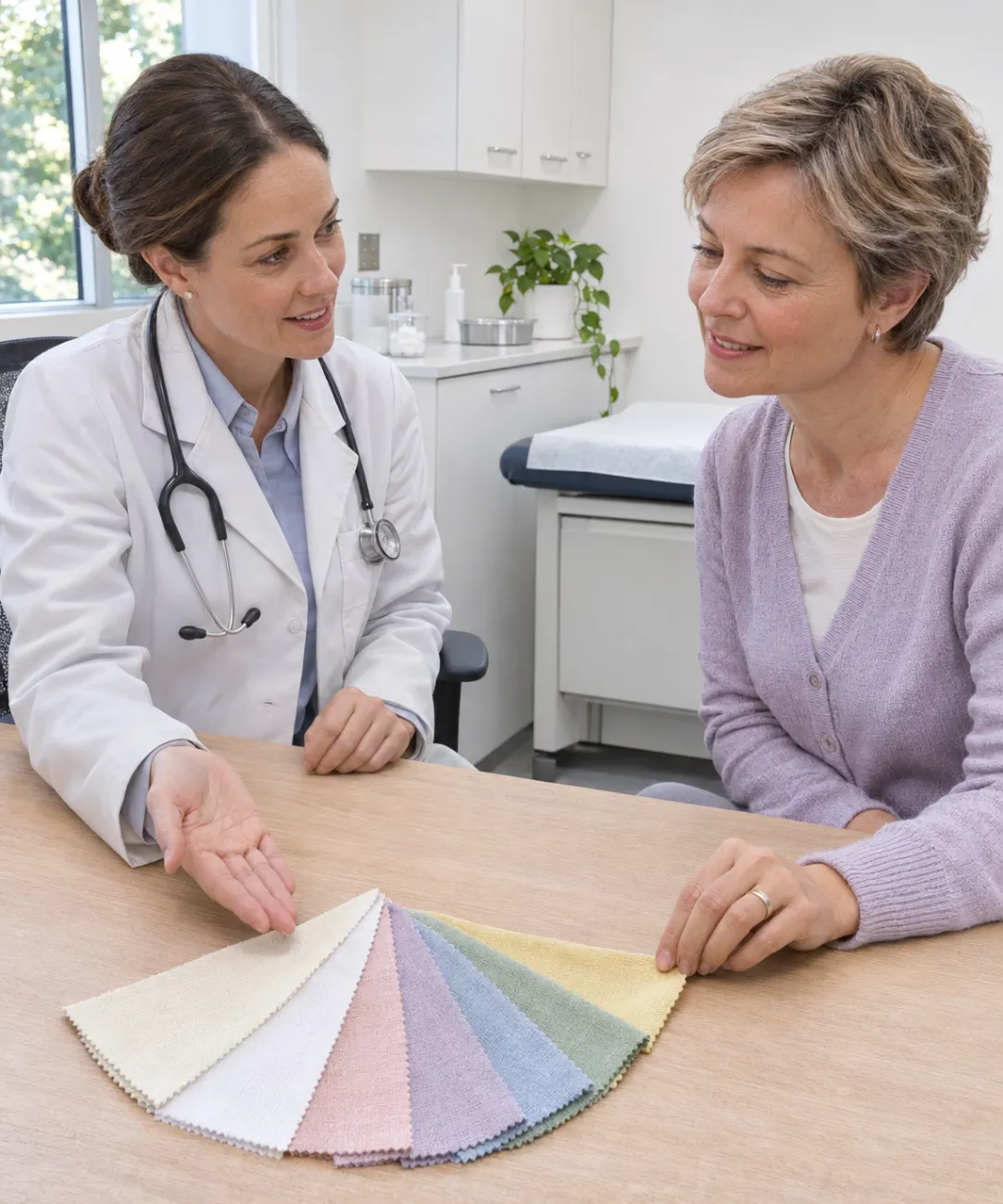
Doctor in a white coat showing a fan of pastel fabric swatches to a patient in a lilac cardigan
Photograph of a consultation. The dots mark what the doctor assesses; the image does not show the intimate area.

Why it happens

What may be behind dryness after childbirth

There is rarely a single cause. Hormones weigh heavily, but the scar, tiredness and contraception also count. Choose a situation to see how it applies.

Breastfeeding

When the baby feeds, the hormone that produces milk (prolactin) slows the activity of the ovaries and can keep oestradiol low, especially while the period has not returned. With less oestrogen, the mucosa of the vagina and vulva becomes thinner, produces less lubrication and is more fragile. In a 2025 review, about half of breastfeeding women reported dryness, and some propose calling this group of complaints lactational genitourinary syndrome.

What weighs on it

Thinking that “you just need to be patient” and letting pain set in, or stopping breastfeeding only because of this without talking to a professional.

What helps

Lubricant during sex, vaginal moisturiser and, if it persists, talking to your doctor about the options, including low-dose vaginal oestrogen.


Normal or to be assessed

Expected dryness or something to assess

Some dryness and sensitivity in the first months, especially while breastfeeding, is common. What should not be accepted without checking is pain that does not improve, bleeding and signs of infection.

  • How it shows. Less lubrication, a sensitive mucosa, mild burning at the start of sex or when washing, with no abnormal discharge or bleeding.

  • When it happens. In the months after the birth, more intensely while breastfeeding, and tending to improve over time. In studies, pain during sex decreases over the course of the first year.

  • What the clinic does. The doctor listens to what is going on, examines the vulva and the scar and confirms that there is no infection or other cause.

  • At home. Water-based lubricant, vaginal moisturiser, more time for arousal and sex without hurry, stopping if it hurts.

Do you have heavy bleeding, a high fever, very severe or sudden pain, shortness of breath, chest pain or thoughts of harming yourself or the baby? Call 112 or go to the emergency department. If there is bleeding after sex, foul-smelling discharge, pain that does not improve or doubts, outside opening hours you can call SNS 24: 808 24 24 24.

Book an assessment consultation

What can help

Options for dryness after childbirth

First-line treatment is simple and almost risk-free: water-based lubricant for sex, vaginal moisturiser for everyday use, time and conversation with your partner, and care of the vulva and the scar. If pain persists, pelvic floor physiotherapy and sex therapy have their place and, when the dryness is severe and prolonged, the doctor can discuss low-dose vaginal oestrogen with you, a decision made jointly, especially once breastfeeding is well established. Vaginal prasterone (DHEA) has no safety data in breastfeeding. For this problem we do not propose a routine procedure: what we do is an assessment consultation, to understand the cause and guide you towards what really helps, without promising results that the evidence does not show.

Book an assessment consultation
Dr Michelle Campagnoli, clinical director of Clínica Luxmed

First step

Assessment consultation

The doctor listens to what you are experiencing, examines your case and explains the suitable options. No treatment begins without this consultation.

you want to understand the cause and decide on the best path, with time and without commitment.

Book an assessment consultation

What the journey looks like

From the first consultation to the plan tailored to you

No treatment starts without an assessment consultation with the doctor. We start with the simplest and only then consider more, at the pace that this stage of life allows.

  1. 01At the clinic

    Assessment consultation

    The doctor listens to since when and in what situations there is dryness or pain, asks about the birth, breastfeeding, your period, contraception, sleep and mood, and lets you speak in private and without hurry.

  2. 02At the clinic

    Examination and ruling out other causes

    A gynaecological examination is carried out with care, the vulva, mucosa and perineal scar are examined, the pelvic floor is assessed and, if there is doubt, infections or skin changes are looked for.

  3. 03At home

    Appropriate care and products

    We start with lubricant, moisturiser, care of the vulva and sex without hurry. If the pain comes from a scar or from muscle, pelvic floor physiotherapy may be proposed.

  4. 04Over time

    Reassessing and deciding

    We look again at how the dryness, pain and intimate life are. If breastfeeding continues and the symptoms are severe, vaginal oestrogen is discussed; if there are warning signs, you are referred to obstetrics or to your family doctor.

Day to day

What helps while you wait for the consultation

Simple, safe care, alongside the plan the doctor indicates.

It is not just you

Dryness after childbirth is very common and nothing to be ashamed of

It is one of the little-discussed effects of the postpartum period: in an online survey in 2026, almost two thirds of women had never been asked about intimate symptoms and fewer than a third were offered treatment. Talking about this is not complaining, it is looking after your health. In many women it improves with time and the right care.

Water-based lubricant during sex

It reduces friction and pain, and works straight away, without waiting for the body to adapt.

In practice: apply it at the entrance to the vagina and on your partner, reapply if needed and choose a product without perfume or warming effect.

Regular vaginal moisturiser

It hydrates the mucosa over the days and not only during sex.

In practice: use it a few times a week, separately from the lubricant, and bring the product to the consultation if you would like help choosing.

Allowing time and varying intimacy

Slower arousal is common at this stage, and hurry makes dryness and pain worse.

In practice: start with caresses and other forms of contact, go slowly and stop if it hurts.

Talking and asking for help early

Tiredness, mood and fear of pain feed the dryness.

In practice: tell your partner how you feel and talk to the doctor if the pain does not improve or if you are feeling very low.

Dr Michelle Campagnoli, clinical director of Clínica Luxmed

Who will look after you

An assessment carried out by the doctor

At Luxmed, the first step is always an assessment consultation with Dr Michelle Campagnoli. She listens to what is going on, examines carefully, rules out other causes and designs the plan with you, in private and without hurry, coordinating with obstetrics, pelvic physiotherapy or your family doctor when needed.

  • Physical examination and medical historyA conversation about the birth, breastfeeding and the symptoms, a careful gynaecological examination and tests only when they are needed.
  • A plan tailored to youFirst the simple and safe care; any additional treatment only if it is appropriate, with the evidence explained.
  • No obligationThe cost of any treatment is confirmed only after the assessment.
Book an assessment consultation

Book a consultation

Book your consultation

Choose how you prefer to get in touch. We will arrange the assessment consultation with Dr Michelle Campagnoli.

Booking through the website100€70€Assessment consultationExclusive price for those who book the assessment through the website. Outside the website, the price is 100 €.

New Life Miraflores, Algés · Office Center, R. Santa Teresa do Menino Jesus n.º 6, 9.º C, 1495-048

Your details are used only for this contact. Any treatment depends on a prior medical assessment.

Request an appointmentIt takes less than a minute.
Speciality
You do not need to go into detail. The doctor will talk to you during the consultation.
Request received. Our team will contact you as soon as possible.
Why do I have vaginal dryness after childbirth?

Because hormones change a great deal after the birth and, in women who breastfeed, prolactin keeps oestrogen levels low, which leaves the mucosa thinner and with less lubrication. The perineal scar, tiredness, stress and medication or hormonal contraception also count. Most of the time it is a phase, but it is worth confirming that there is no other cause, such as an infection.

Is vaginal dryness worse while breastfeeding? How long does it last?

It is usually more marked, because oestrogen levels stay lower while you breastfeed. There is no fixed timescale: it depends on each woman and on how long she breastfeeds. In studies, pain during sex decreases over the course of the first year, and it is reasonable to expect it to improve when oestrogen recovers, with the return of the period or the end of breastfeeding, but in some women it goes on longer. If it bothers you, you do not need to wait to do something.

Is it normal for sex to hurt after childbirth?

It is common, especially in the first months: in a 2025 review, 60% of women who breastfeed reported pain at 3 months and about 40% at 6. Studies do not fully agree on the role of breastfeeding: one meta-analysis found more pain in those who breastfeed (48% versus 33%), whereas a cohort of 582 first-time mothers did not find it to be a factor. Common does not mean you should put up with it: if the pain is severe, comes from a scar, does not improve or makes you avoid sex, it is worth having it assessed.

When can I have sex again after childbirth?

There are no fixed rules or timescales. The British National Health Service (NHS) says there is no need to rush, because it is natural to feel pain and tiredness, and that if there is still pain at the postnatal check you should talk to the doctor. In a recent study, sex resumed on average between 3.8 and 4.8 months. What matters is that it is when you want it and without pain, and contraception is needed from 3 weeks, even while breastfeeding.

Lubricant or moisturiser: which to choose?

They serve different purposes: lubricant is used during sex to reduce friction, moisturiser is used regularly to hydrate the mucosa. Prefer water-based products, without perfume or warming effect, and as similar as possible to vaginal secretions. With a latex condom, avoid oils and petroleum jelly.

Can I use vaginal oestrogen while breastfeeding?

It is an option to decide on with the doctor, not something to do on your own. When the dryness is severe and persists despite lubricants and moisturisers, low-dose vaginal oestrogen is a possibility, as a shared decision and especially once breastfeeding is established. A small postpartum trial showed minimal benefit. Vaginal prasterone (DHEA) has no safety data in breastfeeding.

Do pelvic floor physiotherapy and sex therapy help?

They can help when the pain also has a muscular component, a scar component or a fear of pain, which is common at this stage. Pelvic physiotherapy helps to relax the muscles and to treat the area of the scar, and sex therapy helps to restart intimacy at your own pace. They are part of the initial steps described for these complaints.

Do laser, radiofrequency or PRP resolve dryness after childbirth?

There is no evidence that they do. For Sectum (Neauvia radiofrequency, NRose Protocol) we did not find controlled studies at this stage; for the CO2 laser there is one small study of 30 breastfeeding women, without a control group; and in postmenopausal women sham-controlled trials did not show an advantage. That is why they are not a first line for this problem, and the doctor explains what is known before any decision.

Do these treatments carry risks?

In 2018 the FDA warned that vaginal energy-based devices are not approved for the symptoms of the menopause, urinary incontinence or sexual function, and that they can cause burns, scars and pain during sex. They are not carried out in the presence of active infection, unexplained bleeding, undiagnosed lesions or pregnancy, and there are no safety data during breastfeeding.

When should I book a consultation?

Book a consultation if the dryness or pain bothers you, if you avoid sex, if there is burning or itching that does not go away, fissures or pain in a perineal scar. If you have bleeding after sex, foul-smelling discharge, fever, blood in the urine or sadness that does not go away, do not wait and speak to your doctor or call SNS 24 (808 24 24 24). If you have heavy bleeding, very severe pain, shortness of breath, chest pain or thoughts of harming yourself, call 112.

We could not find that question. Ask us on WhatsApp

Scientific references

This page is based on the sources below and was reviewed by Dr. Michelle Campagnoli. Last updated on .

  1. National Health Service (NHS), Reino Unido. Sex and contraception after birth. (nhs.uk, acedido 2026-11-11)
  2. National Health Service (NHS), Reino Unido. Vaginal dryness. (nhs.uk, acedido 2026-11-11)
  3. Perelmuter S, Stokes C, Chapalamadugu M, et al. Postpartum and Lactation-Related Genitourinary Symptoms: A Systematic Review. Obstetrics & Gynecology 146:59-72, 2025.
  4. Orozco Fernández R, Gil-Antuñano SP. Genitourinary syndrome of lactation: An underrecognized postpartum condition affecting women's vulvovaginal, urinary and sexual health. Women's Health (London) 22, 2026.
  5. Wisniewski PM, Wilkinson EJ. Postpartum vaginal atrophy. American Journal of Obstetrics and Gynecology 165(5):1249-1254, 1991.
  6. Rosen NO, Dawson SJ, Binik YM, et al. Trajectories of Dyspareunia From Pregnancy to 24 Months Postpartum. Obstetrics & Gynecology 139(3):391-399, 2022.
  7. Ghasemi V, Beheshti Nasab M, Saei Ghare Naz M, et al. Estimating the prevalence of dyspareunia according to mode of delivery: a systematic review and meta-analysis. Journal of Obstetrics and Gynaecology 42(8):2867-2878, 2022.
  8. Risløkken J, Macedo MD, Bø K, et al. The severity of second-degree perineal tears and dyspareunia during one year postpartum: A prospective cohort study. Acta Obstetricia et Gynecologica Scandinavica 104(5):968-975, 2025.
  9. National Institute for Health and Care Excellence (NICE). Postnatal care (NG194). NICE guideline NG194, 2021.
  10. Potter N, Panay N. Vaginal lubricants and moisturizers: a review into use, efficacy, and safety. Climacteric 24(1):19-24, 2021.
  11. The NAMS 2020 GSM Position Statement Editorial Panel. The 2020 genitourinary syndrome of menopause position statement of The North American Menopause Society. Menopause 27(9):976-992, 2020.
  12. Li FG, Maheux-Lacroix S, Deans R, et al. Effect of fractional carbon dioxide laser vs sham treatment on symptom severity in women with postmenopausal vaginal symptoms: a randomized clinical trial. JAMA 326(14):1381-1389, 2021.
  13. Prodromidou A, Zacharakis D, Athanasiou S, et al. CO2 Laser versus Sham Control for the Management of Genitourinary Syndrome of Menopause: A Systematic Review and Meta-Analysis of Randomized Controlled Trials. Journal of Personalized Medicine 13(12):1694, 2023.
  14. Huang WC, Su CY, Wang YL. The efficacy of fractional CO2 laser treatment on postpartum vulvovaginal atrophy: A prospective observational study. Taiwanese Journal of Obstetrics & Gynecology 64(3):463-468, 2025.
  15. Medsafe (Nova Zelândia), a retransmitir o alerta da U.S. FDA. Safety Information: energy-based devices used for vaginal 'rejuvenation' or vaginal cosmetic procedures (relays the USFDA safety communication of July 2018). Medsafe, New Zealand Medicines and Medical Devices Safety Authority, 2018.
  16. Perelmuter S, Drian A, Vereecken SJ, et al. Genitourinary Syndrome of Lactation: Patient-Reported Survey of Symptom Burden, Care Gaps, and Treatment Utilization in the Postpartum Period. Journal of Women's Health, 2026.
  17. Smith PE, McLaughlin EM, Pandya LK, et al. A pilot randomized controlled trial of vaginal estrogen on postpartum atrophy, perineal pain, and sexual function. International Urogynecology Journal 33(12):3383-3390, 2022.
CallAssistantAvailableBook