
Algés, Oeiras Mon to Fri · 09:00 to 13:00 and 14:00 to 19:00 · Sat · 09:00 to 14:00
WhatsApp Book a consultation

Aesthetic gynaecology

Feeling of vaginal saggingHeaviness, pressure or a “ball”: what it could be and how it is confirmed

Feeling heaviness, pressure or a “dragging” in the vagina, noticing a “ball” when washing or having the idea that “everything is coming down” are very common and little-discussed complaints. In most cases, the cause is pelvic organ prolapse: the bladder, womb or rectum descend and push against the walls of the vagina. But it is a sensation, and only an examination tells what lies behind it. Here we explain how a prolapse is distinguished from other causes, what the grades mean, what the first line of treatment is and the very limited place of the technologies the clinic offers, with honesty about what the evidence shows.

Reviewed by Dr Michelle Campagnoli, clinical director

  • 16weeks of supervised training: the first recommended option in mild prolapse
  • 1assessment consultation, always first
  • 70 €assessment booked through the website
Woman in a light blue shirt holding a cup in a bright kitchen, with a calm smile

How to recognise it

Could it be vaginal descent?

There is not always a visible “ball”. Often it starts only with a feeling of heaviness that comes on at the end of the day and goes away when lying down. What matters is what you feel, at what times and for how long.

Tick what you recognise0/7

Tick the signs you recognise in your case. This is not a diagnosis, it is only meant to give you an idea.

Does the “ball” bleed, have sores, feel hard or no longer go back in? Have you noticed a firm lump in the vagina or vulva? Are you unable to pass urine, or do you have blood in the urine, fever with pain or sudden severe pain? Have you had bleeding after the menopause or after sex, or a discharge different from usual? You need assessment without waiting. If you have doubts, outside opening hours, call SNS 24: 808 24 24 24.

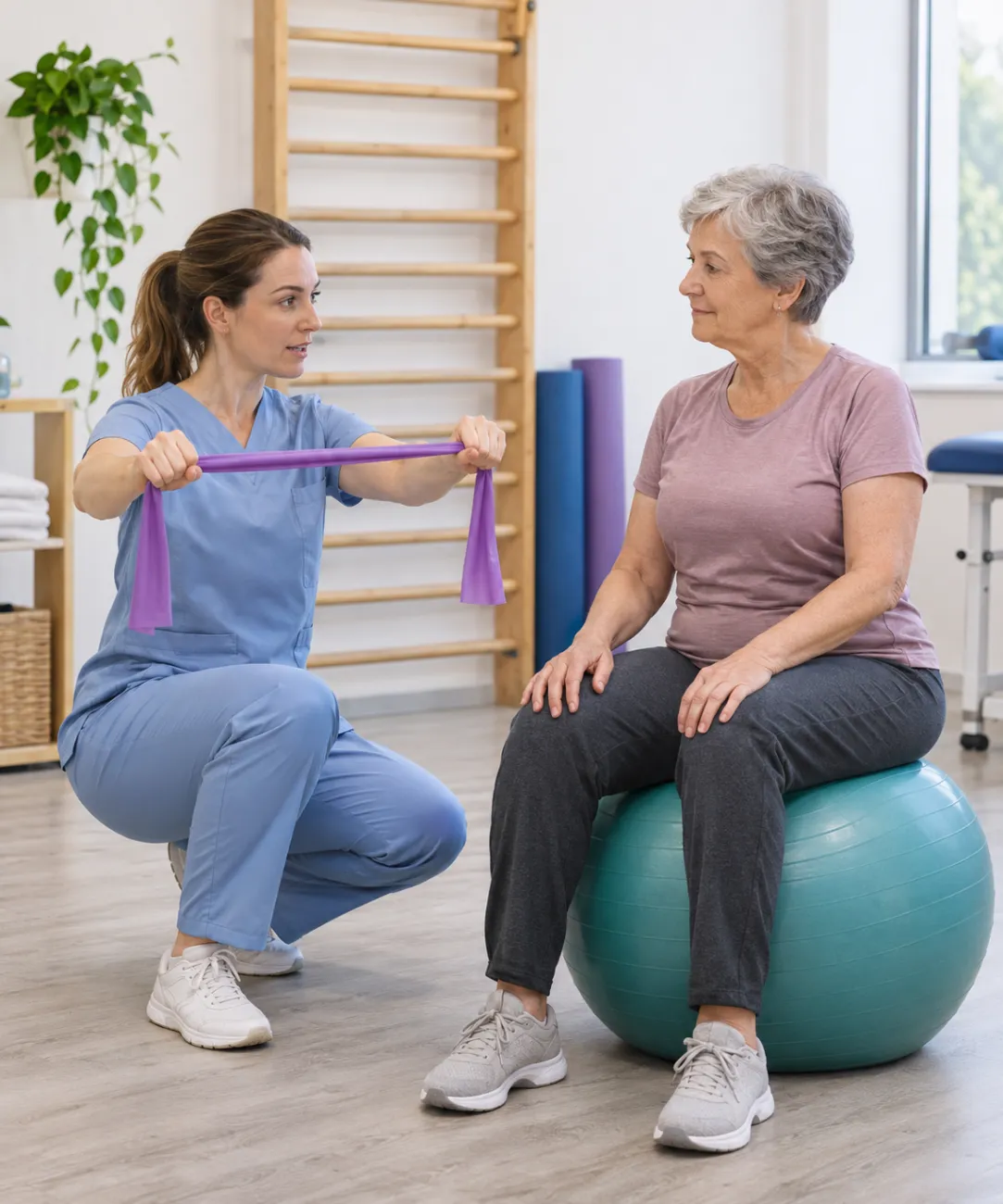
A physiotherapist and a patient sitting on a pilates ball do an exercise with an elastic band
Photograph of a consultation. The dots mark what the doctor assesses; the image does not show the intimate area.

Why it happens

What lies behind a feeling of descent

The organs of the pelvis are held in place by the pelvic floor muscles, ligaments and supporting tissue. When these give way, an organ can descend, and it is usually several factors combined. Choose a situation to see how it applies.

Vaginal births

Vaginal birth stretches and can injure the muscles, nerves and supporting ligaments, especially with several births, large babies or forceps. The effect may only appear many years later, and caesarean section reduces the risk but does not eliminate it completely.

What weighs on it

Concluding that, after years without symptoms, the birth “no longer counts”.

What helps

Pelvic floor training and assessment if heaviness or a “ball” appear, even a long time afterwards.


Prolapse or another cause

Descent of organs, or something else?

Not everything that feels like a “ball” is a prolapse. Cysts, nodules and other changes can also give that impression, and the feeling that the vagina is “wide” is another complaint. Only an examination can tell the difference.

  • How it shows. Heaviness or pressure at the end of the day, relief when lying down, and a “ball” that changes with straining and goes back in.

  • What is described. It can be the bladder (cystocele), the rectum (rectocele), the womb or the top of the vagina after hysterectomy, or the small bowel (enterocele); it is common to have more than one.

  • What the clinic does. The doctor identifies which wall is descending, by how much and the grade, using a standardised system, and assesses the pelvic floor.

  • What usually helps. If there are no symptoms, monitoring is often enough. If there are, the first option is supervised training, then the pessary and, in some cases, surgery.

Unable to pass urine, a high fever with pain, or severe pain with the “ball” outside that you cannot put back? Call 112 or go to the emergency department. If you have blood in the urine, a “ball” that bleeds or has sores, or any doubts, outside opening hours you can call SNS 24: 808 24 24 24.

Book an assessment consultation

What can help

Options for the feeling of descent

If the prolapse causes no symptoms, it may not need treatment. When it is troublesome, the options with the best support are, in the usual order: lifestyle adjustments (losing weight if there is excess, avoiding heavy lifting, treating constipation), supervised pelvic floor training for at least 16 weeks (the first option in mild prolapse), the vaginal pessary, alone or with the training, and surgery when symptoms are significant and the rest has not been enough. After the menopause, low-dose vaginal oestrogen can help the mucosa, especially with the pessary. The choice depends on the symptoms, the grade, age, the wish to have children and your preferences, and the pessary and surgery are done with urogynaecology when necessary. The treatments below are not part of those options and do not correct the prolapse: they are additional alternatives, assessed case by case, without promising results.

Book an assessment consultation
Dr Michelle Campagnoli, clinical director of Clínica Luxmed

First step

Assessment consultation

The doctor listens to what you are experiencing, examines your case and explains the suitable options. No treatment begins without this consultation.

May be considered when

you want to understand the cause and decide on the best path, with time and without commitment.

Book an assessment consultation
Private treatment room, with the device on an elegant trolley and a patient resting covered with a towel

Technology

Sectum, Neauvia radiofrequency (NRose Protocol)

Low-intensity radiofrequency energy, which aims to stimulate collagen in the vaginal mucosa. It does not put the organs back in place or treat the prolapse, and it is not among the options recommended for it; for other intimate complaints the evidence is limited.

May be considered when

the prolapse has been assessed and the first options have already been discussed, what bothers you is the quality of the tissue (dryness, a feeling of less firmness), and the doctor has explained what is known and what is not known.

Find out more
The doctor preparing the laser device, with the protective glasses in the foreground

Technology

Fractional CO2 laser

Laser energy applied to the vaginal mucosa, which aims to improve the quality of the tissues. It does not correct the prolapse or form part of the options recommended for it, and in 2018 the FDA warned of the risks of these devices, which it has not approved to treat symptoms of the menopause, incontinence or sexual function.

May be considered when

the doctor has assessed your case, the prolapse has been characterised and treated in line with the recommendations, and the benefits and risks of an alternative have been explained and discussed.

Find out more

What the journey looks like

From the first consultation to the agreed plan

No treatment starts without an assessment consultation with the doctor. This is how it goes, and you can interrupt or decline any part of the examination.

  1. 01At the clinic

    Assessment consultation

    The doctor listens to what you feel and when, asks about urine, bowel and sex life, childbirth, surgeries and the menopause, and lets you speak in private and without hurry.

  2. 02At the clinic

    The examination

    The walls of the vagina and the cervix are observed at rest and while bearing down, sometimes also standing, to see what descends and by how much, and the prolapse is graded. The pelvic floor is assessed and other causes of a “ball” are ruled out. The examination should not hurt, and it can be stopped.

  3. 03At the clinic and at home

    A plan tailored to you

    If there are no symptoms, we monitor. If there are, we start with lifestyle measures and supervised training, coordinated with pelvic physiotherapy. If needed, the pessary and surgery are discussed, with urogynaecology, and only then other alternatives.

  4. 04Over time

    Follow-up

    A reassessment is made after about 16 weeks of training. Pessary users have periodic check-ups, and if the symptoms do not improve or there are warning signs, the consultation is brought forward.

Day to day

What helps while you wait for the consultation

Simple care that eases the load on the pelvis, alongside the plan the doctor sets out.

The pattern helps the doctor

Worse at the end of the day, better lying down

A heaviness that builds up over the day, with effort or when standing, and eases lying down, is typical of prolapse and helps the doctor guide the examination. Try noting down for a week or two when it appears, what you were doing and how you pass urine and stools. This record is worth more than a description from memory and saves time at the consultation.

Noting when it appears

A short diary makes the consultation more precise.

In practice: note the time, what you were doing, whether it eases lying down and whether there is leaking of urine or difficulty passing a stool.

Passing stools without straining

Constipation and straining push the organs downwards.

In practice: drink water, eat fibre, rest your feet on a small stool at the toilet and do not strain; talk to the doctor if constipation persists.

Contracting before effort and lifting weights carefully

It reduces pressure peaks on the pelvic floor.

In practice: breathe out when lifting instead of holding your breath, contract the pelvic floor first and ask for help with heavy loads.

Treating cough and weight

They are two causes of constant pressure on the pelvis.

In practice: treat a chronic cough, stop smoking if you smoke, and lose weight gradually if there is excess.

Dr Michelle Campagnoli, clinical director of Clínica Luxmed

Who will look after you

An assessment carried out by the doctor

At Luxmed, the first step is always an assessment consultation with Dr Michelle Campagnoli. She listens to what is going on, examines the vagina, cervix and pelvic floor at rest and under effort, looks for a prolapse and other causes of a “ball”, and explains what she has found, in private and without hurry. The plan is adjusted to you and, when needed, coordinated with pelvic physiotherapy or urogynaecology.

  • Physical examination and medical historyA conversation about the symptoms, an examination at rest and under effort and an assessment of the pelvic floor, with your consent.
  • A plan tailored to youFirst what has the best support (monitoring, training, pessary, surgery); the clinic's technologies only if they are appropriate, with the evidence explained.
  • No obligationThe cost of any treatment is confirmed only after the assessment.
Book an assessment consultation

Book a consultation

Book your consultation

Choose how you prefer to get in touch. We will arrange the assessment consultation with Dr Michelle Campagnoli.

Booking through the website100€70€Assessment consultationExclusive price for those who book the assessment through the website. Outside the website, the price is 100 €.

New Life Miraflores, Algés · Office Center, R. Santa Teresa do Menino Jesus n.º 6, 9.º C, 1495-048

Your details are used only for this contact. Any treatment depends on a prior medical assessment.

Request an appointmentIt takes less than a minute.
Speciality
You do not need to go into detail. The doctor will talk to you during the consultation.
Request received. Our team will contact you as soon as possible.
Why do I feel heaviness in the vagina, especially at the end of the day?

The most common cause is pelvic organ prolapse: the bladder, womb or rectum descend and push against the walls of the vagina. The heaviness appears with time on your feet, effort and tiredness, and eases lying down. It can come with urinary, bowel or sexual symptoms. But other changes can also give a similar sensation, so confirmation is made with a gynaecological examination.

Dropped bladder, dropped womb, “everything coming down”: is it all prolapse?

Yes, in most cases these are different names for a prolapse. A bladder that descends is called a cystocele (front wall of the vagina), the rectum a rectocele (back wall), the womb or the top of the vagina after hysterectomy an apical prolapse, and the small bowel an enterocele. It is common to have more than one at the same time.

Is a “ball” in the vagina always a prolapse?

No. Cysts of the Bartholin gland or of the vaginal wall and a urethral diverticulum can also look like a “ball”. A cyst is usually a soft, smooth lump to one side that does not change with straining, and a diverticulum causes pain on passing urine and repeated infections. If the “ball” is hard, bleeds, has sores or does not go back in, it should be assessed without delay.

What do the grades of prolapse (1, 2, 3, 4) mean?

The most widely used system measures, with the woman bearing down, how far the lowest part descends in relation to the entrance of the vagina: in grade 1 it is more than 1 cm above, in grade 2 near the entrance, in grade 3 it goes beyond it and in grade 4 the vagina is practically all outside. The grade helps, but it does not always match the symptoms, so treatment is guided by how much it bothers you.

Does prolapse always get worse or can it go away by itself?

It does not always get worse. In studies of women after the menopause, mild prolapse appears and disappears from year to year in some, and in most it varies little. More advanced ones tend to stay the same or progress without treatment. The factors that favour progression, such as straining, constipation and excess weight, are the ones that can be worked on.

Do pelvic floor exercises help with prolapse?

Yes, it is the first option in mild prolapse. The NICE recommendations indicate a supervised programme for at least 16 weeks. In a trial of women aged 55 or over, 57% of those who trained reported improvement, compared with 13% of those who were monitored, although the difference in symptom score was small. An assessment beforehand is advisable, to confirm that the right muscles are contracting and that there is no tension making the situation worse.

Pessary, physiotherapy or surgery: which to choose?

None is better for everyone. Physiotherapy is the first line in mild prolapse and has almost no risks. The pessary suits any grade and does not require surgery, but it needs check-ups and not all women adapt to it. In one trial, improvement at 24 months was reported by 76% with a pessary and 82% with surgery, and more than half of the women in the pessary group ended up opting for surgery. The decision depends on the symptoms, the grade, age, whether you want more children and your preferences.

Can I exercise and have sex with prolapse?

In general, yes. Exercise is important, but high-impact exercise or exercise with heavy weights may need to be adapted, and pelvic physiotherapy will guide you. As for sex, in most cases prolapse neither prevents it nor is made worse by it. If there is discomfort, pain, a feeling of heaviness or loss of sensation, it is worth talking about it at the consultation.

Do vaginal laser or radiofrequency treat prolapse?

No. They do not put the organs back in place, and the NICE recommendations for prolapse do not mention them. A review of sham-controlled trials assessed urinary leakage, not prolapse, and found a small, short-lived benefit, inconsistent with the CO2 laser and insufficient for radiofrequency. In 2018 the FDA warned that these devices are not approved for the menopause, incontinence or sexual function and that they can cause burns, scars and pain.

When should I book a consultation, and when is it urgent?

Book a consultation if you feel heaviness or a “ball” in the vagina, if you need to push to pass urine or stools, if you have a weak stream, repeated urinary infections or discomfort during sex. Consult without delay if the “ball” bleeds, has sores, feels hard or does not go back in, or if there is a firm lump in the vagina or vulva. If you have doubts, call SNS 24 (808 24 24 24). If you cannot pass urine, have a high fever with pain or severe pain and cannot put the “ball” back, call 112.

We could not find that question. Ask us on WhatsApp

Scientific references

This page is based on the sources below and was reviewed by Dr. Michelle Campagnoli. Last updated on .

  1. National Institute for Health and Care Excellence (NICE). Urinary incontinence and pelvic organ prolapse in women: management (NG123). NICE guideline NG123, 2019.
  2. NHS. Pelvic organ prolapse. (NHS (nhs.uk), acedido 2026-11-11)
  3. Jelovsek JE, Maher C, Barber MD. Pelvic organ prolapse. The Lancet 369(9566):1027-1038, 2007.
  4. Bump RC, Mattiasson A, Bø K, Brubaker LP, DeLancey JO, Klarskov P, et al. The standardization of terminology of female pelvic organ prolapse and pelvic floor dysfunction. American Journal of Obstetrics and Gynecology 175(1):10-17, 1996.
  5. Haylen BT, de Ridder D, Freeman RM, et al. An International Urogynecological Association (IUGA)/International Continence Society (ICS) joint report on the terminology for female pelvic floor dysfunction. Neurourology and Urodynamics 29(1):4-20, 2010.
  6. Swift S, Woodman P, O'Boyle A, et al. Pelvic Organ Support Study (POSST): the distribution, clinical definition, and epidemiologic condition of pelvic organ support defects. American Journal of Obstetrics and Gynecology 192(3):795-806, 2005.
  7. Bradley CS, Zimmerman MB, Qi Y, Nygaard IE. Natural history of pelvic organ prolapse in postmenopausal women. Obstetrics & Gynecology 109(4):848-854, 2007.
  8. Nygaard I, Barber MD, Burgio KL, et al. Prevalence of symptomatic pelvic floor disorders in US women. JAMA 300(11):1311-1316, 2008.
  9. Hagen S, Stark D, Glazener C, Dickson S, Barry S, Elders A, et al; POPPY Trial Collaborators. Individualised pelvic floor muscle training in women with pelvic organ prolapse (POPPY): a multicentre randomised controlled trial. The Lancet 383(9919):796-806, 2014.
  10. Wiegersma M, Panman CM, Kollen BJ, et al. Effect of pelvic floor muscle training compared with watchful waiting in older women with symptomatic mild pelvic organ prolapse: randomised controlled trial in primary care. BMJ 349:g7378, 2014.
  11. Bugge C, Adams EJ, Gopinath D, Stewart F, Dembinsky M, Sobiesuo P, Kearney R. Pessaries (mechanical devices) for managing pelvic organ prolapse in women. Cochrane Database of Systematic Reviews 2020, 11:CD004010, 2020.
  12. van der Vaart LR, Vollebregt A, Milani AL, et al. Effect of pessary vs surgery on patient-reported improvement in patients with symptomatic pelvic organ prolapse: a randomized clinical trial. JAMA 328(23):2312-2323, 2022.
  13. Maher C, Feiner B, Baessler K, Christmann-Schmid C, Haya N, Brown J. Surgery for women with apical vaginal prolapse. Cochrane Database of Systematic Reviews 2016, 10:CD012376, 2016.
  14. The NAMS 2020 GSM Position Statement Editorial Panel. The 2020 genitourinary syndrome of menopause position statement of The North American Menopause Society. Menopause 27(9):976-992, 2020.
  15. Lukanović D, Shah G, Matjašič M, Phillips C. The use of energy-based devices for the treatment of stress urinary incontinence: a systematic review and meta-analysis of the randomised sham-controlled trials. International Urogynecology Journal 37:2779-2790, 2026.
  16. Medsafe (Nova Zelândia), a retransmitir o alerta da U.S. FDA. Safety Information: energy-based devices used for vaginal 'rejuvenation' or vaginal cosmetic procedures (relays the USFDA safety communication of July 2018). Medsafe, New Zealand Medicines and Medical Devices Safety Authority, 2018.
CallAssistantAvailableBook