


- Home
- Facial aesthetics
- Persistent redness on the face
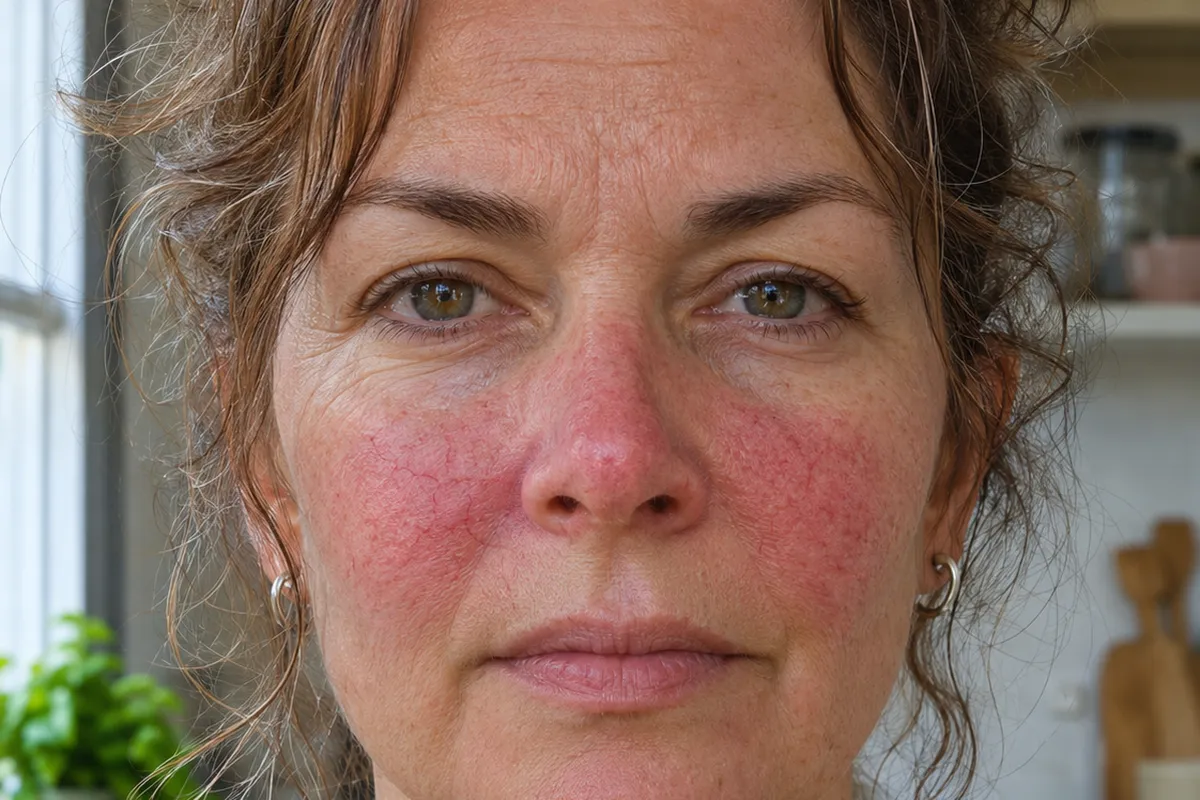
- Constantly red face
Always-red face: possible causes
A constantly red face can have several causes. The best known is rosacea, but there are others. Understanding the cause is essential, because the treatments are different.
 Luxmed TeamAuthor
 Dr Michelle CampagnoliClinical review · OM no. 69467
In this article
A constantly red face can have several causes. The best known is rosacea, but there are others: sensitive skin, seborrhoeic dermatitis, contact dermatitis, sun damage, use of corticosteroids and, more rarely, general illnesses. Understanding the cause is essential, because the treatments are different.
Three ideas to remember.
Most common causes
| Cause | Clues |
|---|---|
| Rosacea | Central redness, flushing, vessels, spots without blackheads (Gallo et al., 2018) |
| Sensitive skin | Burning and stinging with products or changes in temperature (Misery et al., 2017) |
| Seborrheic dermatitis | Redness and flaking at the sides of the nose, eyebrows, scalp |
| Contact dermatitis | Redness and itching after a new product |
| Sun damage | Redness and vessels in exposed areas, with dark patches |
| Corticosteroids on the face | Redness, spots and worsening on stopping |
| Emotional or heat-related flushing | Episodic, with no permanent changes |
Less frequent causes
- Autoimmune conditions, such as lupus.
- Hormonal changes, such as the menopause.
- Medicines that cause flushing.
- Rare conditions that cause episodic flushing.
When to see a doctor
- Persistent redness with no clear cause.
- Redness with tiredness, fever, joint pain or weight loss.
- Lesions that flake or do not improve.
- Red or irritated eyes.
What helps in almost all cases
- Gentle cleansing and moisturising.
- Mineral sunscreen.
- Avoid irritating products.
- Do not apply corticosteroids to the face without medical advice.
At Luxmed Clinic
At Luxmed Clinic, we help work out the origin of the redness and adapt skin care. When the cause requires medical treatment or vascular laser, which we do not offer, we advise on referral.
Talk to us
The assessment is a conversation, with no obligation. Tell us what concerns you and our team will reply.
This article is for information purposes and does not replace a consultation. The results of any treatment vary from person to person.
Frequently asked questions
Is going red easily a sign of rosacea?
Not always. Isolated flushing can be normal. Persistent redness raises more suspicion.
Do corticosteroids calm the redness?
In the short term they can calm it, but prolonged use on the face makes the skin worse.
Does diet influence it?
Alcohol, spicy food and hot drinks can trigger flushing in some people.
Can redness be an allergy?
Yes, especially if it appeared after a new product.
Scientific references 2
- Gallo RL, Granstein RD, Kang S, et al. Standard classification and pathophysiology of rosacea: the 2017 update by the National Rosacea Society Expert Committee. J Am Acad Dermatol. 2018;78(1):148-155. doi:10.1016/j.jaad.2017.08.037 Guideline
- Misery L, Ständer S, Szepietowski JC, et al. Definition of sensitive skin: an expert position paper from the Special Interest Group on Sensitive Skin of the International Forum for the Study of Itch. Acta Derm Venereol. 2017;97(1):4-6. doi:10.2340/00015555-2397 Artigo
Editing and development: Rúben Brito · Operial Development
Keep exploring