


- Home
- Body aesthetics
- Body carboxytherapy
- Carboxytherapy for the abdomen
Carboxytherapy for abdominal fat: realistic expectations
Carboxytherapy for the abdomen is promoted as a way to ‘burn’ fat. See how it compares with a sham treatment and what you can reasonably expect.
 Luxmed TeamAuthor
 Dr Michelle CampagnoliClinical review · OM no. 69467
In this article
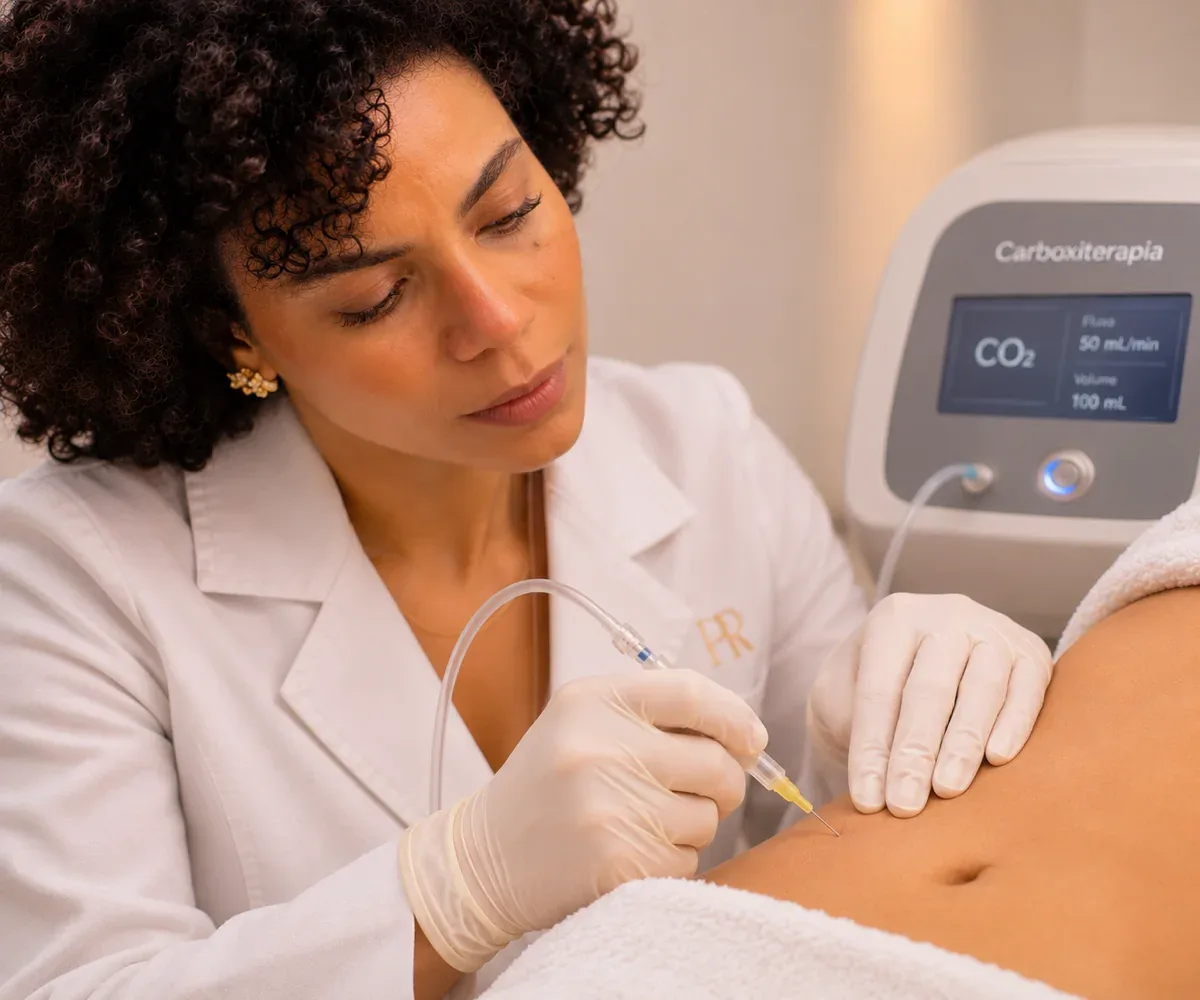
Carboxytherapy for the abdomen is often promoted as a way to ‘burn’ localised fat. The idea is appealing: a few gas injections, little downtime and fewer centimetres. But what happens when carboxytherapy is tested against a sham treatment? We explain what is known and what you can reasonably expect.
Three ideas to remember.
What the studies say
Studies without a control group
The Italian study that popularised the technique, published in 2001, treated 48 women with localised fat deposits and reported a reduction in circumference and changes in fat cells (Brandi et al., 2001). A clinical audit in Singapore, published in 2010, analysed 101 women treated on the abdomen over four years and recorded average reductions in abdominal circumference of around 2 to 3 cm after 5 sessions (Lee, 2010). Neither study had a control group.
Randomised sham-controlled trial
In 2018, a US team conducted a trial in which one side of the abdomen received carboxytherapy and the other received a sham treatment, over five weekly sessions (Alam et al., 2018). The results were more modest:
- there was a reduction in fat on the treated side, but it was small and temporary;
- the authors concluded that the effect might not last;
- there was no significant difference in circumference between the two sides.
Why the results differ
| Factor | How it affects the results |
|---|---|
| No control group | Any change is attributed to the treatment |
| Habits during treatment | Many people improve their diet and exercise habits when they start a treatment |
| Fluid | Changes in fluid retention affect circumference |
| Tape measurement | Small differences in position and breathing change the result |
| Sham treatment | Helps separate the true effect from the effect of the treatment context |
What is realistic to expect
- A slight and probably temporary improvement in localised volume.
- Possible improvement in skin texture and elasticity.
- Better results when diet and exercise habits also change.
- No effect on visceral fat, which is the fat inside the abdomen.
Alternatives with more evidence for localised fat
| Technique | Evidence |
|---|---|
| Cryolipolysis | Systematic review showing average reductions in fat-layer thickness of approximately 10 to 25% (Ingargiola et al., 2015) |
| Injectable deoxycholic acid | Randomised trials for double chin; observational studies on the body |
| Liposuction | Permanent result, with the risks and recovery associated with surgery |
At Luxmed Clinic
At Luxmed in Algés, near Lisbon, the assessment begins by distinguishing subcutaneous fat from visceral fat, skin laxity or diastasis, and by explaining which options are most likely to work in each case.
Talk to us
The assessment is a conversation, with no obligation. Tell us what concerns you and our team will reply.
This article is for information only and does not replace a medical consultation.
Frequently asked questions
Does carboxytherapy help you lose weight?
No. It is not a weight-loss treatment, and its effect on localised fat is small.
Why did I lose centimetres after the first few sessions?
It may be due to fluid, changes in habits and the way measurements are taken, rather than the treatment alone.
Is carboxytherapy on the abdomen worthwhile?
It may be useful as an adjunct, particularly for skin quality, provided expectations are realistic.
What works best for localised abdominal fat?
Cryolipolysis and deoxycholic acid have more supporting evidence. Surgery is the most effective option for larger volumes.
Scientific references 4
- Alam M, Sadhwani D, Geisler A, et al. Subcutaneous infiltration of carbon dioxide (carboxytherapy) for abdominal fat reduction: a randomized clinical trial. J Am Acad Dermatol. 2018;79(2):320-326. doi:10.1016/j.jaad.2018.04.038 Artigo
- Brandi C, D'Aniello C, Grimaldi L, et al. Carbon dioxide therapy in the treatment of localized adiposities: clinical study and histopathological correlations. Aesthetic Plast Surg. 2001;25(3):170-174. doi:10.1007/s002660010116 Artigo
- Lee GS. Carbon dioxide therapy in the treatment of cellulite: an audit of clinical practice. Aesthetic Plast Surg. 2010;34(2):239-243. doi:10.1007/s00266-009-9459-0 Artigo
- Ingargiola MJ, Motakef S, Chung MT, Vasconez HC, Sasaki GH. Cryolipolysis for fat reduction and body contouring: safety and efficacy of current treatment paradigms. Plast Reconstr Surg. 2015;135(6):1581-1590. doi:10.1097/PRS.0000000000001236 Artigo
Editing and development: Rúben Brito · Operial Development
Keep exploring