


- Home
- Facial aesthetics
- Carboxytherapy
- Carboxytherapy for dark circles
Carboxytherapy for dark circles: what the evidence says
Not all dark circles are the same. Learn which types carboxytherapy may help, what studies say, its limitations and when other options are more suitable.
 Luxmed TeamAuthor
 Dr Michelle CampagnoliClinical review · OM no. 69467
In this article
Dark circles are one of the most common reasons for seeking facial carboxytherapy. However, not all dark circles are the same: they may be caused by pigmentation, blood vessels, shadowing from the tear trough or a combination of factors. This article explains which types of dark circles carboxytherapy may help, what the studies say and when other options are more suitable.
Three ideas to remember.
What type of dark circles do you have?
| Type of dark circle | How to recognise it | Role of carboxytherapy |
|---|---|---|
| Vascular | Bluish or purplish tone, worse when tired | Good candidate |
| Pigmented | Brown tone, does not change when the skin is stretched | May help when combined with depigmenting agents or peels |
| Structural (tear trough) | Shadow that changes with the light; visible hollow | Not very effective; filler is more suitable |
| Combination | Multiple contributing factors | May form part of a combined treatment plan |
What the studies say
| Study | What was done | Result |
|---|---|---|
| Nofal et al., 2018 | 30 people; platelet-rich plasma on one side every 2 weeks and weekly carboxytherapy on the other | Both were effective, with comparable effectiveness; carboxytherapy was slightly more effective and well tolerated |
| Kołodziejczak and Rotsztejn, 2024 | 39 people with light skin, 5 sessions, with and without accompanying peels | Reduction in dark circles, particularly the vascular component in the tear trough |
| Paolo et al., 2012 | Carboxytherapy around the eyes | Improved appearance of the periorbital area |
These studies have important limitations: few participants, no placebo group in most studies and short follow-up periods. Carboxytherapy is a reasonable and safe option, but it is not a guaranteed solution.
What does treatment for dark circles involve?
- Assessment of the type of dark circles, with the skin stretched and under different lighting.
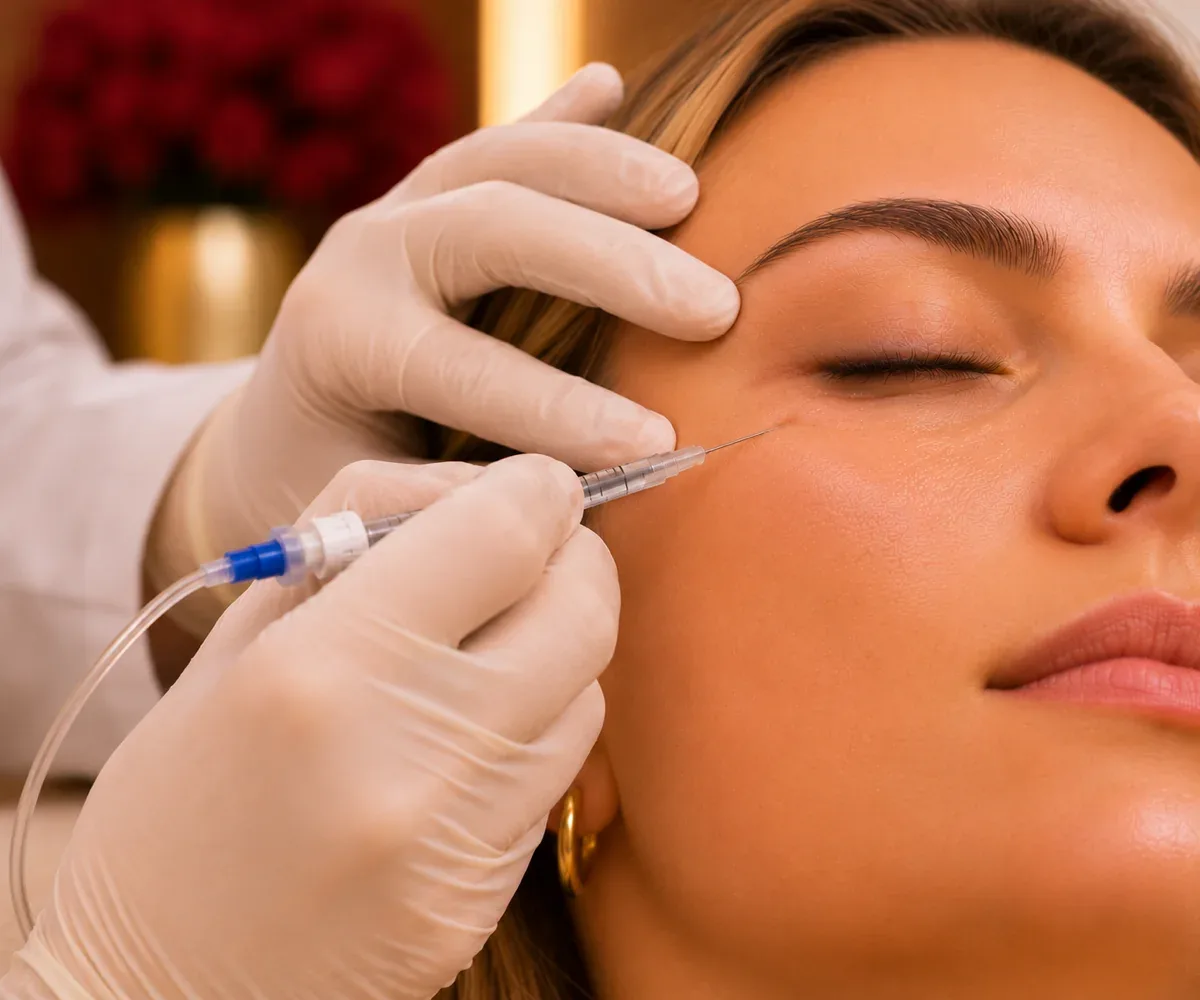
- Microinjections of medical-grade carbon dioxide into the lower eyelid using a very fine needle.
- The area swells for a few minutes and there may be a mild burning sensation.
- Usually 4 to 8 sessions, weekly or fortnightly.
Carboxytherapy or another option?
| Condition | Usual option |
|---|---|
| Bluish dark circles, thin skin | Carboxytherapy, polynucleotides or PDRN |
| Brown dark circle | Depigmenting agents, gentle peels, with carboxytherapy as an adjunct |
| Deep tear trough with shadowing | Hyaluronic acid filler suitable for the area |
| Fat bags | Assessment for blepharoplasty |
At Luxmed Clinic
At Luxmed in Algés, near Lisbon, we begin by identifying the type of dark circles and only then recommend carboxytherapy, filler or a combination.
Talk to us
The assessment is a conversation, with no obligation. Tell us what concerns you and our team will reply.
This article is for information purposes and is not a substitute for a consultation. Results vary from person to person.
Frequently asked questions
Does carboxytherapy for dark circles hurt?
It causes a burning sensation and pressure for a few seconds, which are generally tolerable.
Will there be swelling afterwards?
Yes, for a few minutes to an hour. Small bruises may occur.
How long do the results last?
It varies; maintenance sessions are generally recommended.
Can I have carboxytherapy and filler for dark circles?
Yes, at different stages, when the dark circles have different contributing factors.
Scientific references 3
- Nofal E, Elkot R, Nofal A, Eldesoky F, Shehata S, Sami M. Evaluation of carboxytherapy and platelet-rich plasma in treatment of periorbital hyperpigmentation: a comparative clinical trial. J Cosmet Dermatol. 2018;17(6):1000-1007. Artigo
- Kołodziejczak A, Rotsztejn H. The impact of carboxytherapy and treatments combining carboxytherapy and selected chemical peels on vascular and pigmentary components of the dark circles. Clin Cosmet Investig Dermatol. 2024;17:1875-1885. Artigo
- Paolo F, Nefer F, Paola P, Nicolò S. Periorbital area rejuvenation using carbon dioxide therapy. J Cosmet Dermatol. 2012;11(3):223-228. Artigo
Editing and development: Rúben Brito · Operial Development
Keep exploring