


- Home
- Body mesoaesthetics
- Rough, dry or dull skin
- Exfoliating the body
Exfoliating the body: when, how and with what
Exfoliating well leaves the skin smoother; in excess, it irritates and dries. See the difference between mechanical and chemical exfoliation, the right frequency and when not to exfoliate.
 Rúben BritoAuthor
 Dr Michelle CampagnoliClinical review · OM no. 69467
In this article
Exfoliating the body has a reputation as the secret to smooth, glowing skin. And it can be, when done well. But it is also one of the care gestures most easily overdone: coarse-grain scrubs every day, rough mitts used with force, brushes that leave the skin red. The result, often, is skin that is more irritated, drier and even rougher than before.
This article explains when it makes sense to exfoliate the body, the differences between mechanical and chemical exfoliation, how often to do it, and when it is better not to.
Three ideas to remember.
Fica por baixo do resumo, se existir uma segunda foto.
Why exfoliate and when it makes sense
The outermost layer of the skin is made up of dead cells that are gradually shed, invisibly, in a natural process called desquamation. In young, healthy skin, this process works well without help. But there are situations in which the cells build up:
- Dry skin, in which the enzymes that release the cells work less well for lack of water.
- Age, because skin renewal slows down.
- Areas of friction or pressure: elbows, knees, heels.
- Keratosis pilaris, with keratin plugs in the follicles (Keratosis pilaris: the “little bumps” on the arms and what helps).
- Ingrown hairs, especially in areas that are shaved or waxed.
In these cases, gentle exfoliation can:
- Leave the skin smoother to the touch and better in appearance.
- Help moisturisers spread better (although the idea that they “penetrate more” is often exaggerated).
- Reduce ingrown hairs by freeing the hair that grows under the skin.
- Prepare the skin for an even self-tan.
What exfoliation does not do: it does not eliminate cellulite, stretch marks or laxity, it does not “detoxify” and it does not replace moisturising. On skin that is already irritated or fragile, it can do more harm than good.
Mechanical exfoliation
Removes cells by friction.
| Method | What it is like | Notes |
|---|---|---|
| Scrubs with grains | Creams or gels with particles (sugar, salt, crushed seeds, mineral oxides, waxes) | Prefer fine, rounded grains; large, irregular grains (such as crushed stones) can cause microinjuries. Since October 2023, plastic microbeads have been banned in rinse-off cosmetics sold in the EU |
| Sugar or salt scrubs | Blends with oils | Salt can sting on skin with small wounds or after hair removal; sugar is gentler |
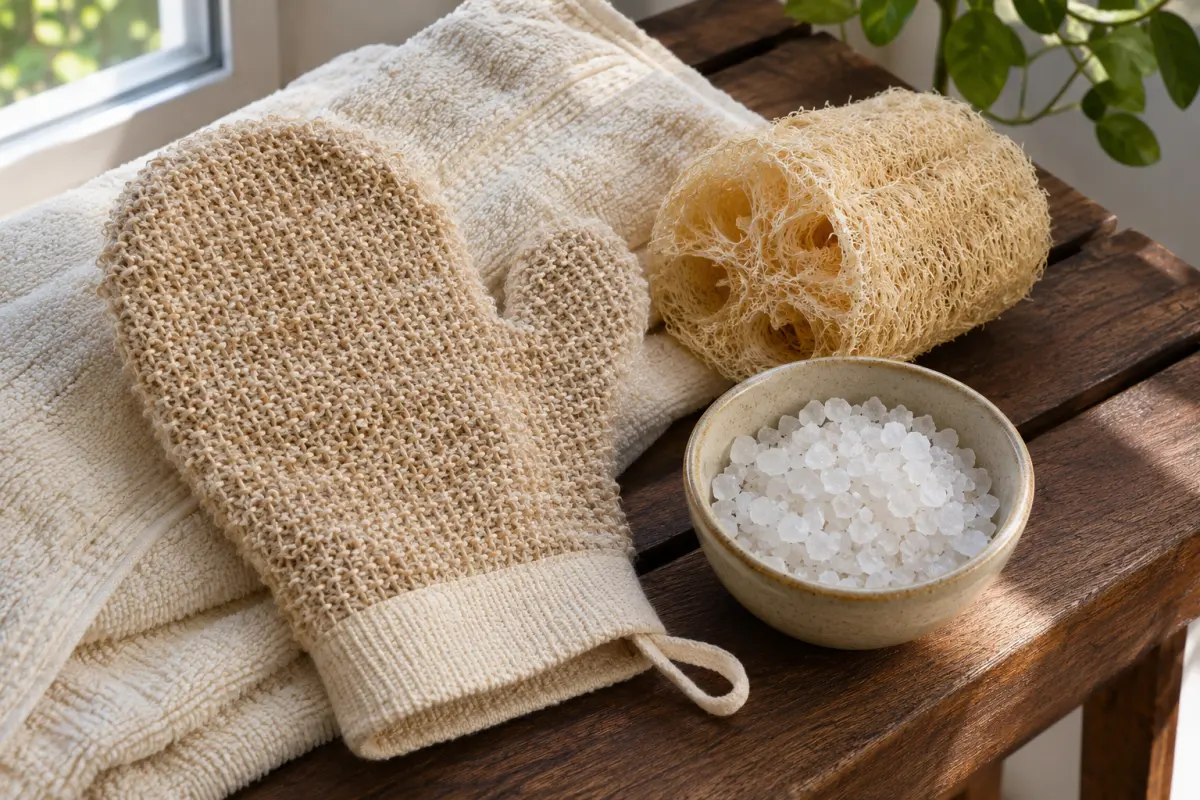
| Exfoliating mitts and sponges | Used with shower gel | Very effective; easy to overdo. Wash and dry them well, because they harbour bacteria |
| Body brush (dry or wet) | Natural or synthetic bristles | See note below |
Source on microbeads: Regulation (EU) 2023/2055 (European Commission, 2023).
How to do it
- On wet skin, with light circular movements.
- No pressure: if the skin becomes very red or stings, it was too much.
- Avoid sensitive areas (face, breasts, genitals) with body products.
- Moisturise straight afterwards.
And what about dry brushing?
Dry brushing became popular with promises of “activating lymphatic circulation”, “draining toxins” and “eliminating cellulite”. There are no studies to support these promises. What it does is mechanical exfoliation that can leave the skin smoother and gives a feeling of energy and temporary redness. On sensitive or dry skin, or skin with eczema, it can irritate. If you like it, do it with soft bristles, light pressure and only a few times a week.
Chemical exfoliation
Instead of rubbing, it uses ingredients that loosen the bonds between dead cells (Kornhauser et al., 2010). It is more even and, for many skin types, gentler than mechanical exfoliation. On the body, it is found mainly in leave-on creams and lotions, and in some shower gels.
| Ingredient | How it works | For whom | Notes |
|---|---|---|---|
| Urea (10% to 20%) | Moisturises and loosens the cells | Dry, rough skin, heels, keratosis pilaris | Very well tolerated; may sting on irritated skin |
| Lactic acid (5% to 12%) | Mild alpha-hydroxy acid (AHA), also moisturising | Dry, rough skin, keratosis pilaris | A good starting point |
| Glycolic acid | Small-molecule AHA, more intense | Thick, rough skin that is not sensitive | May irritate more |
| Salicylic acid (BHA) | Penetrates sebum and pores | Back and chest with spots, ingrown hairs, keratosis pilaris | Avoid over large areas in pregnancy and in small children; do not use if you are allergic to aspirin without guidance |
| Polyhydroxy acids (PHAs) | Larger molecules, gentler | Sensitive skin | Slower effect |
Sources: Pan et al., 2013; Kornhauser et al., 2010; Wang and Orlow, 2018.
How to use
- Apply after the bath, with the skin dry or slightly damp, to the areas to be treated.
- Start 2 to 3 times a week and increase if well tolerated.
- A slight initial tingling is normal; strong burning, redness or intense peeling are not.
- Sunscreen on exposed areas: AHAs increase sensitivity to the sun during use and for up to a week after stopping.
- Do not combine with strong mechanical exfoliation on the same day.
How often
| Skin type | Mechanical exfoliation | Chemical exfoliation |
|---|---|---|
| Normal | 1 to 2 times a week | Optional, 2 to 3 times a week |
| Dry | Once a week, very gently | Cream with urea or lactic acid, even daily |
| Oily, with spots on the back | 1 to 2 times a week | Salicylic acid 2 to 3 times a week or more |
| Sensitive or atopic | Avoid or only very occasionally | PHA or urea at low concentration, if tolerated |
| With keratosis pilaris | Avoid strong friction | Urea, lactic or salicylic acid daily |
Specific situations
Ingrown hairs
Exfoliating gently 2 to 3 times a week, starting a few days after hair removal, helps to free the hairs. Lotions with salicylic or glycolic acid are useful. Do not exfoliate on the day of waxing or shaving. If ingrown hairs often become inflamed, laser hair removal may be a solution.
Before the self-tanner
Exfoliating the day before or on the day itself, paying attention to elbows, knees and ankles, helps the colour to be even. Avoid oils just beforehand, which can create patches.
After summer
Skin that flakes after a lot of sun benefits from moisturising and gentle exfoliation, never aggressive. Sunburnt skin should not be exfoliated. See also The skin of the body after summer: what to assess and how to recover.
Heels and elbows
Thicker areas tolerate mechanical exfoliation and higher-concentration urea creams better. In people with diabetes or poor circulation, the feet need special care: avoid harsh files and ask for guidance.
Pregnancy
Gentle mechanical exfoliation, urea and lactic acid are generally safe. Avoid salicylic acid over large areas and check products with your doctor.
When not to exfoliate
Common mistakes
- Exfoliating every day with friction.
- Using the same body exfoliant on the face.
- Pressing hard to “feel it working”.
- Combining brush, mitt and acids on the same day.
- Forgetting to moisturise afterwards (Rawlings and Harding, 2004). See Dry skin on the body: the bathing mistakes that make it worse.
- Using damp mitts and sponges for weeks without washing and drying them.
- Expecting exfoliation to resolve cellulite or stretch marks.
At Luxmed, we help you work out whether your skin needs exfoliation and the best way to do it, and in the clinic we carry out body treatments that renew the skin safely, such as body peels and moisturising protocols.
Talk to us
The assessment is a conversation, with no obligation. Tell us what concerns you and our team will reply.
Telephone 214 044 241 · info@luxmed.pt
This article is for information purposes and does not replace a consultation.
Frequently asked questions
How often should I exfoliate the body?
For most people, mechanical exfoliation 1 to 2 times a week. Gentle exfoliating creams (urea, lactic acid) can be used more often.
Does dry brushing eliminate cellulite?
There is no evidence. It can leave the skin smoother, but does not treat cellulite or “drain toxins”.
Does exfoliating help ingrown hairs?
Yes, when done gently, a few days after hair removal and regularly.
Can I exfoliate before hair removal?
Yes, the day before or one to two days earlier. On the day itself and straight afterwards, it is better to avoid it.
Chemical or mechanical exfoliation: which is better?
It depends on the skin. Chemical is more even and gentle for dry, rough skin or skin with keratosis pilaris. Mechanical gives an immediate effect and is useful before self-tanner.
Are scrubs with microplastics still sold?
Since October 2023, plastic microbeads have been banned in rinse-off cosmetics sold in the European Union.
Can I exfoliate with dry, itchy skin?
With care and preferring creams with urea or lactic acid. If there are plaques, fissures or intense itching, treat the skin first.
Scientific references 6
- Comissão Europeia. Regulamento (UE) 2023/2055 da Comissão, de 25 de setembro de 2023, que altera o anexo XVII do Regulamento (CE) n.º 1907/2006 (REACH) no que diz respeito às micropartículas de polímeros sintéticos. Jornal Oficial da União Europeia. L 238, 27.9.2023. Site
- Kornhauser A, Coelho SG, Hearing VJ. Applications of hydroxy acids: classification, mechanisms, and photoactivity. Clin Cosmet Investig Dermatol. 2010;3:135-142. Artigo
- U.S. Food and Drug Administration. Guidance for industry: labeling for topically applied cosmetic products containing alpha hydroxy acids as ingredients. 2005. Guideline
- Rawlings AV, Harding CR. Moisturization and skin barrier function. Dermatol Ther. 2004;17(Suppl 1):43-48. Artigo
- Pan M, Heinecke G, Bernardo S, Tsui C, Levitt J. Urea: a comprehensive review of the clinical literature. Dermatol Online J. 2013;19(11):20392. Artigo
- Wang JF, Orlow SJ. Keratosis pilaris and its subtypes: associations, new molecular and pharmacologic etiologies, and therapeutic options. Am J Clin Dermatol. 2018;19(5):733-757. Artigo
Keep exploring