


- Home
- Facial aesthetics
- Sun-aged skin
- Photoageing
Photoageing: how the sun ages the skin
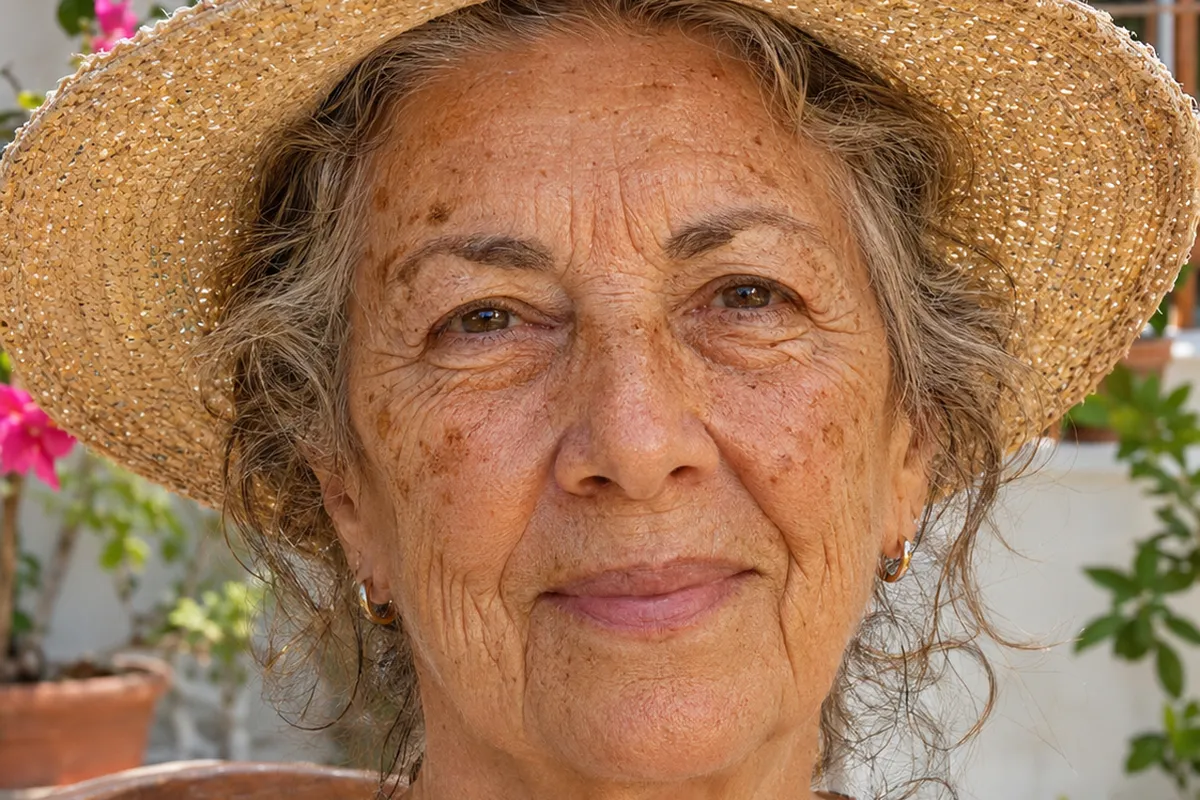
Much of what we see as facial ageing does not come from age, but from the sun. This difference is called photoageing.
 Luxmed TeamAuthor
 Dr Michelle CampagnoliClinical review · OM no. 69467
In this article
Much of what we see as facial ageing does not come from age, but from the sun. Just compare the skin of the face with the skin of the inner arm, which is rarely exposed. This difference is called photoageing: wrinkles, pigmentation marks, loss of firmness, uneven texture and small visible vessels, accumulated over years of exposure.
Three ideas to remember.
How the sun ages the skin
Ultraviolet radiation activates enzymes that break down collagen and reduces the production of new collagen. Repeated over years, this aggression accumulates damage that the skin cannot fully repair (Fisher et al., 2002). At the same time, melanocytes produce pigment irregularly, giving rise to marks (Yaar and Gilchrest, 2007).
Signs of photoageing
| Sign | What happens in the skin |
|---|---|
| Fine and deep wrinkles | Loss of collagen and elastic fibres |
| Sun spots | Pigment accumulated irregularly |
| Rough, thick skin | Changes in the surface layer |
| Loss of firmness | Damaged elastic fibres |
| Visible vessels | Weakened vessel walls |
| Precancerous lesions | Accumulated damage to the DNA of cells |
Prevention
In a randomised trial, adults who used sunscreen every day had no detectable increase in skin ageing over 4.5 years, unlike the group that used it irregularly (Hughes et al., 2013). It is never too late to start.
- Daily sunscreen, SPF 30 or higher.
- Hat, sunglasses and shade.
- Avoid the sun at the hours of greatest intensity.
- Do not use sunbeds.
Treating it
- Topical retinoids: the most studied for fine wrinkles and texture (Kligman et al., 1986).
- Chemical peels: texture, pigmentation marks and radiance.
- Fractional laser: wrinkles, texture and firmness.
- Microneedling: texture and firmness.
- Topical antioxidants: such as vitamin C, complement protection.
At Luxmed Clinic
At Luxmed, we treat photoageing with plans that combine home care and in-clinic treatments, with sun protection as the basis. Suspicious lesions are referred to dermatology.
Talk to us
The assessment is a conversation, with no obligation. Tell us what concerns you and our team will reply.
This article is for information purposes and does not replace a consultation. The results of any treatment vary from person to person.
Frequently asked questions
Is sun damage reversible?
In part. Fine wrinkles, pigmentation marks and texture improve considerably; deeper damage only partially.
How much of facial ageing comes from the sun?
A significant part, especially in people who have had a lot of exposure.
Does winter sun count too?
Yes, especially ultraviolet A radiation, which varies less across the year.
Do sunbeds age the skin?
Yes, and they increase the risk of skin cancer.
Scientific references 4
- Fisher GJ, Kang S, Varani J, et al. Mechanisms of photoaging and chronological skin aging. Arch Dermatol. 2002;138(11):1462-1470. doi:10.1001/archderm.138.11.1462 Artigo
- Yaar M, Gilchrest BA. Photoageing: mechanism, prevention and therapy. Br J Dermatol. 2007;157(5):874-887. doi:10.1111/j.1365-2133.2007.08108.x Artigo
- Hughes MCB, Williams GM, Baker P, Green AC. Sunscreen and prevention of skin aging: a randomized trial. Ann Intern Med. 2013;158(11):781-790. doi:10.7326/0003-4819-158-11-201306040-00002 Artigo
- Kligman AM, Grove GL, Hirose R, Leyden JJ. Topical tretinoin for photoaged skin. J Am Acad Dermatol. 1986;15(4 Pt 2):836-859. doi:10.1016/s0190-9622(86)70242-9 Artigo
Editing and development: Rúben Brito · Operial Development
Keep exploring