


- Home
- Therapeutic massage
- Tension in the head and face
- Scalp massage
Scalp massage: real benefits, hair and relaxation
Scalp massage relaxes and can relieve tension in the head. As for hair, the evidence is modest: see what has been shown.
 Rúben BritoAuthor
 Dr Michelle CampagnoliClinical review · OM no. 69467
In this article
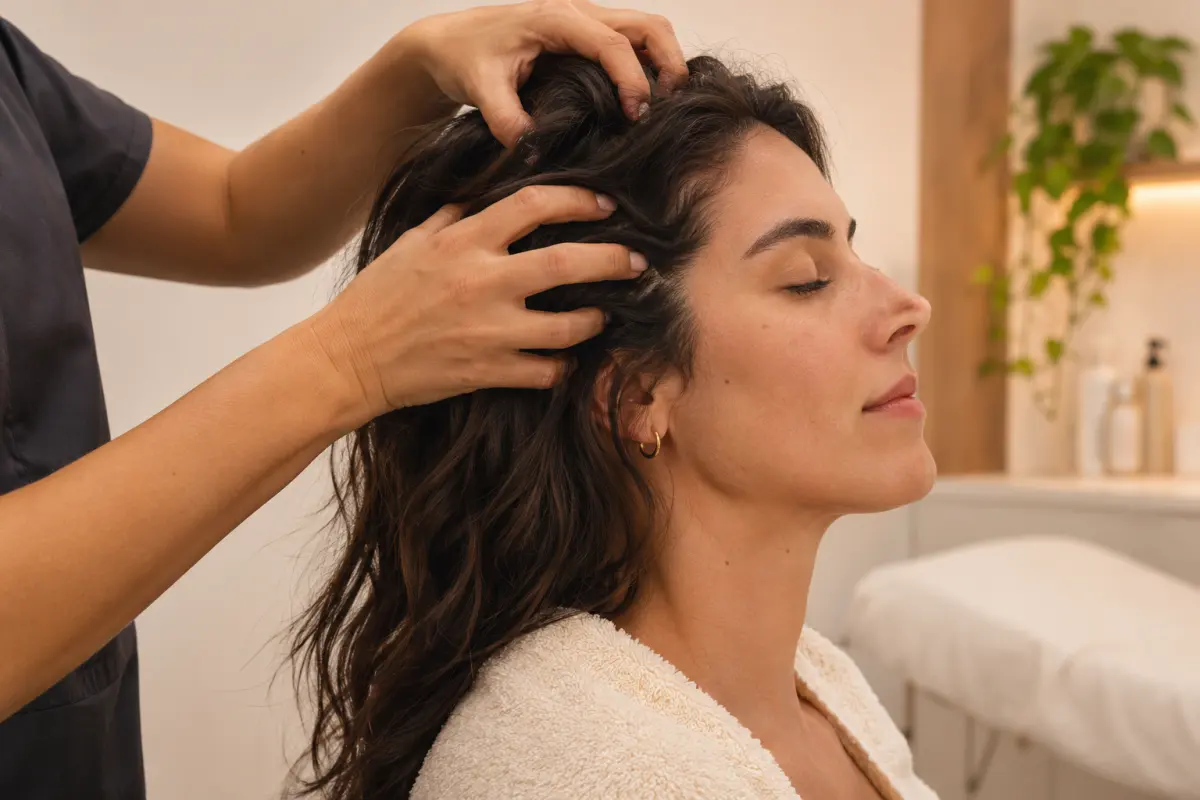
Few sensations are as immediate as that of a good scalp massage: the shoulders drop, breathing slows and the head feels lighter. It is no accident that many people say the best part of the hairdresser's is the hair wash.
On social media, scalp massage also appears as a solution for hair loss. Here, the evidence is more modest than the promises. This article separates what has been shown from what is merely promising.
Three ideas to remember.
Fica por baixo do resumo, se existir uma segunda foto.
What it is and how it is done
Scalp massage consists of movements with the fingertips over the head: pressures, small circles, gliding strokes and movements that gently mobilise the scalp over the skull. It can be done with dry hair, during washing or with an oil.
In a professional session, it is often combined with massage of the neck, shoulders, face and temples, because the muscles in these areas are connected. The scalp has thin muscles (such as the frontalis on the forehead and the occipitalis at the nape) joined by a fibrous layer, the galea aponeurotica, and a rich network of sensitive nerves, which helps explain why touch in this area is so pleasant.
Common forms
- Relaxing head massage: built into a body massage or as a short session focused on the head, neck and shoulders.
- Massage during washing: at the hairdresser's or at home.
- Massage with tools: silicone brushes or pointed massagers. They should be used gently, without scratching.
- Traditions such as Indian head massage: combine scalp, face, neck and shoulders, with or without oil.
Stress and relaxation: what the studies say
In a Korean study of healthy women, 15 minutes of scalp massage, twice a week for ten weeks, reduced levels of cortisol and noradrenaline (hormones associated with stress), blood pressure and heart rate, compared with a control group (Kim et al., 2016). It was a small study, but consistent with what research shows about massage in general: reduced anxiety and tension, especially with regular sessions (Moyer et al., 2004).
In practice, many people use head massage to:
- Decompress after a day of intense mental work.
- Get ready for sleep.
- Relieve the feeling of a “heavy head” or a “tight band”.
And headaches?
Tension-type headache is often associated with tension in the muscles of the neck, shoulders, face and scalp. Massage of these areas can bring relief, and some trials showed a reduction in headache frequency with massage of the head and neck, although in one of them a placebo treatment had a similar effect (Moraska et al., 2015). In other words: it helps, but part of the benefit may come from relaxation and dedicated attention, and not only from the technique.
In migraine, massage is more useful between attacks than during them, when touch can be bothersome. Learn to tell the two types apart in Tension-type headache or migraine: how to tell the difference and what helps.
Does massage make hair grow?
It is the most searched question on the topic. The honest answer: there are interesting signs, but the evidence is weak.
What has been studied
- Japanese study (Koyama et al., 2016): nine healthy men had 4 minutes a day of standardised scalp massage, with a device, for 24 weeks. The average thickness of the hairs increased slightly, but the number of hairs did not change significantly. The authors propose that mechanical stretching stimulates the dermal papilla cells, at the base of the follicle. With no control group and only nine participants, it is a preliminary result.
- Survey in androgenetic alopecia (English and Barazesh, 2019): around 340 people who followed a self-massage protocol twice a day answered a questionnaire, and about two thirds reported stabilisation of hair loss or some growth. But this is self-assessment, with no control group or objective measurement, and many participants dropped out.
How to read these results
- Massage does not replace the treatments with evidence for hair loss, which should be prescribed by a doctor.
- It can be a pleasant complement, without relevant risks, for those who like it.
- Any effect would require daily regularity for months, not an occasional session.
- Promises to “grow hair” or “end baldness” with massage have no scientific support.
And oils?
Rosemary oil gained its reputation after a small Iranian trial in which, after six months, it had an effect similar to a 2% minoxidil solution in androgenetic alopecia, with less itching (Panahi et al., 2015). The study had important limitations and was not confirmed by larger trials. Other oils (castor, coconut, argan) moisturise the hair shaft, but there is no evidence that they stimulate growth.
Precautions with oils:
- Pure essential oils can irritate the skin and cause contact dermatitis: they must always be diluted in a vegetable oil.
- Do a patch test on a small area first.
- Avoid on irritated skin, with sores or active dermatitis.
- In people with dandruff or seborrhoeic dermatitis, heavy oils may make it worse.
The hair loss that alarms you during massage
It is normal to see a few hairs on your hand during a massage or hair wash. On average we lose between 50 and 100 hairs a day, which were already in the shedding phase (telogen). Massage does not make them fall out, it simply loosens those that were about to fall. If the amount increases greatly or bald patches appear, seek assessment.
Self-massage: how to do it at home
Five minutes, once or twice a day, or while washing your hair:
- Posture: seated, shoulders relaxed, slow breathing.
- Fingertips, not nails: place the fingertips of both hands on the scalp, next to the hairline at the forehead.
- Small circles: make slow circles, with firm but comfortable pressure, moving the skin over the skull rather than rubbing the hair. Stay 10 to 20 seconds in each area.
- Work your way over the head: from the forehead to the top, then the sides above the ears, and finally the nape.
- Base of the skull: with your thumbs, apply gentle pressure to the area where the neck meets the head, for a few seconds.
- Finish with long, light strokes, from the forehead to the nape.
Avoid sudden movements, scrubbing hard or pulling the hair, especially if it is fine, fragile or chemically treated.
Care and when to see a doctor
Scalp massage is very safe. Avoid it or ask for guidance if you have:
- Wounds, infections, lice or scalp lesions.
- Psoriasis or dermatitis in an active phase (may irritate).
- Recent surgery or procedure on the head, including a hair transplant.
- Recent head injury.
See a doctor (family doctor or dermatologist) if you have:
Hair loss can have several causes: genetic and hormonal (androgenetic alopecia), stress, recent illness or childbirth (telogen effluvium), iron deficiency, thyroid problems, autoimmune diseases (alopecia areata) or tight hairstyles. Treatment depends on the cause.
Seek urgent help (112) for a sudden, very severe headache, with fever and a stiff neck, or with weakness, difficulty speaking or changes in vision. If in doubt, call SNS 24 (808 24 24 24).
At Luxmed Clinic
At Luxmed Clinic, in Algés, head massage can form part of a relaxing massage or be carried out together with the neck, shoulders and face, for those seeking decompression or relief of tension. If your concern is hair loss, we recommend starting with an assessment. Massages are carried out by a massage therapist.
Talk to us
The assessment is a conversation, with no obligation. Tell us what concerns you and our team will reply.
Telephone 214 044 241 · info@luxmed.pt
Massage is a wellbeing complement and does not replace medical assessment or treatment. It is not a treatment for hair loss. Results vary from person to person.
Frequently asked questions
Does scalp massage make hair grow?
There are small studies suggesting a slight increase in hair thickness with daily massage for months, but the evidence is weak. It is not a treatment for hair loss.
How long should I massage each day?
To relax, a few minutes are enough. In the studies on hair, 4 minutes or more a day were used, for several months.
Can massage make hair fall out?
It does not make healthy hairs fall out. It loosens those that were already in the shedding phase. Just avoid scrubbing hard or pulling the hair.
Does rosemary oil work?
A small trial suggested results similar to those of a common topical treatment, but it was not confirmed. If you use it, always dilute it and do a patch test.
Can I have a scalp massage if I have dandruff?
Yes, gently and without heavy oils. If there is intense itching, redness or thick scaling, seek assessment.
Does head massage help you sleep?
Many people feel that it does, because of the relaxing effect. Studies on massage in general show improved sleep in some groups.
Are silicone massagers a good idea?
They can be useful during washing, if used gently. Avoid those that scratch, and do not use them with too much force.
Scientific references 6
- Kim IH, Kim TY, Ko YW. The effect of a scalp massage on stress hormone, blood pressure, and heart rate of healthy female. J Phys Ther Sci. 2016;28(10):2703-7. Artigo
- Moyer CA, Rounds J, Hannum JW. A meta-analysis of massage therapy research. Psychol Bull. 2004;130(1):3-18. Artigo
- Moraska AF, Stenerson L, Butryn N, et al. Myofascial trigger point-focused head and neck massage for recurrent tension-type headache: a randomized, placebo-controlled clinical trial. Clin J Pain. 2015;31(2):159-68. Artigo
- Koyama T, Kobayashi K, Hama T, Murakami K, Ogawa R. Standardized scalp massage results in increased hair thickness by inducing stretching forces to dermal papilla cells in the subcutaneous tissue. Eplasty. 2016;16:e8. Artigo
- English RS Jr, Barazesh JM. Self-assessments of standardized scalp massages for androgenic alopecia: survey results. Dermatol Ther (Heidelb). 2019;9(1):167-78. Artigo
- Panahi Y, Taghizadeh M, Marzony ET, Sahebkar A. Rosemary oil vs minoxidil 2% for the treatment of androgenetic alopecia: a randomized comparative trial. Skinmed. 2015;13(1):15-21. Artigo
Keep exploring