


In this article
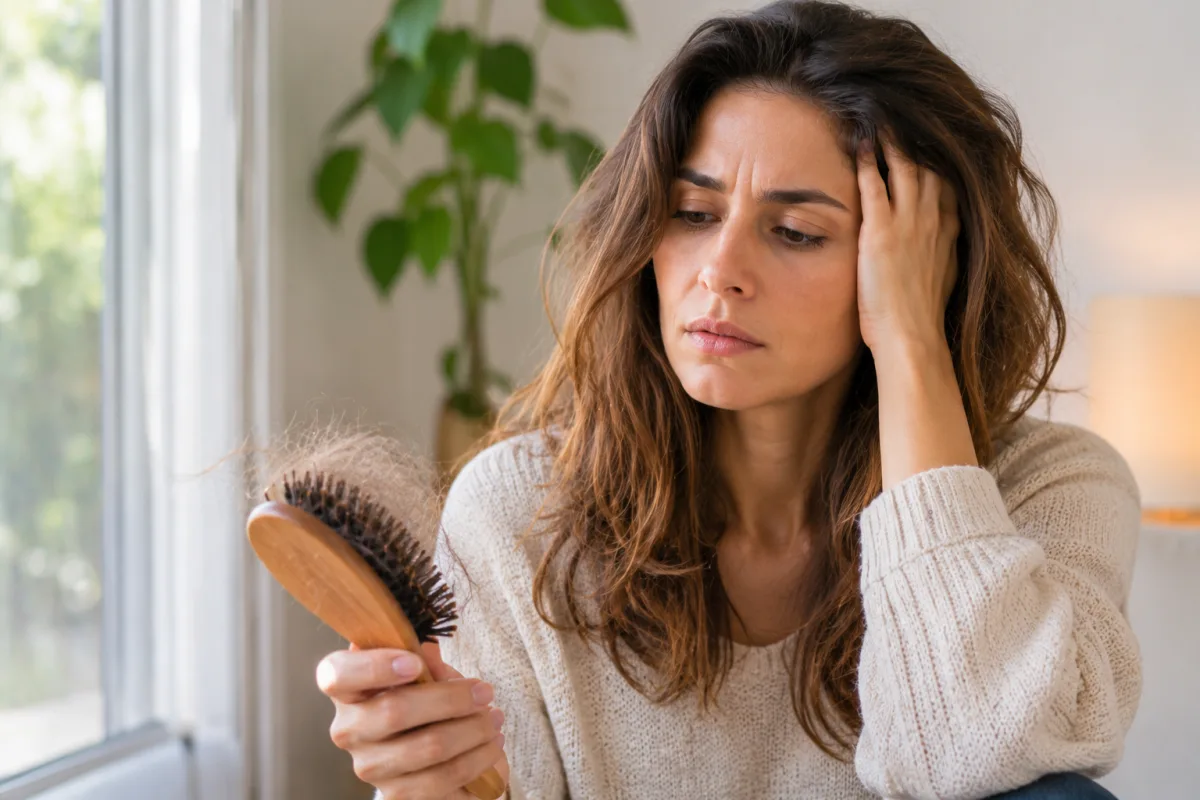
Yes, stress can make hair fall out, but not just any stress, and not overnight. The events that most clearly cause shedding are those that "shock" the body: an illness with fever, surgery, bereavement, childbirth, an intense emotional crisis. In these cases, shedding usually appears 2 to 4 months later and is temporary.
Everyday stress has a more subtle effect that is harder to measure. In mice, researchers have already shown how the stress hormone puts the cells that make hair grow on "pause". In people, the evidence is more modest, but consistent with that idea.
Stress is linked mainly to three types of hair loss: telogen effluvium, alopecia areata and trichotillomania, the urge to pull out one's hair. In this guide we explain what is known about each, why hair loss appears months later, which other causes to rule out and what helps recovery.
Three ideas to remember.
Fica por baixo do resumo, se existir uma segunda foto.
How stress acts on hair
What was discovered in the laboratory
In 2021, researchers at Harvard University published a study in the journal Nature that explained, in mice, one mechanism by which stress halts hair growth (Choi et al., 2021):
- Chronic stress raised corticosterone,the stress hormone in mice, equivalent to human cortisol.
- The hormone did not act directly on the follicle's stem cells,but on the dermal papilla, a small group of cells at the base of the follicle.
- The papilla stopped producing a molecule called GAS6,which "wakes up" the stem cells.
- Result:the follicles stayed longer in the resting phase and the hair grew less.
- Mice without adrenal glands,which do not produce this hormone, renewed their fur much faster.
- Giving GAS6 back to the skin restarted growth
What does this mean for people? It is not yet known whether the same mechanism works in humans; the researchers themselves stress that more studies are needed (NIH, 2021). But it is a plausible biological explanation for what is seen in clinical practice.
Other proposed mechanisms
- Nerves and inflammatory mediators. The follicle is surrounded by nerve endings. Under stress, they release substances, such as substance P, that activate inflammatory cells and may bring forward the resting phase.
- Immune system. Stress alters the balance of immune responses. In a study of medical students during exam periods, there was a trend towards fewer growing follicles and changes in cytokines, which returned to normal after the exams (Peters et al., 2017).
- Indirect effects. People under stress sleep worse, eat irregularly, skip meals and may lose weight. All of this also affects the hair.
Three types of hair loss linked to stress
| Type | How it shows | Relationship with stress | Course |
|---|---|---|---|
| Telogen effluvium | Diffuse shedding across the whole scalp; many hairs on the pillow, in the drain and in the brush | Appears 2 to 4 months after an intense event | Usually recovers on its own in 6 to 9 months |
| Alopecia areata | Round, smooth patches with no hair, appearing within weeks | Stress is one of the factors cited as a trigger, in an autoimmune disease | Variable; many patches recover, others need treatment |
| Trichotillomania | Areas with hair broken at different lengths, from pulling the hair out | Pulling relieves tension or anxiety | Improves with behavioural therapy |
Telogen effluvium: the most common
It is the most common form of stress-related hair loss. An intense event causes many hairs to move at the same time from the growth phase to the resting phase, and they fall out weeks to months later. The shedding is diffuse and does not cause complete baldness. We explain the mechanism in Hair loss: why it happens and what to do.
The triggers with the most evidence are physical and emotional: illness with a high fever, infections such as COVID-19, surgery, childbirth, rapid weight loss, bereavement, divorce, redundancy. When the effluvium lasts for more than 6 months, it is called chronic effluvium, and ongoing stress may contribute.
Alopecia areata: stress as a trigger
Alopecia areata is an autoimmune disease in which the immune system attacks the follicles without destroying them. It appears as round, smooth patches on the scalp, beard or eyebrows. Many patients report a period of stress before onset, and the proposed mechanisms include the loss of the follicle's natural immune protection (Malta and Corso, 2025). The relationship works both ways: alopecia areata also increases anxiety and depression. Stress is not the only cause: genetics and the immune system play the main role. Learn more in Alopecia areata: what it is and how to recognise it.
Trichotillomania: pulling out hair
It is a disorder in which the person feels a repeated urge to pull out hair from the scalp, eyebrows or eyelashes. Before pulling there is often tension or anxiety, and the act brings relief. It affects about 1% to 2% of people, usually starts around puberty and, in adults, is more common in women (MSD Manual, 2026).
It is not a "lack of willpower". First-line treatment is a form of cognitive behavioural therapy called habit reversal training, which teaches people to recognise high-risk moments and replace the gesture. Some medicines may help. On trichoscopy, the pattern of hairs broken at different lengths helps distinguish this condition from alopecia areata.
What studies in people show
- Illness as "physical stress". After COVID-19, many patients had telogen effluvium. In a case series and literature review, shedding began on average 73 to 87 days after the infection, that is, about 2.5 to 3 months (Journal of Skin, case series). This is the same interval described for other "shocks".
- Exam stress. In a study of medical students, the exam period was associated with a trend towards fewer growing follicles and with immune changes, which reversed afterwards. The differences were small and within physiological limits (Peters et al., 2017).
- Alopecia areata and mental health. Several studies show a two-way association between alopecia areata, anxiety and depression.
An honest reading of the evidence
- The effect of intense events on the hair is well established in clinical practice.
- The effect of everyday stress, moderate and ongoing, is plausible but harder to demonstrate in people.
- Often stress does not act alone: people sleep badly, eat worse, lose weight. It is the sum that weighs.
- Attributing all the hair loss to stress can delay the diagnosis of other treatable causes.
Why the shedding appears months later
This is the most common question: "the stress is over, so why is my hair falling out now?"
The explanation lies in the hair cycle:
- The eventThe body undergoes a physical or emotional shock.
- The change of phaseIn the following weeks, many hairs move from the growth phase to the resting phase, without anything being noticed.
- The restThe hairs stay anchored in the follicle for about 3 months.
- The sheddingAt the end of the rest, the hairs fall out, pushed by new ones that start to grow. This is when, 2 to 4 months later, the shedding is noticed.
- The recoveryIf the trigger does not recur, the shedding slows down and short, new hairs appear. Volume recovers in 6 to 12 months, because hair grows about 1 cm per month.
So, when you look for the cause, think about what happened 2 to 4 months before the shedding began, not the week before.
A piece of good news hidden in this process: the hairs that fall out in effluvium are, in part, pushed out by new hairs. The shedding is also a sign that the follicle is still active.
Other causes to rule out
It is easy to blame the hair loss on stress, because almost everyone goes through difficult periods. But there are treatable causes that may coexist or be the real explanation:
- iron deficiency, especially in women with heavy periods;
- thyroid disorders, which also cause anxiety, insomnia or fatigue, and can be mistaken for stress;
- androgenetic alopecia, which can be unmasked by an effluvium;
- medicines started in the previous months;
- weight loss or changes in diet;
- postpartum or menopause;
- scalp conditions, such as seborrhoeic dermatitis or psoriasis.
Find out which tests can help in Blood tests for hair loss: what to ask for.
What helps recovery
Giving the cycle time
In telogen effluvium, the most important thing is to remove or reduce the trigger and allow time. The shedding usually slows down after a few months, and the hair grows back.
Looking after the body
- Getting enough sleep, with regular hours. Sleep is one of the first things sacrificed in periods of stress. See Sleeping well and hair: what rest changes.
- Eating regularly, with protein at every meal. Stress often leads to skipping meals. See Diet and hair loss.
- Regular physical activity, which reduces perceived stress and improves sleep.
- Correcting deficiencies confirmed by blood tests.
Managing stress
There are no studies proving that a stress management technique makes hair grow. But reducing chronic stress has well-established benefits for general health and may reduce new episodes:
- slow breathing and short breaks throughout the day;
- walking, especially outdoors;
- limiting screens before bed;
- talking to people close to you;
- psychological support when stress becomes persistent or disabling.
Practical ideas in How to lower stress effortlessly.
Medical treatment, when indicated
- Effluvium that does not recover, or associated androgenetic alopecia: may justify treatments such as minoxidil, after assessment.
- Alopecia areata: has specific treatments, such as topical corticosteroids and, in severe cases, newer oral medicines.
- Trichotillomania: habit reversal training and, at times, medication, with the support of psychology or psychiatry.
The vicious circle: anxiety and hair loss
Seeing hair fall out causes anxiety, and anxiety increases stress. Many people start counting hairs, avoiding washing their hair or spending a lot of time at the mirror, which feeds the worry even further.
Some ideas that help break the cycle:
- Knowing that effluvium shedding is usually temporary and does not cause complete baldness.
- Carrying on washing your hair normally. Washing does not increase hair loss; it only releases hairs that were about to fall anyway. Avoiding washing makes them build up and look like more in one go.
- Not counting hairs every day. Prefer a photograph every 3 months, with the same light and the same angle.
- Having a diagnosis. Knowing the cause and having a plan greatly reduces uncertainty.
- Asking for help if worry about your hair is affecting your sleep, work or social life.
Hair loss has a real emotional impact, especially in women. Talking about it, with a doctor or a psychologist, is part of the treatment.
When to seek a medical assessment
If stress, anxiety or low mood are persistent, also speak to your family doctor or a psychologist.
At Luxmed, the Hair Medicine consultation assesses the type of hair loss with trichoscopy and, when indicated, blood tests, to distinguish stress-related effluvium from other causes and define the most suitable plan.
Talk to us
The assessment is a conversation, with no obligation. Tell us what concerns you and our team will reply.
Telephone 214 044 241 · info@luxmed.pt
This article is for information only and does not replace a medical consultation.
Frequently asked questions
Does stress really make hair fall out?
Yes. Intense physical or emotional events can trigger telogen effluvium. Everyday stress has a more subtle effect, and generally adds to other factors, such as sleep and diet.
How long after stress does hair fall out?
Usually 2 to 4 months later. That is why many people do not make the connection.
Does hair that fell out because of stress grow back?
In telogen effluvium, yes: the follicles are still alive. The shedding slows down within a few months and volume recovers in 6 to 12 months.
Does anxiety cause bald patches?
Round, smooth patches are typical of alopecia areata, an autoimmune disease in which stress may be a trigger. Patches with broken hair may point to trichotillomania. Both deserve assessment.
Can stress cause grey hair?
In mice, intense stress depleted the cells that give colour to the fur. In people there are similar observations, but genetics and age are the main factors.
Which vitamins should I take for stress-related hair loss?
It only makes sense to correct confirmed deficiencies, such as iron or vitamin D. Supplements "for the hair" without a deficiency have no demonstrated benefit, and biotin can distort blood tests.
If I reduce stress, does the shedding stop right away?
Not immediately: the hairs that are going to fall had already entered the resting phase months earlier. But reducing the trigger prevents new episodes and helps recovery.
Scientific references 7
- Choi S, Zhang B, Ma S et al. Corticosterone inhibits GAS6 to govern hair follicle stem-cell quiescence. Nature. 2021;592(7854):428-432. Registo
- National Institutes of Health. How stress causes hair loss. NIH Research Matters, 2021. Artigo
- Peters EMJ, Müller Y, Snaga W et al. Hair and stress: a pilot study of hair and cytokine balance alteration in healthy young women under major exam stress. PLoS One. 2017;12(4):e0175904. Artigo
- Telogen effluvium in patients recovering from COVID-19 (série de casos e revisão da literatura). Journal of Skin. Artigo
- Malta M Jr, Corso G. Understanding the association between mental health and hair loss. Cureus. 2025;17(5):e84777. Artigo
- Phillips KA, Stein DJ. Hair-pulling disorder (trichotillomania). MSD Manual, 2025, atualizado em 2026. Página
- DermNet. Telogen effluvium. Artigo


Keep exploring