Algés, Oeiras Mon to Sat · 09:00 to 13:00 and 14:00 to 19:00
WhatsApp Book a consultation
  1. Home
  2. Blog
  3. Sleep and hair

Sleep and hair: what rest changes

Does sleep affect hair? See what studies show about sleep, stress and melatonin, how to sleep better and how to protect your hair at night.

Rúben BritoAuthor
Dr Michelle CampagnoliClinical review · OM no. 69467
11 min read
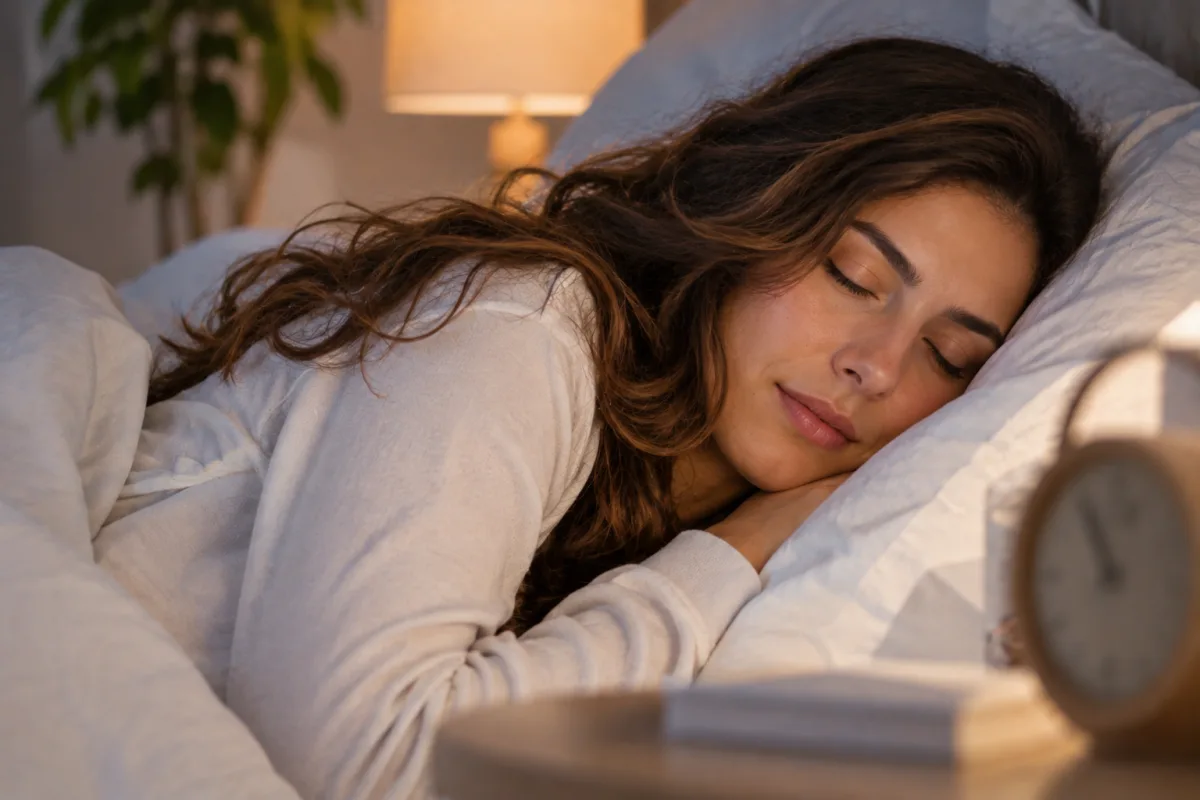
Woman sleeping peacefully in a light-coloured bed, with a lamp on and an alarm clock on the bedside table
In this article
  1. In short
  2. How much we should sleep
  3. What happens while we sleep
  4. What is known about sleep and hair
  5. Melatonin and hair: what the studies say
  6. When the sleep problem has another cause
  7. How to sleep better
  8. Caring for your hair at night
  9. When to seek a medical assessment
  10. Frequently asked questions

Poor sleep leaves visible marks on the face, but hair may feel it too. The honest answer is this: there are no studies showing that sleeping little, on its own, causes hair loss in people. But several pieces fit together. The hair follicle has its own biological "clock", synchronised with day and night. Poor sleep goes hand in hand with stress, which is a known trigger of hair loss. And sleep disorders are associated with a higher risk of alopecia areata.

In practice, sleeping well is one of the foundations for hair to recover after a difficult period, and for reducing new episodes of shedding. In this guide we explain what is known, what melatonin can and cannot do, how to sleep better with evidence-based strategies and how to protect your hair during the night.

In 30 seconds

Three ideas to remember.

1Direct evidence is limitedThere are no studies proving that sleeping little, on its own, makes hair fall out in people.
2But there are good biological reasonsThe follicle has its own clock, poor sleep goes hand in hand with stress, and the risk of alopecia areata is higher.
3Sleep well and protect your hair at nightAt least 7 regular hours; a smooth pillowcase, hair tied up loosely and dry roots.
Imagem opcional · abertura1200 × 800 px
Fica por baixo do resumo, se existir uma segunda foto.

How much we should sleep

The American Academy of Sleep Medicine and the Sleep Research Society recommend that adults sleep at least 7 hours a night, regularly, to promote health (Watson et al., 2015). Habitually sleeping less than 7 hours is associated with more health problems, including weight gain, diabetes, high blood pressure, depression and reduced immunity.

It is not only about quantity:

  • Regularity: go to bed and get up at the same time, including at weekends.
  • Continuity: waking up many times fragments sleep, even if the total seems sufficient.
  • Quality: feeling rested on waking is a good indicator.

What happens while we sleep

During sleep, the body regulates several hormones that matter for skin and hair:

  • cortisol, the stress hormone, falls at night and rises in the morning; short or fragmented sleep disrupts this rhythm;
  • growth hormone is released mainly during deep sleep;
  • melatonin, produced in the dark, signals to the body that it is night and also acts on the skin;
  • the immune system and cell repair processes follow a day-and-night rhythm.

What is known about sleep and hair

The follicle has its own clock

A study published in PLoS Genetics showed that circadian clock genes, which regulate the 24-hour rhythm, are active in the hair follicle and follow the hair cycle. In mice lacking one of these genes (Bmal1), entry into the hair growth phase was clearly delayed, because of a block in cell division (Lin et al., 2009). The cycle did eventually move forward, but later.

This suggests that the body's "clock" influences when the follicle starts to grow. It has not yet been shown whether irregular sleep or shift work has the same effect on human hair.

Sleep disorders and alopecia areata

A large population study in Taiwan, with more than 93,000 people with sleep disorders and more than 5,600 with alopecia areata, found an association in both directions (Dai et al., 2020):

How many times higher the risk is

Adjusted relative risk, Taiwan study

Insomnia → alopecia areata4.8 times
Sleep apnoea → alopecia areata3.9 times
Alopecia areata → insomnia4.2 times
Alopecia areata → sleep apnoea3.8 times

This is an observational study, which shows an association and does not prove cause. One possible explanation is that poor sleep alters the immune system and the stress axis; another is that anxiety caused by hair loss impairs sleep.

Sleep, stress and telogen effluvium

Poor sleep and stress feed each other. Intense stress is a known trigger of telogen effluvium, the diffuse shedding that appears 2 to 4 months after a "shock". In mice, the stress hormone put follicles on pause (Choi et al., 2021). Here, sleep works mostly as part of the stress picture, rather than as an isolated cause. We explain this mechanism in Stress and hair loss: what is known.

Sleep and habits

People who sleep little tend to crave high-calorie foods, skip breakfast, exercise less and consume more caffeine and alcohol. Taken together, these habits also weigh on the hair.

In summary

  • Direct evidence that sleeping little makes hair fall out in people is limited.
  • There is a good biological basis and consistent associations that make sleep a plausible and relevant factor.
  • Sleeping well has proven benefits for health in general, so it is worthwhile regardless of hair.

Melatonin and hair: what the studies say

Melatonin is known as the "sleep hormone", but it is also produced in, and acts on, the skin and the hair follicle. That is why it has been studied for hair loss, especially when applied directly to the scalp.

Topical melatonin

In a randomised, double-blind trial with 40 women with diffuse hair loss or androgenetic alopecia, daily application of a 0.1% melatonin solution for 6 months increased the percentage of hairs in the growth phase compared with placebo, in some areas of the scalp (Fischer et al., 2004). Blood melatonin levels stayed within the normal range.

How to read this result:

  • it is a small, pilot study;
  • the effect was measured in the percentage of growing hairs, not in density or in how the hair looks;
  • significant results appeared only in some areas and some subgroups;
  • it is not a first-line treatment in the European guidelines for androgenetic alopecia.

Melatonin tablets for sleeping

There is no evidence that taking oral melatonin makes hair grow. For insomnia, the 2023 European guideline does not recommend immediate-release melatonin, the best-selling kind, and accepts prolonged-release melatonin only in adults aged 55 and over, for up to 3 months (Riemann et al., 2023). Before taking it, talk to your doctor, especially if you take other medicines.

When the sleep problem has another cause

Some conditions affect sleep and hair at the same time. They are worth considering when there is persistent tiredness and hair loss:

  • Thyroid disease. Hyperthyroidism causes insomnia, anxiety and palpitations; hypothyroidism causes drowsiness and tiredness. Both can cause diffuse hair loss.
  • Iron deficiency. It causes tiredness and is associated with restless legs, which disturb sleep. Low ferritin is also associated with hair loss in women.
  • Sleep apnoea. Loud snoring, pauses in breathing noticed by whoever sleeps next to you, daytime sleepiness and morning headaches. In the Taiwan study, it was associated with a higher risk of alopecia areata.
  • Menopause. Hot flushes and night sweats fragment sleep, and hormonal changes affect hair. See Menopause and hair loss: what is known.
  • Postpartum. Interrupted nights add to the normal postpartum shedding. See Hair loss after childbirth.
  • Anxiety and depression. They affect sleep and are associated with several forms of hair loss.

A blood count, ferritin and TSH help clarify many of these situations. See Blood tests for hair loss: what to ask for.

How to sleep better

For people with persistent insomnia

The European insomnia guideline, updated in 2023, recommends cognitive behavioural therapy for insomnia (CBT-I) as the first treatment, which can be done in person or through supervised digital programmes. The most effective components are sleep restriction and stimulus control. "Sleep hygiene" advice on its own is not considered effective for treating chronic insomnia (Riemann et al., 2023). Medicines are kept for when CBT-I is not enough, and as a rule for a short time.

Habits that help day to day

Even though they do not treat established insomnia, these habits help protect sleep:

  1. Regular times for going to bed and for waking up, every day.
  2. Natural light in the morning, in the first minutes after waking; it helps set the biological clock.
  3. Caffeine only until early afternoon.
  4. Alcohol in moderation: it helps you fall asleep, but fragments sleep in the second half of the night.
  5. A light dinner, at least 2 to 3 hours before bed.
  6. Regular exercise, preferably not in the hours immediately before sleep.
  7. A dark, quiet and cool bedroom.
  8. Screens away in the last hour before bed, especially stimulating content.
  9. The bed is for sleeping. If you do not fall asleep in about 20 minutes, get up, do something calm in low light and go back when you feel sleepy.
  10. A wind-down routine: a warm bath, reading, slow breathing.

Shift work

People who work shifts often have a disrupted biological clock. It helps to protect a dark, quiet block of sleep, keep times as regular as possible within each shift, and take particular care with diet and stress.

Caring for your hair at night

Besides sleep itself, what happens to hair during the night can cause breakage, which is often mistaken for hair loss.

  • Satin or silk pillowcase. It reduces friction and tangling, especially in long, curly or weakened hair. It does not treat hair loss, but it may reduce breakage.
  • Tie hair up loosely. A loose braid or a high, loose bun, with a soft hair tie or fabric scrunchie. Avoid tight ponytails and hair ties with metal: repeated traction can cause traction alopecia.
  • Avoid sleeping with very wet hair. Wet hair is more elastic and fragile, and breaks more easily with friction. Prolonged dampness may also encourage dandruff in people prone to it. Dry at least the roots before going to bed.
  • Do not sleep with extensions or very tight braids without loosening or protecting them.
  • Light night-time products. A little leave-in conditioner on the ends can help dry hair; avoid applying heavy oils to the scalp if you tend to have an oily scalp or seborrhoeic dermatitis.

If you notice many hairs on your pillow every morning for weeks, it may be true hair loss and not just breakage. In that case, an assessment is worthwhile.

When to seek a medical assessment

For sleep, talk to your family doctor if:

Sleep signs

Tick what applies to you.

For your hair, book an appointment if:

Hair signs

Tick what applies to you.

At Luxmed, the Hair Medicine consultation assesses the cause of hair loss with trichoscopy and, when indicated, blood tests, and takes factors such as sleep, stress and diet into account in the treatment plan.

Talk to us

The assessment is a conversation, with no obligation. Tell us what concerns you and our team will reply.

Telephone 214 044 241 · info@luxmed.pt

This article is for information only and does not replace a medical consultation.

Frequently asked questions

Does lack of sleep make hair fall out?

There are no studies that directly prove it in people. But poor sleep is associated with stress, which is a known trigger of hair loss, and sleep disorders are associated with a higher risk of alopecia areata.

How many hours should I sleep?

Adults should sleep at least 7 hours a night, regularly.

Does melatonin make hair grow?

A small study with melatonin applied to the scalp showed an increase in hairs in the growth phase. Melatonin tablets have no evidence for hair, and are not generally recommended for insomnia.

Is sleeping with wet hair bad?

Wet hair breaks more easily with friction from the pillow. Dry at least the roots before going to bed.

Does a silk pillowcase prevent hair loss?

It does not treat hair loss, which starts in the follicle, but it reduces friction and may lessen breakage and tangling.

Is sleeping with hair tied up bad?

If it is loose, no. Avoid tight hairstyles every night, because repeated traction can cause traction alopecia.

Do shift workers lose more hair?

There are no clear studies in people. But shift work disrupts the biological clock, sleep and diet, and it is worth protecting these habits.


Scientific references 6
  1. Lin KK, Kumar V, Geyfman M et al. Circadian clock genes contribute to the regulation of hair follicle cycling. PLoS Genet. 2009;5(7):e1000573. Artigo
  2. Dai YX, Tai YH, Chen CC et al. Bidirectional association between alopecia areata and sleep disorders: a population-based cohort study in Taiwan. Sleep Med. 2020;75:112-116. Registo
  3. Fischer TW, Burmeister G, Schmidt HW, Elsner P. Melatonin increases anagen hair rate in women with androgenetic alopecia or diffuse alopecia: results of a pilot randomized controlled trial. Br J Dermatol. 2004;150(2):341-345. Registo
  4. Riemann D et al. The European Insomnia Guideline: an update on the diagnosis and treatment of insomnia 2023. J Sleep Res. 2023;32(6):e14035. PDF
  5. Watson NF et al. Recommended amount of sleep for a healthy adult: a joint consensus statement of the American Academy of Sleep Medicine and Sleep Research Society. Sleep. 2015;38(6):843-844. Artigo
  6. Choi S et al. Corticosterone inhibits GAS6 to govern hair follicle stem-cell quiescence. Nature. 2021;592(7854):428-432. Registo
Written byRúben BritoOperial Development
Clinical reviewDr Michelle CampagnoliOM no. 69467 · Doctor with Competence in Aesthetic Medicine.View profile →

Book a consultation

Book your consultation

Choose how you prefer to get in touch. We will arrange the assessment consultation with Dr Michelle Campagnoli.

Booking through the websiteAssessment consultationTalk to our assistant on WhatsApp and ask for the current price of the assessment.

New Life Miraflores, Algés · Office Center, R. Santa Teresa do Menino Jesus n.º 6, 9.º C, 1495-048

Your details are used only for this contact. Any treatment depends on a prior medical assessment.

Request an appointmentIt takes less than a minute.
Speciality
You do not need to go into detail. The doctor will talk to you during the consultation.
Request received. Our team will contact you as soon as possible.
CallAssistantAvailableBook