


- Home
- Facial aesthetics
- PDRN
- PDRN before and after
PDRN before and after: results and number of sessions
PDRN progressively improves texture, elasticity, hydration and the appearance of pores. The usual protocol is 3 to 4 sessions, spaced 2 to 4 weeks apart.
 Luxmed TeamAuthor
 Dr Michelle CampagnoliClinical review · OM no. 69467
In this article
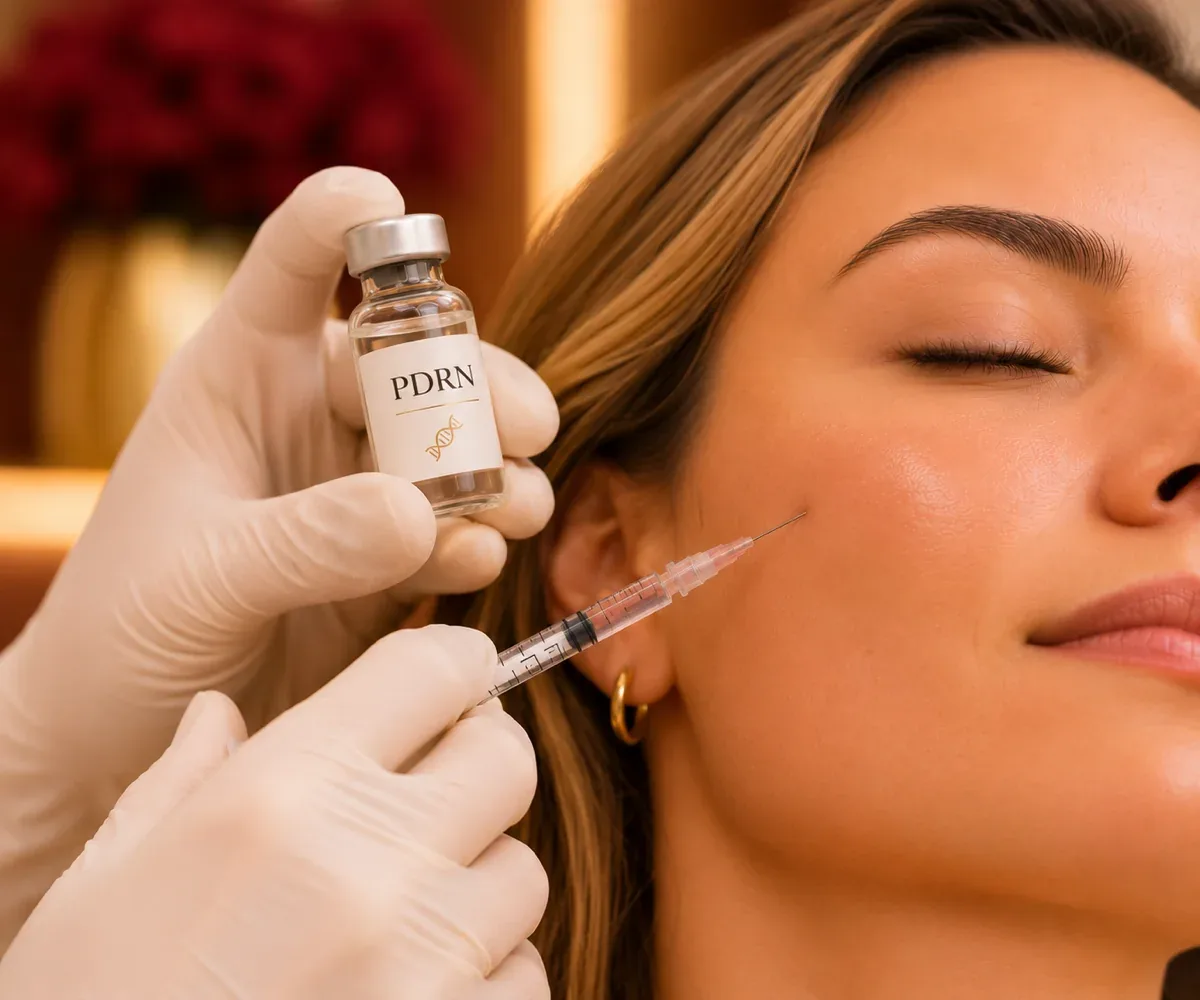
PDRN (polydeoxyribonucleotide), often called ‘salmon DNA’, is a skin-regeneration treatment. It does not change facial volume or produce an overnight effect: PDRN before-and-after results develop over a series of sessions and are measured in terms of skin quality. This article explains what usually changes, how long it takes and how many sessions are needed.
Three ideas to remember.
PDRN before and after: what usually changes
| Skin appearance | What you can expect |
|---|---|
| Texture | Smoother, more even skin |
| Elasticity | Skin that regains its shape more readily |
| Hydration | Less tightness |
| Pores | Less noticeable |
| Redness and sensitivity | Tends to improve due to the anti-inflammatory effect |
| Deep wrinkles and volume | Little change |
In a randomised, double-blind trial, 27 people received a polynucleotide filler on one side of the eye area and non-cross-linked hyaluronic acid on the other, in 3 sessions 2 weeks apart. Overall improvement was similar, but the side treated with polynucleotides showed greater improvements in elasticity, hydration, roughness and pore volume, with no serious adverse effects (Lee et al., 2022).
How many sessions are needed
| Stage | Sessions | Interval |
|---|---|---|
| Initial treatment | 3 to 4 | 2 to 4 weeks |
| Maintenance | 1 | Every few months |
The exact number depends on the skin, age and goal. Sensitive skin or skin recovering from a procedure may require a different protocol.
Results timeline
| Moment | What to expect |
|---|---|
| Day of the session | Small bumps at the injection sites and redness |
| 1 to 3 days | The bumps subside; bruising may occur |
| After the 2nd session | First visible improvement in texture and radiance |
| 1 to 3 months after the final session | More complete result |
How to obtain reliable before-and-after images
- Photographs before the first session, without make-up and in the same lighting.
- Photographs with side lighting to show texture and pores.
- Repeat 1 month after the final session, under the same conditions.
The limits of the evidence
PDRN has a solid experimental basis, particularly in wound healing, through adenosine A2A receptors (Squadrito et al., 2017). In aesthetics, clinical studies are more recent, involve few participants and often use long-chain polynucleotide products, which belong to the same family but are not exactly the same.
At Luxmed Clinic
At Luxmed in Algés, near Lisbon, we define a PDRN protocol tailored to each person’s skin and take photographs before and after the course of treatment to assess the results objectively.
Talk to us
The assessment is a conversation, with no obligation. Tell us what concerns you and our team will reply.
This article is for information purposes and is not a substitute for a consultation. The results of any treatment vary from person to person. Injectable treatments must be performed by doctors with specific training.
Frequently asked questions
When are PDRN results visible?
Generally, after the second or third session.
How long does it last?
It varies from person to person, which is why maintenance is recommended.
Does PDRN hurt?
With anaesthetic cream, you will mainly feel mild pinpricks.
Can I have PDRN if I have acne?
It may be considered for mild acne; if the acne is inflamed, it is preferable to bring it under control first.
Scientific references 2
- Lee YJ, Kim HT, Lee YJ, et al. Comparison of the effects of polynucleotide and hyaluronic acid fillers on periocular rejuvenation: a randomized, double-blind, split-face trial. J Dermatolog Treat. 2022;33(1):254-260. doi:10.1080/09546634.2020.1748857 Artigo
- Squadrito F, Bitto A, Irrera N, et al. Pharmacological activity and clinical use of PDRN. Front Pharmacol. 2017;8:224. doi:10.3389/fphar.2017.00224 Artigo
Editing and development: Rúben Brito · Operial Development
Keep exploring