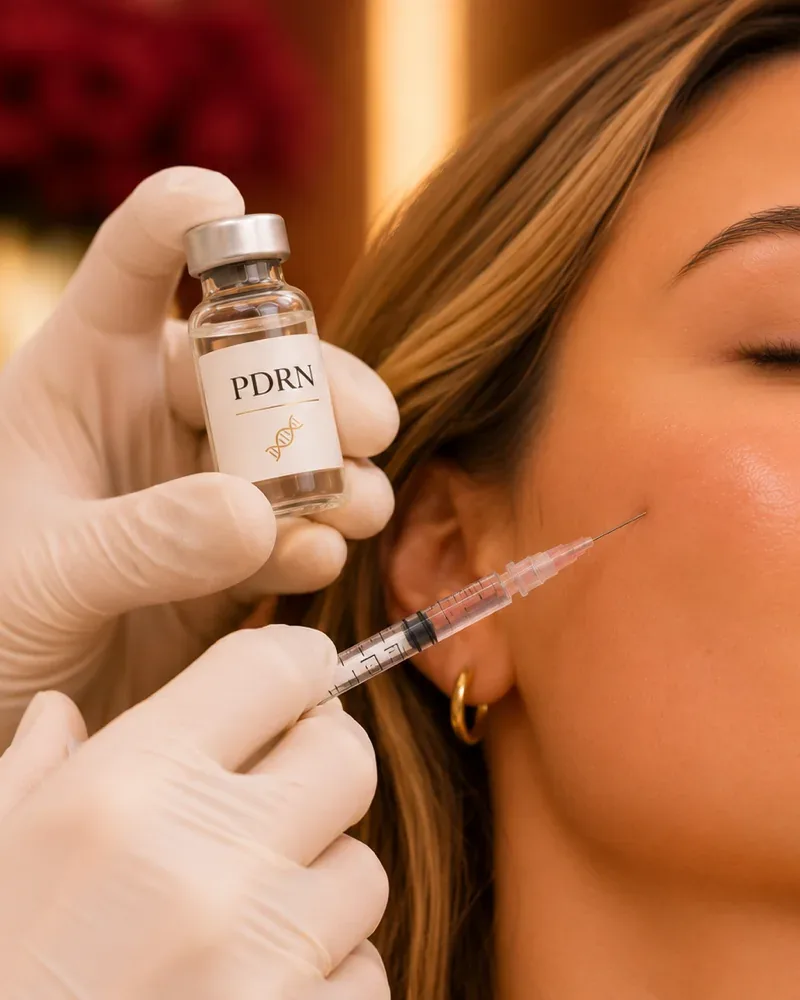
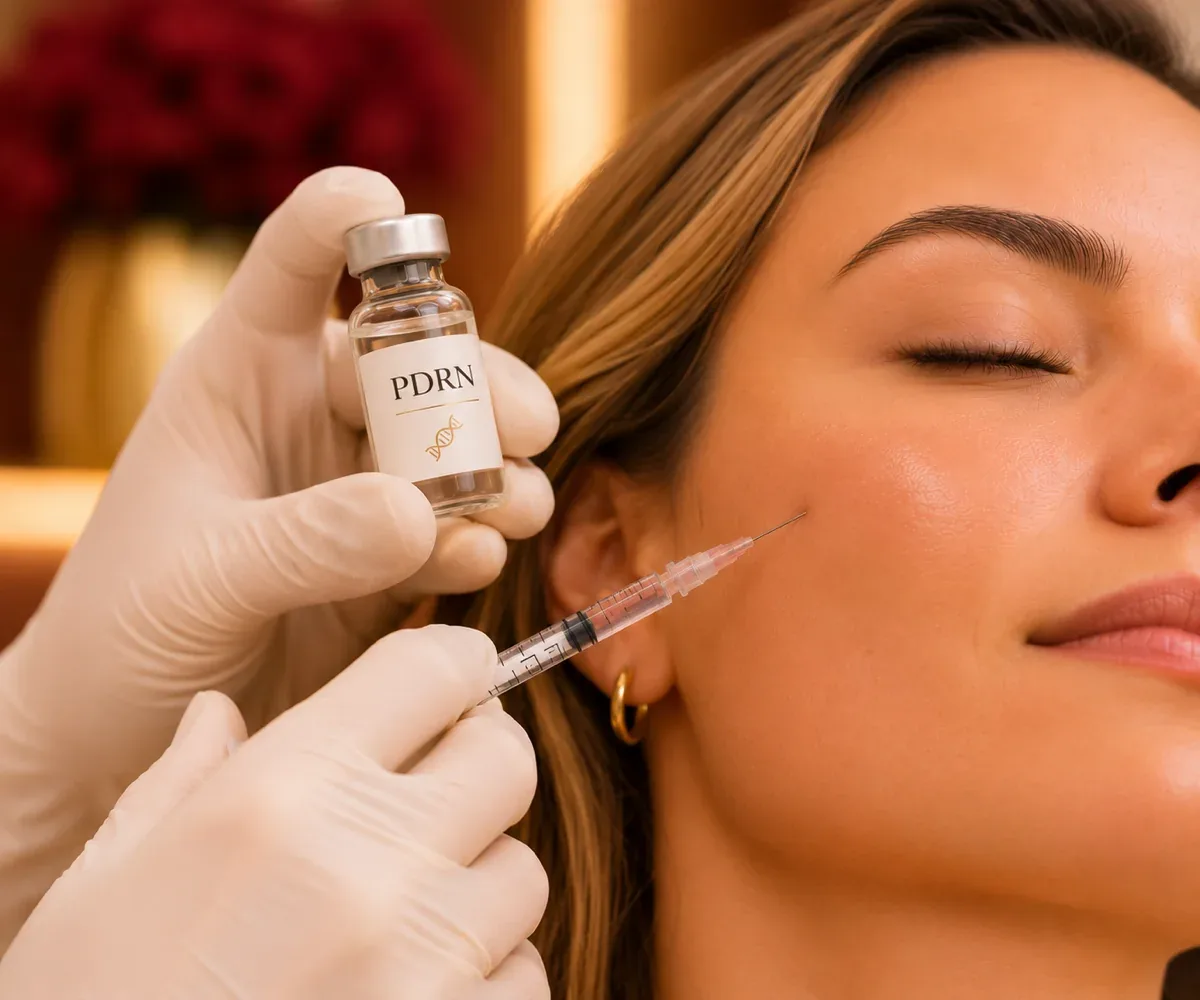
What is PDRN, where does it come from and how does it work?
PDRN stands for polydeoxyribonucleotide: short, highly purified DNA fragments, usually obtained from reproductive cells of salmon or trout. It binds to the adenosine A2A receptor and supplies cells with nucleotides, which, according to the literature, moderates inflammation and supports tissue repair. It is well studied in wound healing. In facial aesthetics, results vary and the evidence is limited, so the doctor will assess with you whether it is appropriate.
Is PDRN the same as polynucleotides?
They are very similar molecules, and the two names are often used interchangeably. A 2025 review proposes reserving ‘PDRN’ for shorter DNA chains and ‘polynucleotides’ for longer ones (from around 1500 kDa). Another 2025 review describes the longer chains as acting mainly on remodelling the skin matrix and the shorter chains mainly through adenosine receptors. This distinction is still debated: what matters is the specific product, and the product and brand are selected during the assessment.
What about exosomes? Are they the same thing?
No. Exosomes are small vesicles released by cells, whereas PDRN is purified DNA. In the United States, the FDA stated in December 2019 that it had not approved any exosome products, warned about their use in clinics and asked for adverse events to be reported. A series of four cases published in 2025 described persistent inflammation, nodules and scarring after cosmetic exosome products were injected into the skin, and stated that this route of administration is off-label and unregulated in many countries. Before accepting an exosome injection, ask what the product is, what authorisation it has and what data are available. The doctor will explain what she recommends and why.
How does it differ from a skinbooster or microneedling?
A skinbooster hydrates the skin with hyaluronic acid, while microneedling stimulates it through micro-injuries. PDRN works differently: it aims to support cell repair with DNA fragments. They may be combined when appropriate, in separate sessions, with the doctor determining the order and interval. If the skin needs volume, muscle relaxation or significant firming, other treatments are more suitable.
What about peptide creams?
Peptide creams are at-home skincare, with no needles or marks, and can be used every day. PDRN is applied to the dermis by the doctor, involving injections and a short recovery, and has been studied in wound-healing trials, although evidence for the face is limited. The two do not replace one another: PDRN does not remove the need for daily skincare or sunscreen. Clínica Luxmed does not consider creams a treatment, and at the assessment the doctor will tell you whether PDRN is appropriate for you.
How is it done? Does it hurt?
The doctor applies small amounts of the product to the dermis at multiple points with a fine needle. There are pricks and some discomfort, which is more noticeable in thin areas, such as around the eyes. Sensitivity varies from person to person, and during the assessment the doctor will explain how it is carried out and how discomfort is managed.
How many sessions are needed, and at what intervals?
Studies generally describe courses of 3 to 4 sessions at intervals of 2 to 4 weeks, and protocols differ according to the area and product. At the clinic, the number and interval are established during the assessment, based on the skin and what is to be improved, and may be adjusted according to the response.
What changes before and after? Are results guaranteed?
There are no guarantees. Reviews generally describe improvements in fine lines, texture and elasticity, with moderate to high satisfaction, but they are based on a small number of small studies of low to moderate quality. The expected outcome is a gradual, subtle improvement in the skin’s appearance: the shape of the face does not change, and no specific ‘before and after’ result is promised. The doctor will tell you what is realistic in your case.
Can I have PDRN after laser treatment or a peel?
The literature describes the use of PDRN to support skin recovery after laser treatment, a peel, microneedling and radiofrequency, and some studies report less redness and faster re-epithelialisation. However, the evidence in aesthetics is limited: the studies are small and use different products and protocols. The right timing depends on the procedure and the condition of the skin, and is decided by the doctor. Do not apply anything on your own to skin that is healing.
Does PDRN replace fillers or botulinum toxin?
No. PDRN does not add volume or relax muscles: it acts on skin quality. There are other treatments for expression wrinkles, folds or loss of volume, which the doctor will explain during the assessment. They can be complementary when appropriate.
When will I see results and how long do they last?
Studies generally assess the skin after about 3 months, and some people notice an improvement during the course. How long the effect lasts and what maintenance is appropriate are not yet well established: studies have short follow-up periods. The doctor will discuss what it is reasonable to expect and any maintenance, if appropriate.
Is the evidence robust?
It depends on the use. For wound healing, there are controlled trials and reviews: in a trial of 216 people with diabetic foot ulcers, complete healing at 8 weeks was 37.3% with PDRN and 18.9% with placebo. In facial aesthetics, a 2025 systematic review of polynucleotides found nine studies, while another from 2026 on randomised trials found seven involving a total of 183 people; both call for larger studies. Results therefore vary and the evidence is limited, and the doctor will assess with you whether it is appropriate.
What are the risks and side effects?
In studies, the reported effects were local pain, swelling, itching, bruising and redness, generally mild and resolving within about a week, and the reviews do not mention any serious effects. As PDRN is derived from fish, anyone with a fish allergy should mention it. If you experience severe pain, pus, fever, spreading redness or signs of an allergic reaction, contact the clinic and, if it is serious, call 112; outside opening hours, you can call SNS 24 (808 24 24 24).
Who should not have it?
Anyone who has a fish allergy (especially to salmon or trout), is pregnant or breastfeeding, or has an infection, active herpes or inflammatory acne in the area. Active autoimmune diseases, immunosuppression, anticoagulant medication and a tendency to develop keloids require careful assessment. The doctor assesses each case individually.
Is an assessment needed first? Is there a charge?
Yes. All treatments at Clínica Luxmed begin with an assessment consultation with the doctor, during which she determines whether the treatment is appropriate for you and what alternatives are available. The cost of the assessment is deducted if you decide to proceed with treatment.
How should I prepare, and what is recovery like?
Come with clean skin, preferably without make-up, and mention allergies (especially to fish), herpes, recent infections and medication, including anticoagulants. Afterwards, redness, mild swelling and sometimes small bruises are normal. A consensus of Italian experts suggests avoiding direct sunlight for the first 48 hours. If you have an important event, mention it during the assessment so that we can schedule the sessions accordingly.