Algés, Oeiras Mon to Fri · 09:00 to 13:00 and 14:00 to 19:00 · Sat · 09:00 to 14:00
WhatsApp Book a consultation

Facial aesthetics

Fine lines and expression wrinklesWhen lines appear on the forehead, around the eyes or around the mouth and you want to understand what they are and what can be done

Not all lines on the face are the same. There are very fine, superficial lines, which dry skin and sun bring out and which can improve with simple care; there are expression lines, which form when we smile, frown or squint; and there are lines that, with the years, can already be seen even with the face at rest. Each calls for different things, and it is this distinction that decides what makes sense to do, starting with the first lines: sunscreen, hydration and habits. Here we explain how to tell them apart, what usually lies behind them, what the evidence says about skinbooster, microneedling and botulinum toxin, and when a medical assessment is advisable before any treatment, at Clínica Luxmed, in Algés.

Reviewed by Dr Michelle Campagnoli, clinical director

  • 3types of line: fine, expression and at rest
  • 1assessment, always first
  • Nocommitment
Fotografia · linhas-finas-e-rugas-de-expressao-hero800 × 1000 px · vertical 4:5Mulher de uns 45 anos, de perfil, ao ar livre ao fim da tarde, com a luz a bater de lado, a olhar o horizonte com ar sereno e um leve sorriso; retrato discreto de meio-corpo, sem close do rosto nem das linhas

How to recognise it

Are they fine lines or expression wrinkles?

Not all lines are the same: some are just on the surface, others come from movement, others have already become marked, and the cause changes what makes sense to do. These signs help you understand what is going on before the assessment.

Tick what you recognise0/7

Tick the signs you recognise in your case. This is not a diagnosis, it is only meant to give you an idea.

Have you noticed a patch or a lesion on the skin of the face that grows, changes colour or outline, bleeds or does not heal? You need a dermatological assessment before any treatment. Do you have a sudden drooping on one side of the face, difficulty speaking or weakness in an arm? Call 112 immediately. If you have already had an injectable treatment and have severe pain, pale skin or skin with purplish patches, changes in vision, a severe headache or facial weakness, call 112 immediately and contact the clinic that injected. Out of hours, call SNS 24: 808 24 24 24.

Fotografia · linhas-finas-e-rugas-de-expressao-consulta1083 × 1300 px · vertical 5:6Mãos da médica de bata branca a passar uma caneta sobre uma ficha de avaliação, ao lado de um espelho de mão pousado numa secretária clara, com uma paciente desfocada em segundo plano; luz natural de consultório, enquadramento discreto, sem close do rosto
Frame for the consultation photograph. The dots mark what the doctor assesses.

Why it happens

What may lie behind the lines on the face

There is almost always more than one cause at the same time, and what looks like a wrinkle may be, in part, dry skin. Choose a situation to see how it fits into the picture and what usually helps.

The repeated movement of the muscles

Every time we frown, smile or squint, the skin folds in the same place. In young skin, the line unfolds afterwards; with the years, the skin loses elasticity and the fold no longer disappears completely, and the expression line can also be seen at rest. These are the lines of the forehead, the glabella (between the eyebrows) and the corners of the eyes.

What weighs on it

Frowning and squinting many times a day, especially in the sun or at a screen, without suitable glasses.

What helps

Sunglasses and, if you need them, vision correction; the doctor explains whether it makes sense to treat the muscle, and what that can and cannot do.

Normal or to be assessed

Common lines or something to assess

Most lines on the face are part of normal skin ageing. But some situations call for an assessment before any treatment, because the line is only the visible part.

  • What it looks like. Fine, superficial lines, lines that appear with movement and lessen at rest, or creases that are already marked, symmetrical, without pain, without swelling and without lesions on the skin.

  • A clue, not a diagnosis. Gently stretch the skin with your fingers: if the line disappears, it is mainly surface or dehydration; if it persists, it is a deeper crease. Frowning and relaxing shows the part that comes from the muscle.

  • What the clinic does. The doctor listens to the history, examines the face at rest and in movement, distinguishes the type of line and says what makes sense to propose, and what does not, without promising results.

  • At home. Sunscreen every day, a moisturiser, the right habits and a realistic view of what the skin can change.

Do you have a sudden drooping on one side of the face, difficulty speaking, severe pain in the eye, a change in vision, or, after an injection in the face, pale skin or skin with purplish patches and a severe headache? Call 112 immediately and tell the clinic that injected. Only a doctor can use hyaluronidase, which dissolves hyaluronic acid, and you should not massage the area on your own. If in doubt, out of hours you can call SNS 24: 808 24 24 24.

Book an assessment

What the clinic may consider

Options for softening the lines

Before any procedure come the first lines of defence: sunscreen every day, hydration, stopping smoking and, if it makes sense, a retinoid product recommended by a professional. Only then is a procedure considered. For this concern, the clinic associates three options: skinbooster, microneedling and botulinum toxin, and the choice depends on the type of line. Skinbooster is intended for skin quality, that is, hydration, radiance and superficial lines, and reviews describe improvements, but with small studies and very different protocols. Botulinum toxin relaxes the muscle and is the one with the most evidence for expression lines of the forehead, between the eyebrows and around the eyes, but it does not treat fine lines caused by dehydration or fill creases. Microneedling stimulates skin renewal through small controlled injuries and is described as having a good level of satisfaction and few adverse effects, but the techniques and the number of sessions vary widely between studies, so it does not appear on a card and is explained in the frequently asked questions. Results vary, are not permanent and are generally temporary.

Book an assessment
Dr Michelle Campagnoli, clinical director of Clínica Luxmed

First step

Assessment consultation

The doctor listens to what you are experiencing, examines your case and explains the suitable options. No treatment begins without this consultation.

May be considered when

you want to understand the cause and decide on the best path, with time and without commitment.

Book an assessment
Superficial hydrating micro-injections in the skin of the face, carried out by the doctor in a facial aesthetics consultation

Skin hydration

Skinbooster

Superficial micro-injections of hyaluronic acid, in small amounts, to hydrate the skin deeply and improve elasticity, smoothness and radiance. It is what comes closest to the cause of fine lines due to dehydration. A review of 13 studies describes improvements in hydration, firmness and texture, with a good safety profile, but calls for larger studies. It does not relax the muscle or fill deep creases, and bruising, swelling, small lumps and, very rarely, vascular complications are possible.

May be considered when

the lines are fine and superficial, the skin is dry or dull, the simple causes have been ruled out, and the doctor has explained that the effect is gradual, variable and temporary.

Find out more
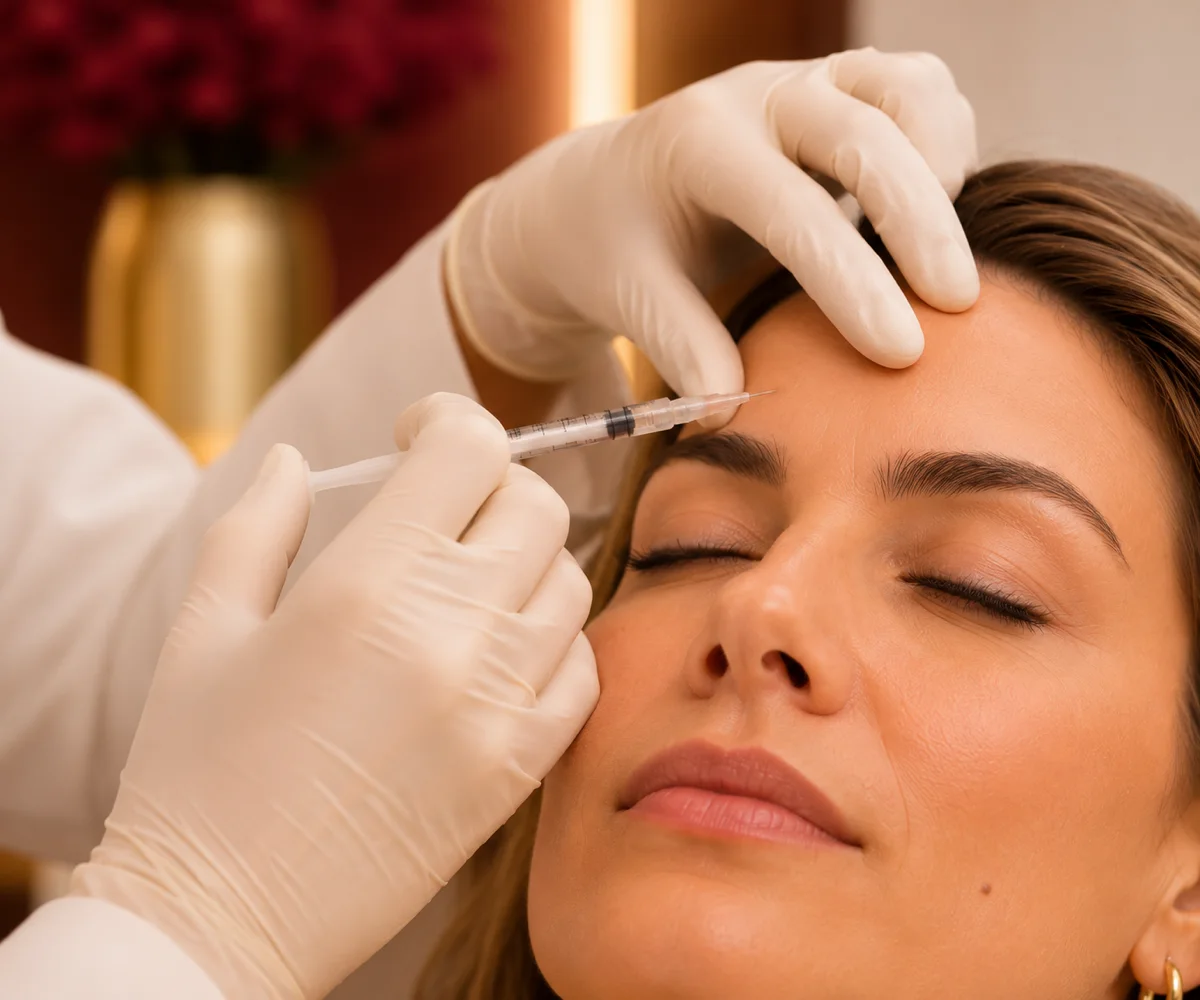
The doctor’s gloved hands injecting botulinum toxin into the forehead with a fine syringe

Expression lines

Botulinum toxin

Injection in small doses to soften wrinkles and expression lines of the forehead, between the eyebrows and around the eyes, by temporarily relaxing the muscle. A meta-analysis of 14 trials (8369 people) describes good efficacy, with an effect that usually wears off after about 6 months, and safety is well described, with a drooping eyelid or eyebrow as a known effect. It does not hydrate the skin or treat lines that do not come from movement, and it is not carried out during pregnancy or breastfeeding.

May be considered when

the lines appear mainly with movement, the doctor has assessed the balance of the face and the risk of adverse effects, and the person accepts that the effect is temporary and is repeated.

Find out more

What the journey looks like

From the first conversation to a plan tailored to you

No procedure begins without an assessment by the doctor. Most people start with the simplest approach, and only then is anything further considered.

  1. 01At the clinic

    Telling your story

    The doctor asks since when you noticed the lines, in which areas, whether they get worse with expression, sun or dry skin, what you use on your skin, whether you smoke, which medicines you take and whether you have had any treatment on the face.

  2. 02At the clinic

    Examining the face

    The skin is examined at rest and in movement, along with hydration, skin thickness and whether there are lesions. If there is a patch to be clarified, signs that call for another assessment or a contraindication, the doctor says what to do before treating, including referral.

  3. 03At home

    Protect and care for the skin

    The first step is what is simplest: sunscreen every day, hydration and stopping smoking. If it makes sense, the doctor or pharmacist recommends a retinoid product and how to introduce it carefully. In many cases, this is what most improves the look of fine lines.

  4. 04Over time

    Decide and follow up

    If the lines persist and bother you, the doctor explains whether a procedure makes sense, what can be expected, the risks and whether it needs to be repeated, without promising results. The examination is repeated and the plan adjusted.

Day to day

What helps at home

What you do at home matters more than you might think. These are sensible measures to take while you wait for your consultation and alongside the clinic’s plan.

The golden rule

Protect and moisturise before injecting

Sun and dry skin explain a good part of fine lines, and no procedure makes up for skin that continues to go unprotected. Starting with daily sunscreen, hydration and habits is worth more than any “miracle” product, and prepares the skin for whatever comes afterwards. A lesion that has changed should be seen by a doctor instead of being “treated”.

Sunscreen every day

It is the measure with the most evidence for slowing ageing of the facial skin.

In practice: factor 30 or higher, broad spectrum, applied about 15 minutes before going out and reapplied; a hat and sunglasses.

Moisturise and cleanse gently

Dry skin accentuates superficial lines, which improve when the skin barrier is cared for.

In practice: a moisturiser suited to your skin type, gentle cleansing and lukewarm baths instead of very hot ones.

Stop smoking and sleep well

Tobacco speeds up skin ageing, and regular sleep helps appearance and well-being.

In practice: ask for help to stop smoking and try to keep regular sleep times.

Retinoids with guidance

Topical retinoids have the most solid evidence among products for photoageing, but they irritate and are not used during pregnancy.

In practice: start slowly, at night only, with sunscreen by day, and talk to the doctor or pharmacist before starting.

Dr Michelle Campagnoli, clinical director of Clínica Luxmed

Who will look after you

An assessment carried out by the doctor

At Luxmed, in Algés, the first step is always an assessment with Dr Michelle Campagnoli. She is the one who examines the face at rest and in movement, works out what type of lines you have, rules out other causes and decides with you what makes sense, before any procedure.

  • Physical examination and medical historyA conversation about the history, habits and expectations, and an examination of the face at rest and in movement.
  • A plan tailored to youA clear plan, without promises, with skin care first and follow-up over time.
  • No obligationThe cost of any treatment is confirmed only after the assessment.
Book an assessment

Articles on fine lines and expression wrinkles

From our blog
Fotografia · linhas-finas-e-rugas-de-expressao-blog-11200 × 800 px · horizontal 3:2Bancada de casa de banho com luz lateral rasante: um frasco de hidratante, um tubo de protetor solar de rosto e um copo de água, sobre uma toalha clara; só objetos, sem rostos

Facial aesthetics

Fine lines: dehydration or ageing?

How to distinguish superficial lines, which hydration softens, from those that come from ageing, sun and movement, and what usually helps first.

Fotografia · linhas-finas-e-rugas-de-expressao-blog-21200 × 800 px · horizontal 3:2Mãos da médica de luvas a preparar uma seringa fina numa bancada clara de consultório, ao lado de compressas estéreis, em luz suave; enquadramento só das mãos, sem rostos

Facial aesthetics

Skinbooster: what it is and who it is suitable for

What these hydrating micro-injections are, what the evidence says about skin quality and fine lines, and in which cases it can be considered.

Fotografia · linhas-finas-e-rugas-de-expressao-blog-31200 × 800 px · horizontal 3:2Caneta de microagulhamento pousada num tabuleiro clínico claro, ao lado de compressas e de um frasco de soro, em luz suave; só objetos, sem rostos

Facial aesthetics

Facial microneedling: how it works and what to expect

How micro-punctures stimulate skin renewal, how many sessions are usually needed, the adverse effects and what is realistic to expect.

Book a consultation

Book your consultation

Choose how you prefer to get in touch. We will arrange the assessment consultation with Dr Michelle Campagnoli.

Booking through the websiteAssessment consultationTalk to our assistant on WhatsApp and ask for the current price of the assessment.

New Life Miraflores, Algés · Office Center, R. Santa Teresa do Menino Jesus n.º 6, 9.º C, 1495-048

Your details are used only for this contact. Any treatment depends on a prior medical assessment.

Request an appointmentIt takes less than a minute.
Speciality
You do not need to go into detail. The doctor will talk to you during the consultation.
Request received. Our team will contact you as soon as possible.
What is the difference between fine lines and expression wrinkles?

Fine lines are small superficial creases, mainly in the outer layer of the skin, and are closely linked to dryness, sun and loss of elasticity. Expression wrinkles form where the skin repeatedly folds with the muscles (forehead, between the eyebrows, corners of the eyes). With the years, an expression line stops disappearing and can be seen at rest. In practice they mix, and the doctor distinguishes them by observing the face still and in movement, because the treatment changes.

Fine lines: dehydration or ageing?

Often, both. Dry skin, with a weakened barrier, shows superficial lines more, and these lessen with hydration. Ageing, with less collagen and elastin, sun and movement of the face, creates lines that hydration alone does not erase. A clue: if the lines smooth out when you gently stretch the skin, it is more surface; if they persist, they are deeper. A medical assessment separates what can be improved from what cannot.

Why do expression lines appear and at what age do they start?

They appear through the repeated movement of the muscles and the gradual loss of elasticity of the skin, made worse by sun and tobacco. There is no set age: some people notice them at 30 and some only at 50, and genetics, skin phototype and sun exposure weigh heavily. Lines that can only be seen when smiling or frowning are normal and do not, in themselves, need treatment.

Are the creases I have in the morning, on waking, wrinkles?

They may be compression creases from the pillow, especially if they are always on the same side, and they usually lessen during the morning. With the years, some no longer undo themselves, and the literature describes differences between sleep wrinkles and expression wrinkles, which are distinguished by location and pattern. Varying your sleeping position helps comfort, but there is no strong evidence that it prevents wrinkles.

What can I do at home to soften fine lines?

What has the most evidence is daily sunscreen: in a trial of 903 adults, there was 24% less skin ageing in the group that used it every day. Then comes hydration, which improves the look of superficial lines, and stopping smoking. Topical retinoids are considered the reference for photoageing, although they irritate and are not used during pregnancy. Cosmetics with other substances generally have weaker evidence, and none erases deep wrinkles.

What is skinbooster and does it work on fine lines?

It is a set of superficial micro-injections of hyaluronic acid, in small amounts, to hydrate the skin deeply and improve its quality. A systematic review of 13 studies concluded that there are improvements in hydration, firmness, texture and radiance, with good safety, but calls for larger trials. For fine lines caused by dehydration it makes sense; for marked expression lines or deep creases, it does not replace toxin or a filler. It is generally carried out over several sessions, and the effect varies and is repeated.

Does facial microneedling help with fine lines? How does it work?

It makes small controlled punctures in the skin, with very fine needles, to stimulate its renewal and collagen production. A systematic review of 21 studies, with 723 people, found about 83% satisfaction and adverse effects that were mostly mild and temporary (redness, peeling, stinging), with more than 70% of the studies assessing wrinkles, but the techniques and the number of sessions vary widely. It is carried out over several sessions spaced weeks apart, and not with skin that is irritated, infected or has an active cold sore. The doctor tells you whether it makes sense for you.

Is botulinum toxin suitable for fine lines? Do I need it “to prevent”?

It is suitable mainly for expression lines of the forehead, between the eyebrows and around the eyes, because it relaxes the muscle that forms them. In a meta-analysis of 14 trials and 8369 people, toxin was effective in these areas, and the effect took about 6 months to wear off, which is why it is repeated. It does not hydrate the skin or treat lines that do not come from movement. As for “preventing”, the evidence for preventive toxin is limited: sunscreen and skin care come first, and the decision is made with an honest assessment, without hurry or fear.

What risks do these treatments carry? Are the results permanent?

They are neither permanent nor guaranteed: skinbooster and toxin last months and are repeated, and microneedling requires several sessions. Bruising, swelling and redness are common and temporary. With toxin, the known adverse effect is a drooping eyelid or eyebrow, which is transient (weeks) and is managed with supportive measures: contact the clinic, and with double vision or pain in the eyes seek emergency care. Very rarely, an injection in the face can reach a vessel and cause loss of vision or skin necrosis. Severe pain, pale skin or skin with purplish patches, a change in vision, a severe headache or facial weakness: call 112 and tell the clinic that injected.

When should I see a doctor first?

Book a consultation if a patch or lesion on the face grows, changes colour, shape or outline, bleeds or does not heal, if the skin is rough and scaly in areas heavily exposed to the sun, or if the lines appeared suddenly. Also before any treatment if you are pregnant, breastfeeding, have taken isotretinoin or have a neuromuscular condition. With sudden drooping on one side of the face, difficulty speaking or weakness in an arm, call 112. If in doubt, out of hours call SNS 24 (808 24 24 24).

We could not find that question. Ask us on WhatsApp

Scientific references

This page is based on the sources below and was reviewed by Dr. Michelle Campagnoli. Last updated on .

  1. Fisher GJ, Kang S, Varani J, Bata-Csorgo Z, Wan Y, Datta S, Voorhees JJ. Mechanisms of photoaging and chronological skin aging. Arch Dermatol, 2002.
  2. Hughes MCB, Williams GM, Baker P, Green AC. Sunscreen and prevention of skin aging: a randomized trial. Ann Intern Med, 2013.
  3. Kennedy C, Bastiaens MT, Bajdik CD, Willemze R, Westendorp RGJ, Bouwes Bavinck JN. Effect of smoking and sun on the aging skin. J Invest Dermatol, 2003.
  4. Anson G, Kane MA, Lambros V. Sleep Wrinkles: Facial Aging and Facial Distortion During Sleep. Aesthet Surg J, 2016.
  5. Lemperle G, Holmes RE, Cohen SR, Lemperle SM. A classification of facial wrinkles. Plast Reconstr Surg, 2001.
  6. Verdier-Sévrain S, Bonté F. Skin hydration: a review on its molecular mechanisms. J Cosmet Dermatol, 2007.
  7. Siddiqui Z, Zufall A, Nash M, Rao D, Hirani R, Russo M. Comparing Tretinoin to Other Topical Therapies in the Treatment of Skin Photoaging: A Systematic Review. Am J Clin Dermatol, 2024.
  8. Ghatge AS, Ghatge SB. The Effectiveness of Injectable Hyaluronic Acid in the Improvement of the Facial Skin Quality: A Systematic Review. Clin Cosmet Investig Dermatol, 2023.
  9. Foppiani JA, Fanning JE, Beltran K, Raska O, et al. Microneedling for Facial Rejuvenation: A Systematic Review. Aesthetic Plast Surg, 2025.
  10. Alster TS, Graham PM. Microneedling: A Review and Practical Guide. Dermatol Surg, 2018.
  11. Rahman E, Mosahebi A, Carruthers JDA, Carruthers A. The Efficacy and Duration of Onabotulinum Toxin A in Improving Upper Facial Expression Lines With 64-Unit Dose Optimization: A Systematic Review and Meta-Analysis With Trial Sequential Analysis of the Randomized Controlled Trials. Aesthet Surg J, 2023.
  12. Brin MF, De Boulle K, Liew S, Carruthers A, Carruthers J, Rivkin A, et al. Safety and tolerability of onabotulinumtoxinA in the treatment of upper facial lines from global registration studies in 5298 participants: A meta-analysis. JAAD Int, 2024.
  13. NHS. Sunscreen and sun safety. (NHS, acedido 2026-11-11)
  14. American Academy of Dermatology Association. How to apply sunscreen. (AAD, acedido 2026-11-11)
CallAssistantAvailableBook