Algés, Oeiras Mon to Fri · 09:00 to 13:00 and 14:00 to 19:00 · Sat · 09:00 to 14:00
WhatsApp Book a consultation

Facial aesthetics

Deep wrinklesWhen the lines on your face no longer disappear at rest and you want to understand what causes them and what can be done

Deep wrinkles are creases that stay marked even with the face relaxed. They often begin as expression lines that movement repeats over the years, and gradually deepen as the skin loses collagen, elasticity and volume, and as sun, tobacco and genetics play their part. Not all wrinkles are treated in the same way: some depend on the muscle, others on the skin and others on the volume that has been lost underneath, and that is what determines what makes sense. Here we explain where they come from, what helps at home, what hyaluronic acid, collagen biostimulators and fractional CO2 laser can and cannot do, and the signs that call for medical attention, at Clínica Luxmed, in Algés.

Reviewed by Dr Michelle Campagnoli, clinical director

  • 3treatments that the clinic may consider
  • 1assessment, always first
  • Nocommitment
Fotografia · rugas-profundas-hero800 × 1000 px · vertical 4:5Mulher de uns 55 anos, de cabelo grisalho curto, de perfil e de ombros para cima, junto a uma janela de consultório com luz natural suave da manhã, com ar sereno; retrato discreto, sem close-up das rugas nem do rosto de frente

How to recognise it

Are they deep wrinkles or mild lines?

It is not a diagnosis: it describes what you see. What separates a mild line from a deep wrinkle is, above all, whether the crease is still there when the face is still, and that is what determines the options.

Tick what you recognise0/7

Tick the signs you recognise in your case. This is not a diagnosis, it is only meant to give you an idea.

Have you had a filler and, in the following hours or days, developed severe pain, pale, greyish skin or skin with purplish patches, a change in vision, a severe headache or weakness on one side of the face? It is an emergency: call 112 now and contact immediately the clinic that injected. Do not massage or take anything on your own. A patch or lesion that grows, changes colour or shape, or bleeds, and an area of the face that is suddenly swollen, red, hot or painful, also call for medical assessment before any treatment. Out of hours, call SNS 24: 808 24 24 24.

Fotografia · rugas-profundas-consulta1083 × 1300 px · vertical 5:6Médica de bata branca sentada de frente para uma mulher de uns 55 anos, num consultório luminoso, com um espelho de mão e uma folha de notas sobre a secretária; plano médio, sem close-up do rosto
Frame for the consultation photograph. The dots mark what the doctor assesses.

Why it happens

What lies behind deep wrinkles

There is almost never a single cause. Choose a situation to see how it fits into the picture and what usually helps.

The natural ageing of the skin

With age, the skin produces less collagen and elastin, becomes thinner and loses the ability to “spring back” after each movement. Creases that used to disappear begin to stay. It is a normal process, gradual and different from person to person, and it is not a disease.

What weighs on it

Expecting the skin to “cope” without care and comparing your face with that of other people of the same age.

What helps

Regular care, sun protection and assessment of the options that make sense for your skin type and your age.

Normal or to be assessed

Wrinkles of ageing or something to assess

Most deep wrinkles are a normal part of skin ageing. But some situations call for assessment before any treatment, because the wrinkle is only the visible part.

  • What it looks like. Creases that remain at rest, symmetrical, in the areas where the face moves most or where volume has been lost, with the surrounding skin free of sores, new patches or sudden changes.

  • When it is noticed. In the mirror in overhead light, after a poor night’s sleep and, with age, more and more, especially in people who have had a lot of sun or who smoke.

  • What the clinic does. The doctor examines the face at rest and in movement, distinguishes what is muscle, skin and volume, and explains what makes sense and what is realistic to expect.

  • At home. Sunscreen every day, moisturising, stopping smoking and, if the doctor advises, a topical retinoid, with patience.

Severe pain, pale or dark skin, loss of or a change in vision, a severe headache or facial weakness after a filler? Call 112 and inform the clinic that injected. For any other concern, out of hours you can call SNS 24: 808 24 24 24.

Book an assessment

What the clinic may consider

Options for deep wrinkles

First come sun protection, skin care and, where appropriate, a prescribed topical treatment: without these, any procedure loses part of its effect. Only then, and after an assessment, is a procedure considered. For deep wrinkles, hyaluronic acid restores volume and softens grooves, fractional CO2 laser renews the skin in depth and collagen biostimulators, which are also part of what the clinic offers, stimulate collagen gradually and come in when what is sought is firmness and support. The doctor tells you which (or what combination) makes sense. The evidence varies: results are generally gradual, more or less long-lasting depending on the product and the area, are not permanent and do not smooth the face completely.

Book an assessment
Dr Michelle Campagnoli, clinical director of Clínica Luxmed

First step

Assessment consultation

The doctor listens to what you are experiencing, examines your case and explains the suitable options. No treatment begins without this consultation.

May be considered when

you want to understand the cause and decide on the best path, with time and without commitment.

Book an assessment
Doctor wearing gloves giving an injection into the face of a patient lying down, in a consulting room with warm light

Volume and grooves

Hyaluronic acid

Injectable filler that restores volume, redefines contours and softens grooves and creases, giving hydration back to the treated area. The effect is visible straight away, but it is temporary: the body gradually absorbs the product and it may need repeating. In areas of greater vascular risk, only an experienced doctor should inject.

May be considered when

the creases are static, there is loss of volume underneath, the skin of the area is healthy and there are no lesions awaiting assessment, you are not pregnant or breastfeeding, and the doctor has explained the risks, the likely duration and what is realistic to expect.

Find out more
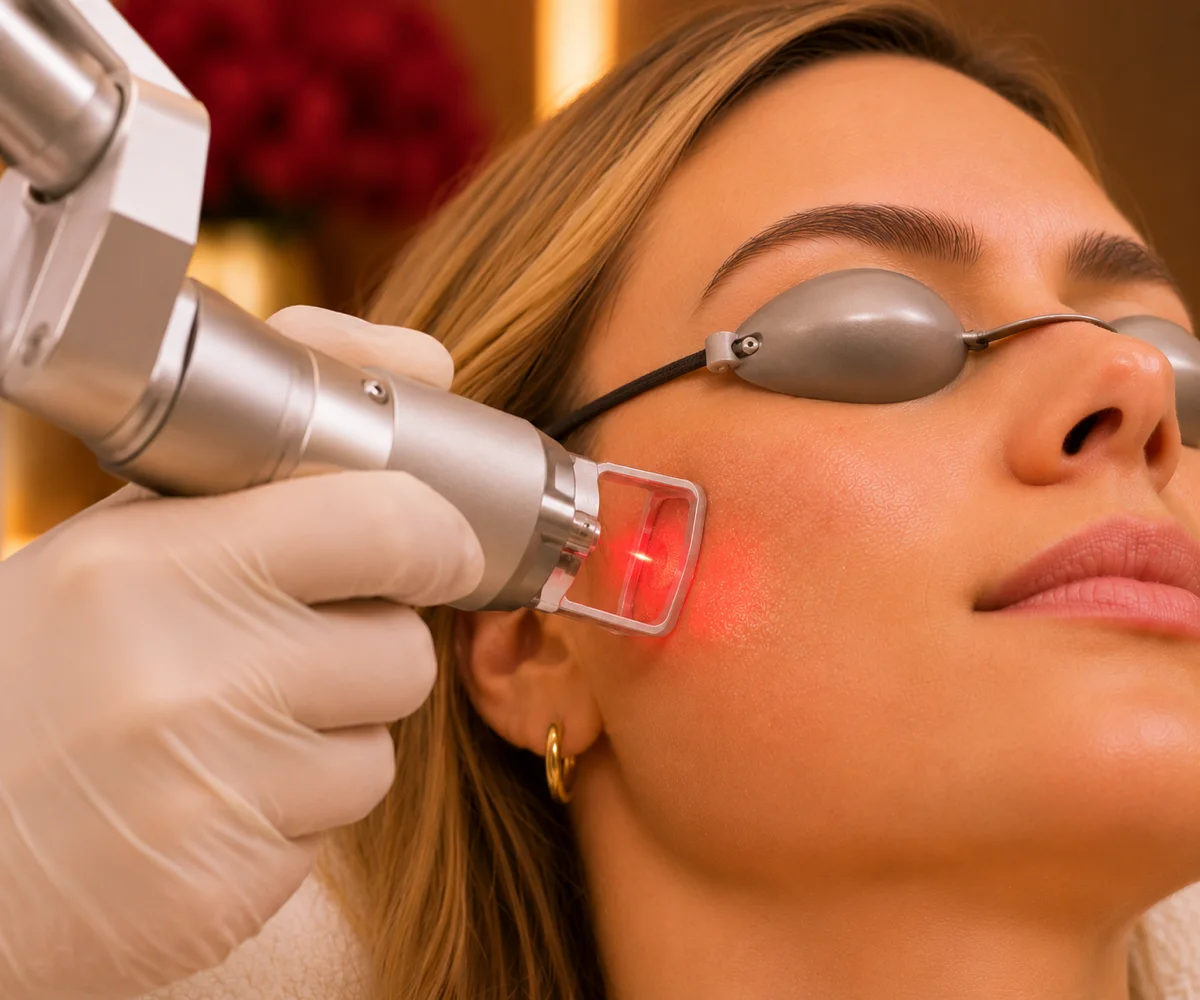
Fractional laser being passed over the face of a patient wearing eye protection, in a consulting room

Skin renewal

Fractional CO2 laser

A laser that renews the skin in depth, treating fine and moderate wrinkles, scars and marks, and improving texture and firmness. It heals more slowly than a light procedure, with redness and peeling, and requires strict sun protection. It is not suitable for all skin types or for all times of year.

May be considered when

the skin calls for renewal and texture, you can tolerate a few days of recovery, the skin is healthy, without an active cold sore or infection, and the doctor has assessed the skin colour, the healing history and the medication, and explained the risks (marks, scars).

Find out more

What the journey looks like

From the first conversation to a plan tailored to you

No procedure begins without an assessment consultation with the doctor. Most people start with what is simplest and safest, and only then is more considered.

  1. 01At the clinic

    Telling your story

    The doctor asks since when you noticed the creases, what bothers you most, which treatments you have already had (fillers, laser, others), medication, any tendency to scarring or cold sores and whether you are pregnant or breastfeeding.

  2. 02At the clinic

    Examining the face

    The face is observed at rest and in movement, to distinguish expression wrinkles from skin wrinkles and from loss of volume, and the texture and colour of the skin are examined. Any lesion that changes or raises doubts is assessed before treating.

  3. 03At home

    Protect the skin and look after it

    Sunscreen every day, moisturising, stopping smoking and, if the doctor advises, a topical retinoid. These measures change what is done next and protect the result of any procedure.

  4. 04Over time

    Decide and follow up

    If the creases persist, the doctor explains which option makes sense, what can be expected, how many sessions, how long it lasts and what the risks are, without promising results. The examination is repeated and the plan adjusted, including maintenance.

Day to day

What helps at home

What is done every day weighs more than it seems. These are the measures that make sense before and alongside any procedure.

The golden rule

Protect the skin before treating it

A deep wrinkle is, in large part, the result of years of sun, movement and loss of support. However well a procedure is carried out, skin that keeps getting sun without protection goes on accumulating damage. Protecting the skin, moisturising it and avoiding tobacco is worth more than any miracle cream, and prepares the ground for whatever is decided in the consultation.

Sunscreen every day

The sun is the main environmental factor in skin ageing, and the damage accumulates.

In practice: broad-spectrum sunscreen, factor 30 or higher, on the face and neck, reapplied, and a wide-brimmed hat.

Moisturise and protect the barrier

Dry, dehydrated skin shows creases more, and irritated skin responds worse to everything.

In practice: a gentle moisturiser morning and night, and cleansing without scrubbing or harsh products.

Stop or cut down on tobacco

It is associated with more signs of ageing of the facial skin, on top of all the health risks.

In practice: talk to your doctor about support to stop smoking; it is worth it for many reasons.

Record and bring to the consultation

It helps the doctor to understand what has changed and what worries you.

In practice: photographs from time to time, in the same light and with the face relaxed, and the list of products, medication and treatments already carried out.

Dr Michelle Campagnoli, clinical director of Clínica Luxmed

Who will look after you

An assessment carried out by the doctor

At Luxmed, in Algés, the first step is always an assessment with Dr Michelle Campagnoli. She is the one who examines the face at rest and in movement, works out what causes each crease and decides with you what makes sense, before any procedure.

  • Physical examination and medical historyA conversation about habits, treatments already carried out and medication, and an examination of the face and skin.
  • A plan tailored to youA clear plan without unrealistic promises, starting with essential skincare and including follow-up over time.
  • No obligationThe cost of any treatment is confirmed only after the assessment.
Book an assessment

Articles on deep wrinkles

From our blog
Fotografia · rugas-profundas-blog-11200 × 800 px · horizontal 3:2Natureza-morta junto a uma janela com luz natural da manhã: um chapéu de palha de abas largas, um tubo de protetor solar e um espelho de mão sobre uma mesa de madeira clara, sem pessoas

Facial aesthetics

Deep wrinkles: why they form and when they appear

What happens to the skin over the years, the role of sun, tobacco, expression and the volume that is lost, and why there is no set age.

Fotografia · rugas-profundas-blog-21200 × 800 px · horizontal 3:2Mulher de uns 45 anos, a rir numa esplanada, fotografada de perfil e a alguma distância, com luz suave da tarde; plano aberto, sem close-up do rosto

Facial aesthetics

Dynamic and static wrinkles: the difference that changes the treatment

How to tell the creases that depend on movement from those that remain at rest, and why this difference guides what is proposed.

Fotografia · rugas-profundas-blog-31200 × 800 px · horizontal 3:2Tabuleiro de consultório com uma seringa fechada, uma caneta e uma folha com um plano de tratamento sob luz clara; plano de pormenor, sem pessoas

Facial aesthetics

Deep wrinkles: filler, biostimulators or laser

What each option does, in which cases it makes most sense, what can be expected, the risks and why, often, you start with care and sunscreen alone.

Book a consultation

Book your consultation

Choose how you prefer to get in touch. We will arrange the assessment consultation with Dr Michelle Campagnoli.

Booking through the websiteAssessment consultationTalk to our assistant on WhatsApp and ask for the current price of the assessment.

New Life Miraflores, Algés · Office Center, R. Santa Teresa do Menino Jesus n.º 6, 9.º C, 1495-048

Your details are used only for this contact. Any treatment depends on a prior medical assessment.

Request an appointmentIt takes less than a minute.
Speciality
You do not need to go into detail. The doctor will talk to you during the consultation.
Request received. Our team will contact you as soon as possible.
How are deep wrinkles removed or softened?

There is no way to “remove” them completely, but there are ways to soften them. First, the skin is protected from the sun, moisturised, tobacco is avoided and, when the doctor advises, a topical retinoid is used, which has evidence of improving photoaged skin but can irritate. Then, if the creases persist, a procedure is considered depending on the cause: hyaluronic acid when volume is lacking, fractional CO2 laser when the skin needs renewal, collagen biostimulators when firmness is sought. Results vary, are generally temporary and rarely leave the face looking like skin without creases.

Why do deep wrinkles appear and when do they appear?

Because the skin loses collagen and elasticity over the years, because sun and tobacco speed up this wear, because movement folds the skin in the same place every time and because the face gradually loses volume underneath. There is no set age: it depends on sun, genetics, skin type and habits. In general, expression lines appear first and become fixed over time, but some people have them early and some have them late.

What is the difference between dynamic and static wrinkles?

Dynamic ones appear with movement, when smiling, frowning or raising the eyebrows, and disappear when the face is still. Static ones stay marked even at rest, because the skin has already lost the ability to stretch back. In practice, many wrinkles are both, which is why the assessment counts: a wrinkle that depends mainly on the muscle is treated differently from a groove that depends on volume or from thin skin damaged by the sun. Movement wrinkles, such as those on the forehead and between the eyebrows, have their own page.

Does hyaluronic acid treat deep wrinkles?

It can soften grooves and creases by restoring volume in the area, with a visible effect straight away. It is temporary: the body gradually absorbs the product, and the duration depends on the product, the area and the person, so it may need repeating. It has a good safety profile in experienced hands, but adverse reactions exist (swelling, bruising, lumps), most of them mild and temporary. Areas of greater vascular risk require special care; see the question on risks.

Do collagen biostimulators help with deep wrinkles?

They stimulate the body’s own collagen and, for that reason, the effect is gradual and appears over weeks to months. They make more sense when firmness and support are sought than for filling a crease that is already marked, and they are often combined with other procedures. Results vary from person to person, are not permanent, and the doctor explains whether it makes sense in your case.

Is fractional CO2 laser suitable for deep wrinkles?

It is a laser that renews the skin in depth and improves wrinkles, scars, marks and texture. Reviews report that ablative lasers tend to be more effective than milder ones, but heal more slowly, and that fractionating them reduces recovery time and complications, at the cost of more sessions. There is redness and peeling for a few days, and sun must be avoided. In darker or tanned skin and in people who tend to scarring or cold sores, the doctor first assesses the risk of marks, scars and infection.

Filler, biostimulators or laser: which to choose?

It depends on what causes the crease. If volume is lacking, hyaluronic acid makes more sense. If the skin is thin, lax and needs stimulation, biostimulators. If the skin has an irregular texture and sun damage, laser. More than one procedure is often combined, at different times, and some people start with care and sun protection alone. The doctor tells you, at the assessment, what makes sense and what is realistic to expect, and the decision is always yours.

How many sessions are needed and how long does the result last?

It varies a lot. Hyaluronic acid lasts months to over a year, depending on the product and the area, and then needs repeating. Biostimulators normally require several sessions spaced weeks apart and the effect is gradual. Laser may need one or more sessions, with a few days of recovery. No result is permanent, because the skin continues to age, and the doctor sets out the plan and expectations without promising results.

What are the risks of a filler, and which areas are more delicate?

The most common effects are swelling, redness, mild pain and bruising, which pass in days. The most serious risk is the blockage of a blood vessel through which the product passes, which can cause skin necrosis and, more rarely, loss of vision. According to a literature review, the highest-risk areas are the nose, the glabella (between the eyebrows), the forehead and the groove from the nose to the mouth. For that reason an experienced doctor is required, with knowledge of the anatomy and the ability to use hyaluronidase (which dissolves hyaluronic acid), and it is not recommended to go to anyone without that training.

When should I see a doctor or go to the emergency department?

Seek a medical assessment before any treatment if you have a patch or lesion that grows, changes colour or shape, bleeds or does not heal, or if an area of the face is suddenly swollen, red, hot or painful, or there is a fever. After a filler, severe pain, pale, greyish skin or skin with purplish patches, a change in vision, a severe headache or facial weakness are an emergency: call 112 and contact immediately the clinic that injected. For other concerns, out of hours, call SNS 24 (808 24 24 24).

We could not find that question. Ask us on WhatsApp

Scientific references

This page is based on the sources below and was reviewed by Dr. Michelle Campagnoli. Last updated on .

  1. Fisher GJ, Kang S, Varani J, Bata-Csorgo Z, Wan Y, Datta S, Voorhees JJ. Mechanisms of photoaging and chronological skin aging. Arch Dermatol, 2002.
  2. Kennedy C, Bastiaens MT, Bajdik CD, Willemze R, Westendorp RG, Bouwes Bavinck JN. Effect of smoking and sun on the aging skin. J Invest Dermatol, 2003.
  3. Hughes MCB, Williams GM, Baker P, Green AC. Sunscreen and prevention of skin aging: a randomized trial. Ann Intern Med, 2013.
  4. Mukherjee S, Date A, Patravale V, Korting HC, Roeder A, Weindl G. Retinoids in the treatment of skin aging: an overview of clinical efficacy and safety. Clin Interv Aging, 2006.
  5. Vleggaar D, Fitzgerald R, Lorenc ZP. Composition and mechanism of action of poly-L-lactic acid in soft tissue augmentation. J Drugs Dermatol, 2014.
  6. Preissig J, Hamilton K, Markus R. Current laser resurfacing technologies: a review that delves beneath the surface. Semin Plast Surg, 2012.
  7. Signorini M, Liew S, Sundaram H, De Boulle KL, Goodman GJ, Monheit G, Wu Y, Trindade de Almeida AR, Swift A, Vieira Braz A; Global Aesthetics Consensus Group. Global Aesthetics Consensus: avoidance and management of complications from hyaluronic acid fillers. Evidence- and opinion-based review and consensus recommendations. Plast Reconstr Surg, 2016.
  8. Beleznay K, Carruthers JDA, Humphrey S, Carruthers A, Jones D. Update on avoiding and treating blindness from fillers: a recent review of the world literature. Aesthet Surg J, 2019.
  9. NHS. Sunscreen and sun safety. (NHS, acedido 2026-11-11)
  10. American Academy of Dermatology Association. How to apply sunscreen. (AAD, acedido 2026-11-11)
CallAssistantAvailableBook