


- Home
- Facial aesthetics
- LuxFusion deep peel
- Is a phenol peel dangerous?
Is a phenol peel dangerous? The risks and how they are managed
Phenol is absorbed through the skin. Applied rapidly to large areas without monitoring, it can affect the heart. Learn the risks and how they are managed.
 Luxmed TeamAuthor
 Dr Michelle CampagnoliClinical review · OM no. 69467
In this article
The phenol peel has a reputation for being dangerous, and many searches about it even mention the word ‘death’. The truth is that phenol is absorbed through the skin and can affect the heart, kidneys and liver when it is applied rapidly to large areas without monitoring. With rigorous patient selection, proper technique and monitoring, these risks can be controlled. This article uses data to explain the real risks and how they are reduced.
Three ideas to remember.
Systemic risks: heart, kidneys and liver
Phenol is absorbed through the skin, metabolised by the liver and eliminated by the kidneys. In large amounts, it can cause cardiac arrhythmias.
| Study | What was observed |
|---|---|
| Gross, 1984 | Arrhythmias occurred in 39% of 54 people treated rapidly; when half of the face was treated on consecutive days, the rate fell to 22% among 100 people, with less severe arrhythmias |
| Landau, 2007 | 181 women underwent a deep full-face peel; arrhythmias occurred in 6.6% and were controlled; they were more common in those with diabetes, hypertension and depression |
| Wambier et al., 2019 (review) | Around 7% experienced transient arrhythmias during full-face peels; cardiac monitoring is mandatory |
Gross’s study also showed that dividing the face into sections and spacing out the application reduces the risk of arrhythmia.
How systemic risks are controlled
- Prior medical assessment, including heart, kidney and liver disease and medication.
- Electrocardiogram and blood tests, when indicated.
- Intravenous hydration before and during the procedure.
- Application by cosmetic units, with intervals of around 15 to 20 minutes.
- Continuous cardiac monitoring during full-face peels.
- Localised peels, such as around the mouth, involve less phenol and a lower systemic risk.
Local risks
| Risk | Comment |
|---|---|
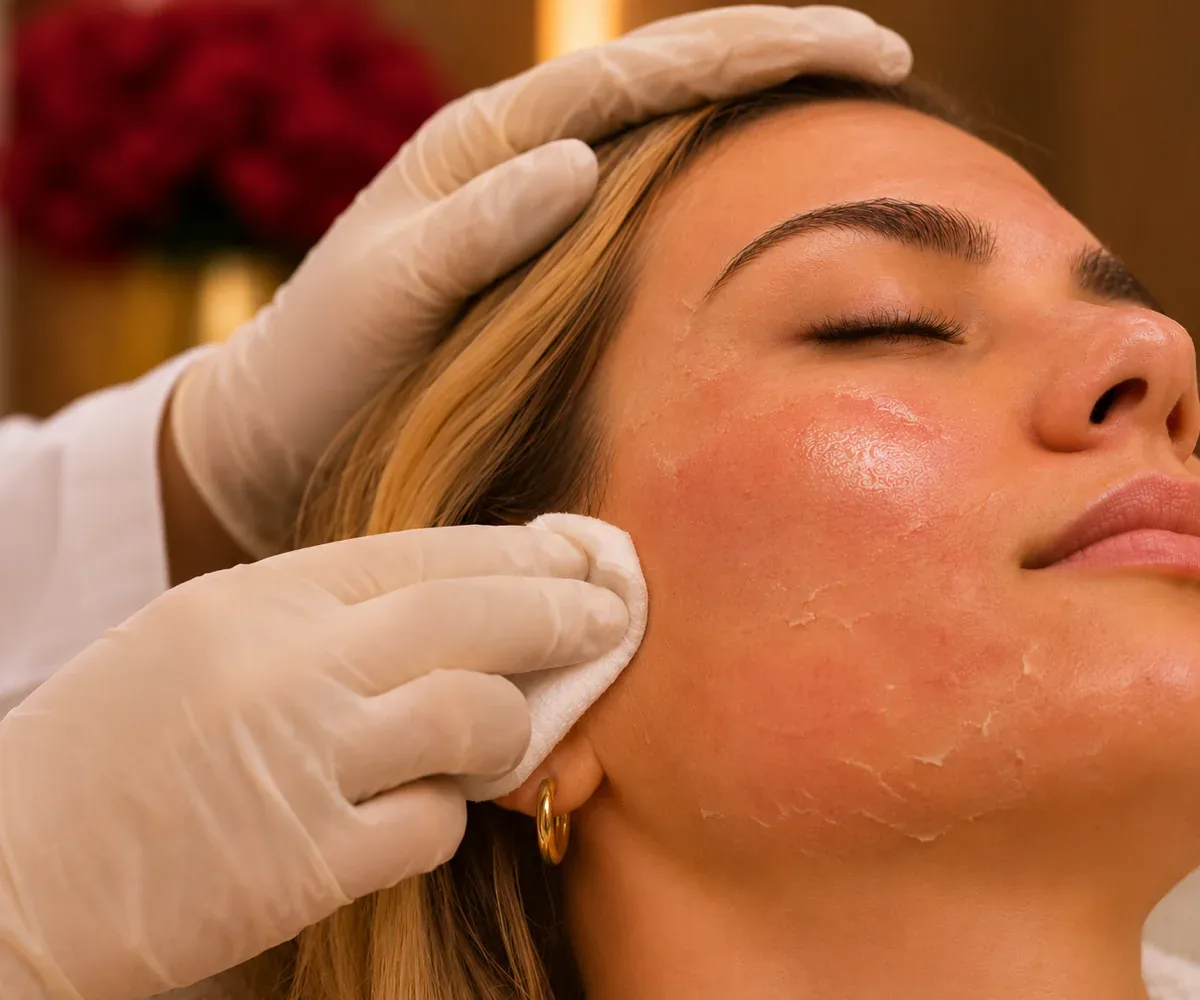
| Prolonged redness | Normal for weeks to months; it is part of the remodelling process |
| Loss of pigment (lighter skin) | More common with deep peels; it may be permanent |
| Demarcation line | Between treated and untreated areas; it can be reduced using blending techniques |
| Hyperpigmentation | Particularly with early sun exposure |
| Infection, including herpes | Prevented with antiviral medication and skin care |
| Milia and acne | Common and temporary |
| Scars | Rare; more likely in areas of thin skin and when improper technique is used |
Results and complications depend mainly on the depth of the injury: the deeper the peel, the more pronounced the result and the greater the risk (Nikalji et al., 2012).
Who should not have it
- Significant heart, kidney or liver disease.
- Pregnancy and breastfeeding.
- Dark skin, for deep full-face peels.
- Recent isotretinoin use.
- Anyone unable to comply with recovery and sun protection requirements.
At Luxmed Clinic
At Luxmed in Algés, near Lisbon, the medium and deep peels used in the LuxFusion treatment are planned following a prior medical assessment, and the formula and treatment area are chosen to balance results and safety.
Talk to us
The assessment is a conversation, with no obligation. Tell us what concerns you and our team will reply.
This article is for information purposes and is not a substitute for a consultation. Phenol peels should be performed by doctors with specific training and appropriate monitoring facilities.
Frequently asked questions
Can a phenol peel really be fatal?
Serious complications are rare and are associated with rapid application over large areas without monitoring. The risk can be controlled through assessment, hydration, application in sections and monitoring.
Is a localised phenol peel safer?
Yes; less phenol is used and the systemic risk is also lower.
Will my skin become whiter?
It can happen, particularly with deep peels. This is one reason why the depth and treatment areas must be chosen carefully.
Are there lower-risk alternatives?
For deep wrinkles, the CO2 laser is an alternative; for finer wrinkles, options include medium-depth peels or radiofrequency microneedling.
Scientific references 4
- Gross BG. Cardiac arrhythmias during phenol face peeling. Plast Reconstr Surg. 1984;73(4):590-594. doi:10.1097/00006534-198404000-00012 Artigo
- Landau M. Cardiac complications in deep chemical peels. Dermatol Surg. 2007;33(2):190-193. doi:10.1111/j.1524-4725.2006.33037.x Artigo
- Wambier CG, Lee KC, Soon SL, et al. Advanced chemical peels: phenol-croton oil peel. J Am Acad Dermatol. 2019;81(2):327-336. doi:10.1016/j.jaad.2018.11.060 Artigo
- Nikalji N, Godse K, Sakhiya J, Patil S, Nadkarni N. Complications of medium depth and deep chemical peels. J Cutan Aesthet Surg. 2012;5(4):254-260. doi:10.4103/0974-2077.104913 Artigo
Editing and development: Rúben Brito · Operial Development
Keep exploring