


- Home
- Facial aesthetics
- Sensitive, reactive skin
- Sensitive skin
Sensitive skin: what it is and why it reacts to everything
Stinging when applying a cream, prickling in the cold, redness after a new product: sensitive skin is a real condition, recognised by dermatology, and very common.
 Luxmed TeamAuthor
 Dr Michelle CampagnoliClinical review · OM no. 69467
In this article
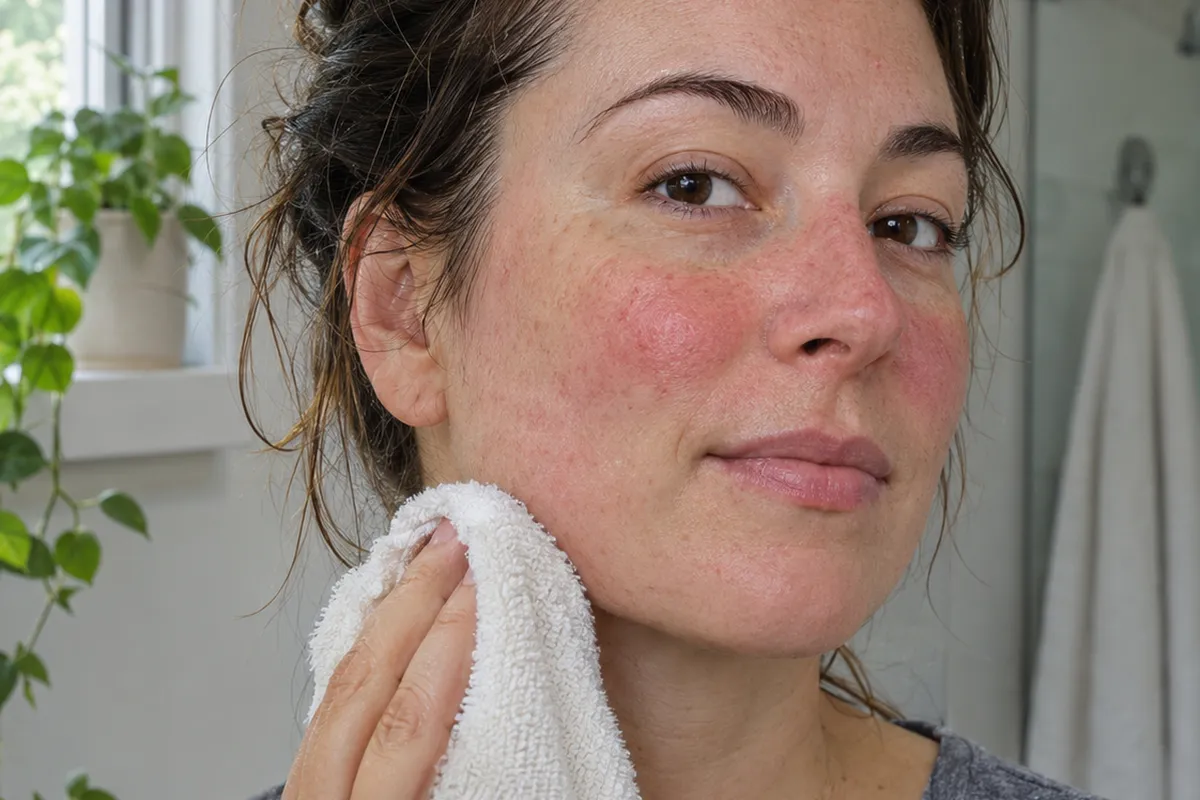
Stinging when applying a cream, prickling in the cold, redness after a new product, tightness after cleansing. People with sensitive skin know these signs well. Sensitive skin is not a disease, but it is a real condition, recognised by dermatology, and very common. Understanding what causes it helps you choose care that soothes rather than irritates.
Three ideas to remember.
What sensitive skin is
An international group of experts defined sensitive skin as a syndrome in which unpleasant sensations, such as burning, stinging, pain, itching or tingling, arise in response to stimuli that would not normally cause them. There may be redness, but not always (Misery et al., 2017).
How common it is
A review of surveys in several countries concluded that about 60% to 70% of women and 50% to 60% of men report some degree of sensitive skin, with variations by region, age and area of the body. The face is the most affected area (Farage, 2019).
Why the skin reacts
- Weakened skin barrier: it lets irritating substances in more easily and loses more water (Rawlings and Harding, 2004).
- More reactive nerve endings: the nerves in the skin respond more intensely to stimuli such as heat, cold or certain ingredients.
- Underlying inflammation: in some people, there is a tendency towards inflammation and redness.
What triggers reactions
| Type | Examples |
|---|---|
| Cosmetics | Fragrances, alcohol, acids, retinoids, some preservatives, exfoliants |
| Environment | Cold, wind, heat, sun, sudden changes in temperature, dry air |
| Water | Very hot or very hard water |
| Lifestyle | Stress, lack of sleep, alcohol, spicy food (in people with rosacea) |
| Hormones | Variations over the menstrual cycle |
Sensitive skin or something else?
Sensitive skin can coexist with, or be mistaken for:
- Rosacea: persistent redness in the centre of the face, visible small blood vessels, sometimes spots. There are dedicated articles: symptoms, types and factors that worsen it, medical treatment and daily care and aesthetic treatments.
- Atopic dermatitis: dry, itchy skin with patches of eczema.
- Seborrhoeic dermatitis: redness and flaking on the eyebrows and the sides of the nose.
- Allergic contact dermatitis: a reaction to a specific ingredient, with itching and redness.
If there is persistent redness, flaking or intense itching, a dermatological assessment is worthwhile.
At Luxmed Clinic
At Luxmed, we treat sensitive skin with extra care: simple routines, well-tolerated products and treatments chosen and adjusted to each person’s sensitivity. When we suspect rosacea or dermatitis, we refer for medical assessment.
Talk to us
The assessment is a conversation, with no obligation. Tell us what concerns you and our team will reply.
This article is for information purposes and does not replace a consultation. The results of any treatment vary from person to person.
Frequently asked questions
Is sensitive skin the same as an allergy?
No. An allergy is a reaction of the immune system to a specific ingredient. Sensitive skin reacts to several stimuli, without being an allergy.
Can it go away with time?
It can improve greatly with appropriate care and with repair of the skin barrier.
Are “hypoallergenic” products better?
The term has no strict legal definition. It is more useful to choose fragrance-free products with few ingredients and to test them on a small area.
Can I have aesthetic treatments?
You can, with careful choice and preparation. There is a dedicated article.
Is sensitive skin related to stress?
Stress can worsen skin reactivity in some people.
Scientific references 3
- Misery L, Ständer S, Szepietowski JC, et al. Definition of sensitive skin: an expert position paper from the Special Interest Group on Sensitive Skin of the International Forum for the Study of Itch. Acta Derm Venereol. 2017;97(1):4-6. Artigo
- Farage MA. The prevalence of sensitive skin. Front Med (Lausanne). 2019;6:98. Artigo
- Rawlings AV, Harding CR. Moisturization and skin barrier function. Dermatol Ther. 2004;17(Suppl 1):43-48. Artigo
Editing and development: Rúben Brito · Operial Development
Keep exploring