


- Home
- Facial aesthetics
- Lips that have lost volume
- Lips and ageing
Why the lips lose volume with age
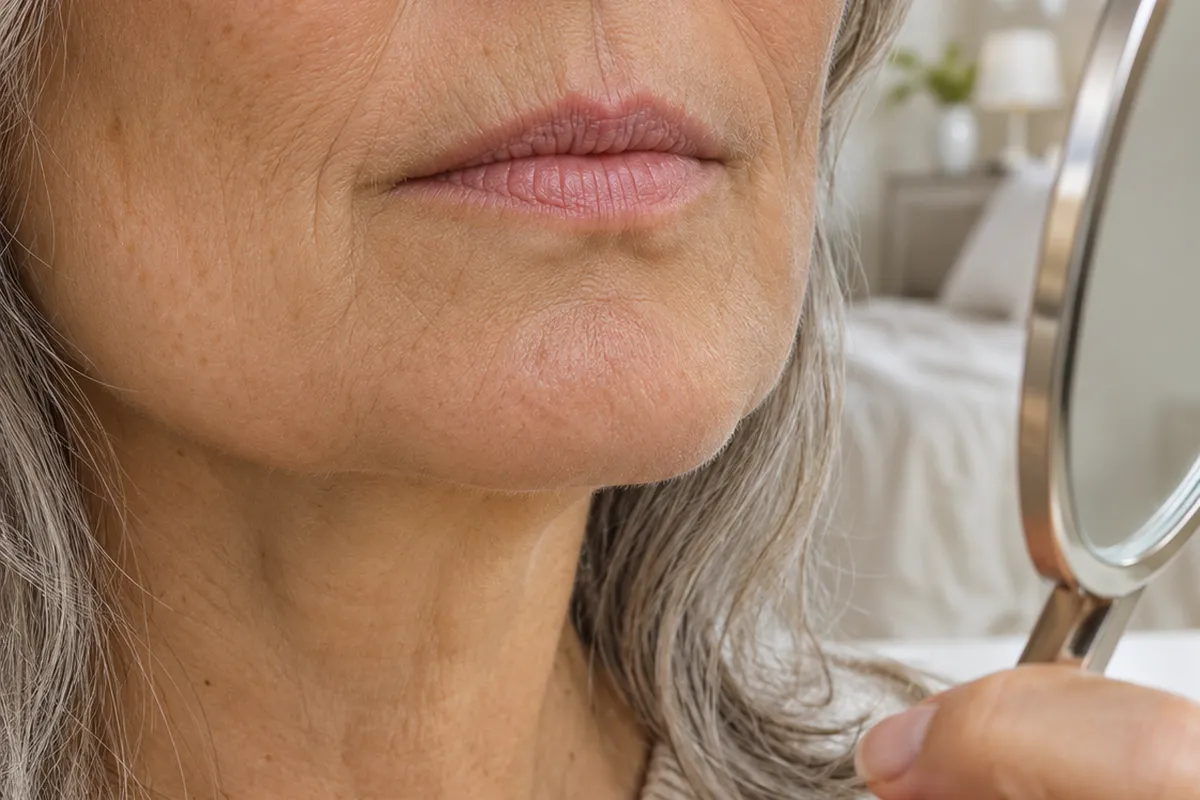
Imaging studies show that the lip does not "sag": the upper lip becomes longer and, at the same time, loses thickness and volume.
 Luxmed TeamAuthor
 Dr Michelle CampagnoliClinical review · OM no. 69467
In this article
The lips are one of the areas of the face where ageing shows earliest, and also one of the least explained. The common idea is that "the lip sags". But imaging studies show that what happens is mainly something else: the upper lip becomes longer and, at the same time, loses thickness and volume.
Understanding these changes helps in choosing the right treatment. A lip that has lost volume responds well to hyaluronic acid. A lip that has lengthened a great deal may need a different approach.
Three ideas to remember.
What changes in the lips with age
The upper lip lengthens
A retrospective study analysed MRI scans of 100 women and 100 men, comparing a group aged 20 to 30 with another aged 65 to 80. In the older group, the upper lip was about 19% longer in women and 18% in men. The thickness of the soft tissues was about 41% lower in women and 33% lower in men (Ramaut et al., 2019).
In practice, this means that less of the red lip and less of the upper teeth are seen at rest. It is one of the signs that most "ages" the mouth, even before wrinkles appear.
The lip thins and loses shape
- The red of the lip becomes narrower and less projected.
- The border between the lip and the skin loses the small ridge that reflects light.
- The Cupid's bow and the philtral columns flatten.
- The corners of the mouth turn down and may form marionette lines.
Inside the lip
A histological analysis compared the upper lips of younger and older people and found differences in the skin, in the connective tissue and in the orbicularis oris muscle of the mouth (Penna et al., 2009). The skin loses collagen and elasticity, and the muscle that gives the lip its shape and projection also changes.
Bone and dental support
The lips rest on the teeth and the upper jaw. With age, the facial skeleton undergoes reabsorption in specific areas, including the region around the nasal opening and the front part of the upper jaw (Mendelson and Wong, 2012). Tooth wear, loss of teeth and poorly fitting dentures reduce this support even further. The result is a more recessed lip with less apparent volume.
What speeds up the process
| Factor | What it does |
|---|---|
| Sun | Ultraviolet radiation degrades collagen and elastic fibres. The lower lip, being more exposed, is the most affected (Yaar and Gilchrest, 2007) |
| Tobacco | It reduces skin collagen and favours premature ageing (Morita, 2007). The gesture of pursing the lips accentuates vertical wrinkles |
| Rapid weight loss | It reduces the volume of fat in the face, including around the mouth |
| Dental problems | Less support for the lip and changes in the bite |
| Genetics | It determines the starting thickness and the pace of ageing |
How to prevent it
It is not possible to stop the lips from ageing, but it is possible to slow it down:
- Daily lip sun protection, with a high SPF, reapplied throughout the day and after eating or drinking.
- Do not smoke. It is the modifiable factor with the greatest impact on the area around the mouth.
- Lip hydration with simple balms, avoiding frequent licking of the lips.
- Look after the teeth. Treating tooth loss and adjusting dentures maintains the support of the lip.
How it is treated
Treatment depends on which of the changes predominates:
- Loss of volume and definition: hyaluronic acid, in moderate amounts, to restore volume and redraw the contour. There are dedicated articles: Restoring lip volume without overdoing it and Defining the lip contour with hyaluronic acid.
- Thin skin and wrinkles around the mouth: skinbooster, fractional CO2 laser or, in some cases, small amounts of hyaluronic acid in the wrinkles.
- Very long upper lip: filler helps little and can leave the lip heavy. An assessment for a surgical lip lift may be justified.
- Downturned corners of the mouth: hyaluronic acid and, sometimes, botulinum toxin in the muscle that pulls the corners down.
For perioral ageing, reviews recommend combining approaches rather than treating everything with volume alone (Wollina, 2013).
At Luxmed Clinic
At Luxmed, we start by understanding what has changed in your lip: volume, length, contour or skin. That determines whether the treatment involves hyaluronic acid, skin quality treatments, a combination or, when it makes sense, a surgical referral.
Talk to us
The assessment is a conversation, with no obligation. Tell us what concerns you and our team will reply.
This article is for information purposes and does not replace a consultation. The results of any treatment vary from person to person.
Frequently asked questions
From what age do the lips start to lose volume?
The changes are gradual and can be noticed from the age of 30 to 40, depending on genetics, sun and smoking.
Do men also lose volume in the lips?
Yes. In the MRI study, men also had longer and thinner upper lips with age, although with slightly smaller differences.
Do lip creams restore volume?
No. They can hydrate and improve the look of the surface, but they do not restore lost volume.
Do dental implants help?
Replacing missing teeth restores some of the support to the lip. Sometimes dental adjustment should come before the aesthetic treatment.
Why does my upper lip seem to disappear?
Probably because it has lengthened and lost volume at the same time. In these cases, the assessment should measure the length of the lip before deciding on the treatment.
Scientific references 6
- Ramaut L, Tonnard P, Verpaele A, et al. Aging of the upper lip: Part I. A retrospective analysis of metric changes in soft tissue on magnetic resonance imaging. Plast Reconstr Surg. 2019;143(2). doi:10.1097/PRS.0000000000005190. Artigo
- Penna V, Stark GB, Eisenhardt SU, Bannasch H, Iblher N. The aging lip: a comparative histological analysis of age-related changes in the upper lip complex. Plast Reconstr Surg. 2009;124(2):624-628. Artigo
- Mendelson B, Wong CH. Changes in the facial skeleton with aging: implications and clinical applications in facial rejuvenation. Aesthetic Plast Surg. 2012;36(4):753-760. Artigo
- Yaar M, Gilchrest BA. Photoageing: mechanism, prevention and therapy. Br J Dermatol. 2007;157(5):874-887. Artigo
- Morita A. Tobacco smoke causes premature skin aging. J Dermatol Sci. 2007;48(3):169-175. Artigo
- Wollina U. Perioral rejuvenation: restoration of attractiveness in aging females by minimally invasive procedures. Clin Interv Aging. 2013;8:1149-1155. Artigo
Editing and development: Rúben Brito · Operial Development
Keep exploring