Algés, Oeiras Mon to Fri · 09:00 to 13:00 and 14:00 to 19:00 · Sat · 09:00 to 14:00
WhatsApp Book a consultation

Facial aesthetics

Lips that have lost volumeWhen your lips are thinner and less defined than they used to be and you want to understand why

As the years go by, the lips change: the pink part is less visible, the outline softens, lines appear around the mouth and the upper lip can become longer. It is not just a matter of a “lack of volume”. Studies show that the skin of the lip becomes thinner, the muscle around it loses mass and the fibres that give it elasticity weaken, so the lip also droops. Then there are sun, tobacco, weight loss and the teeth, which count for more than people think. Here we explain what usually lies behind it, what hyaluronic acid and PRF can and cannot do, how to restore volume without overdoing it, and when a medical assessment is advisable before any treatment, at Clínica Luxmed, in Algés.

Reviewed by Dr Michelle Campagnoli, clinical director

  • 3treatments that the clinic may consider
  • 1assessment, always first
  • Nocommitment
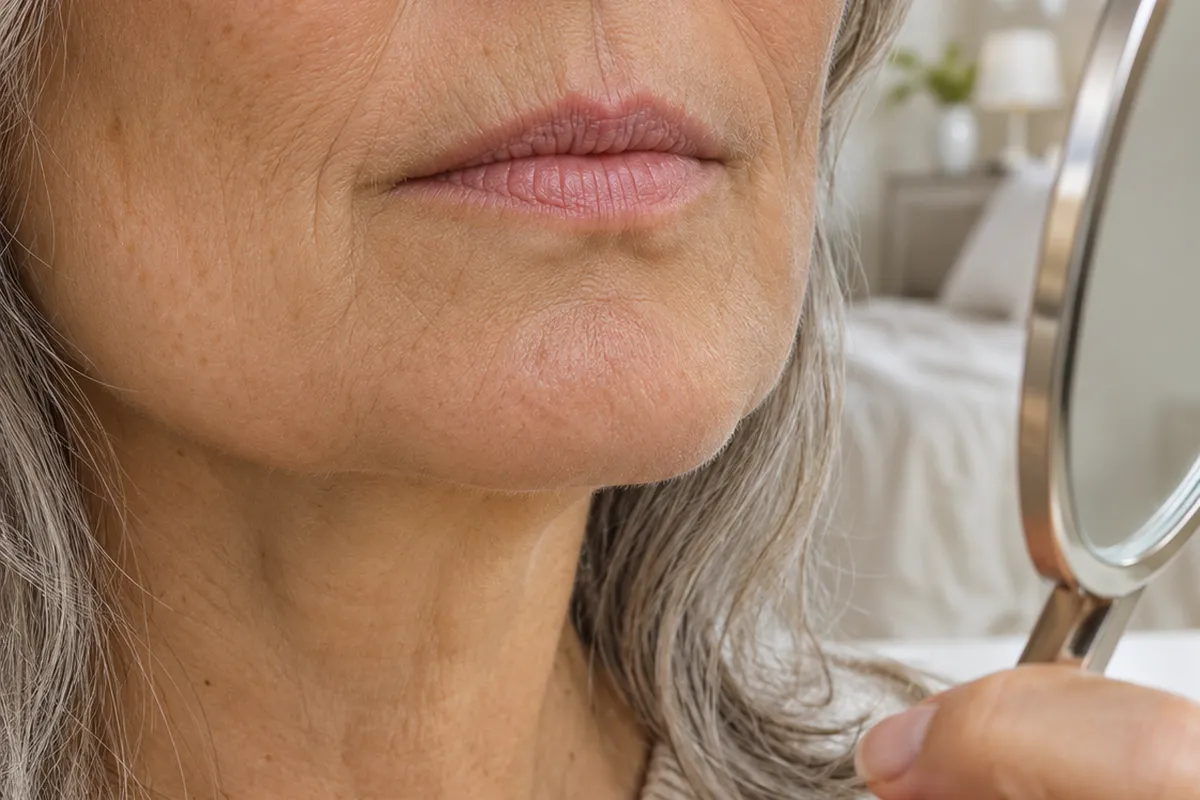
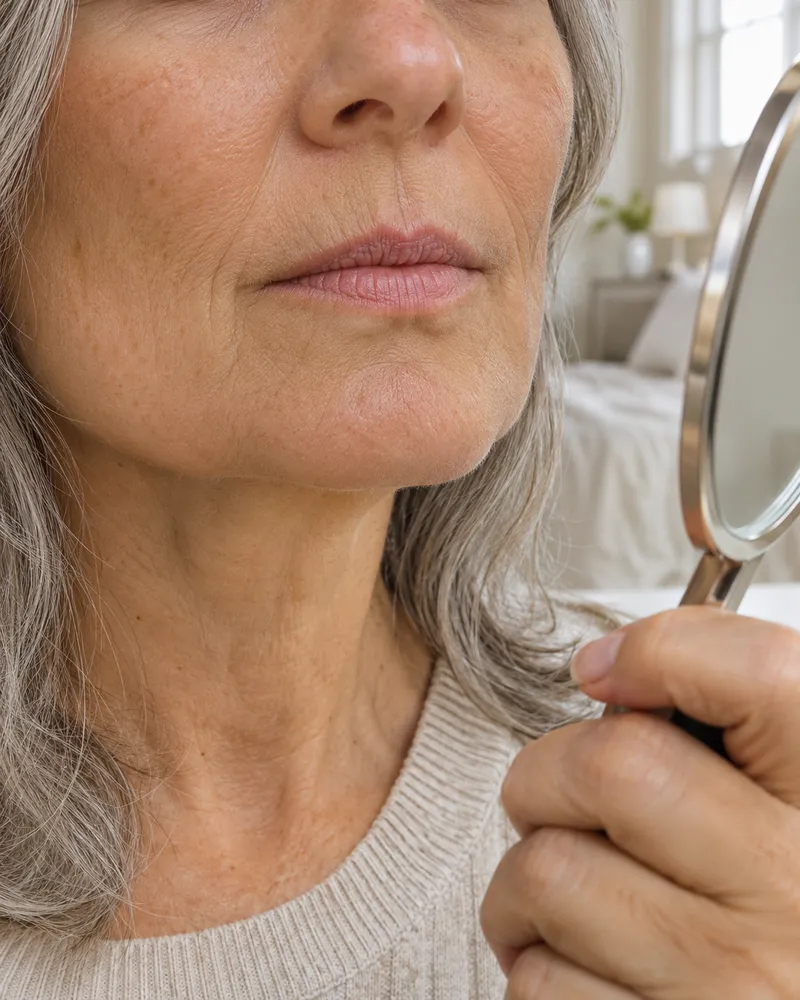
Grey-haired woman holding a hand mirror, with thin lips and vertical lip lines

How to recognise it

Is it loss of volume in the lips?

Lips do not all lose volume in the same way: in some the pink part becomes thinner, in others the outline softens or the upper lip lengthens. These signs help you understand what has changed before the assessment.

Tick what you recognise0/7

Tick the signs you recognise in your case. This is not a diagnosis, it is only meant to give you an idea.

Do you have a sore, a white or red patch, a crust or a rough area on the lip that does not heal within three weeks, or that bleeds? Have your lips changed quickly, on one side only, or is your mouth opening less and less? You need a medical assessment before any treatment. Sudden swelling of the lip with difficulty breathing or swallowing: call 112. Have you had a filler and have severe pain, pale, dark or purplish skin, a change in vision, a severe headache or weakness in the face? It is an emergency: call 112 and contact immediately whoever carried out the treatment. Out of hours, call SNS 24: 808 24 24 24.

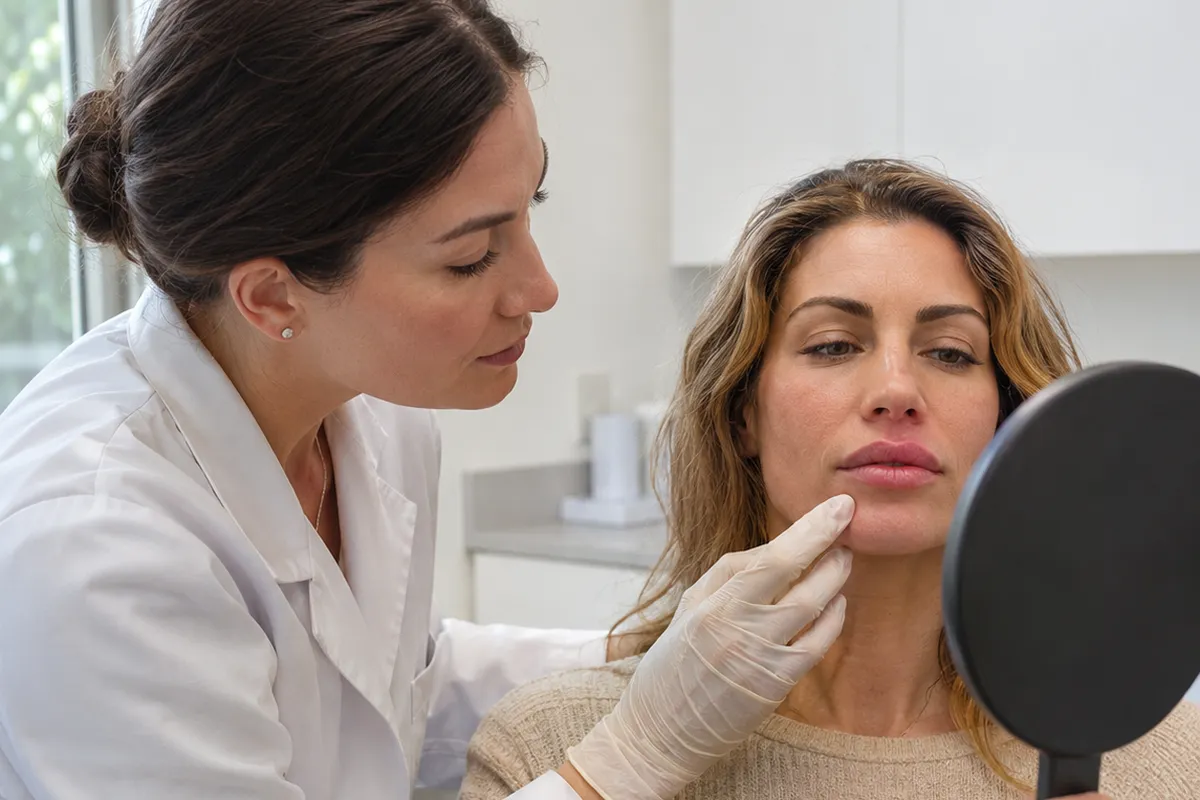
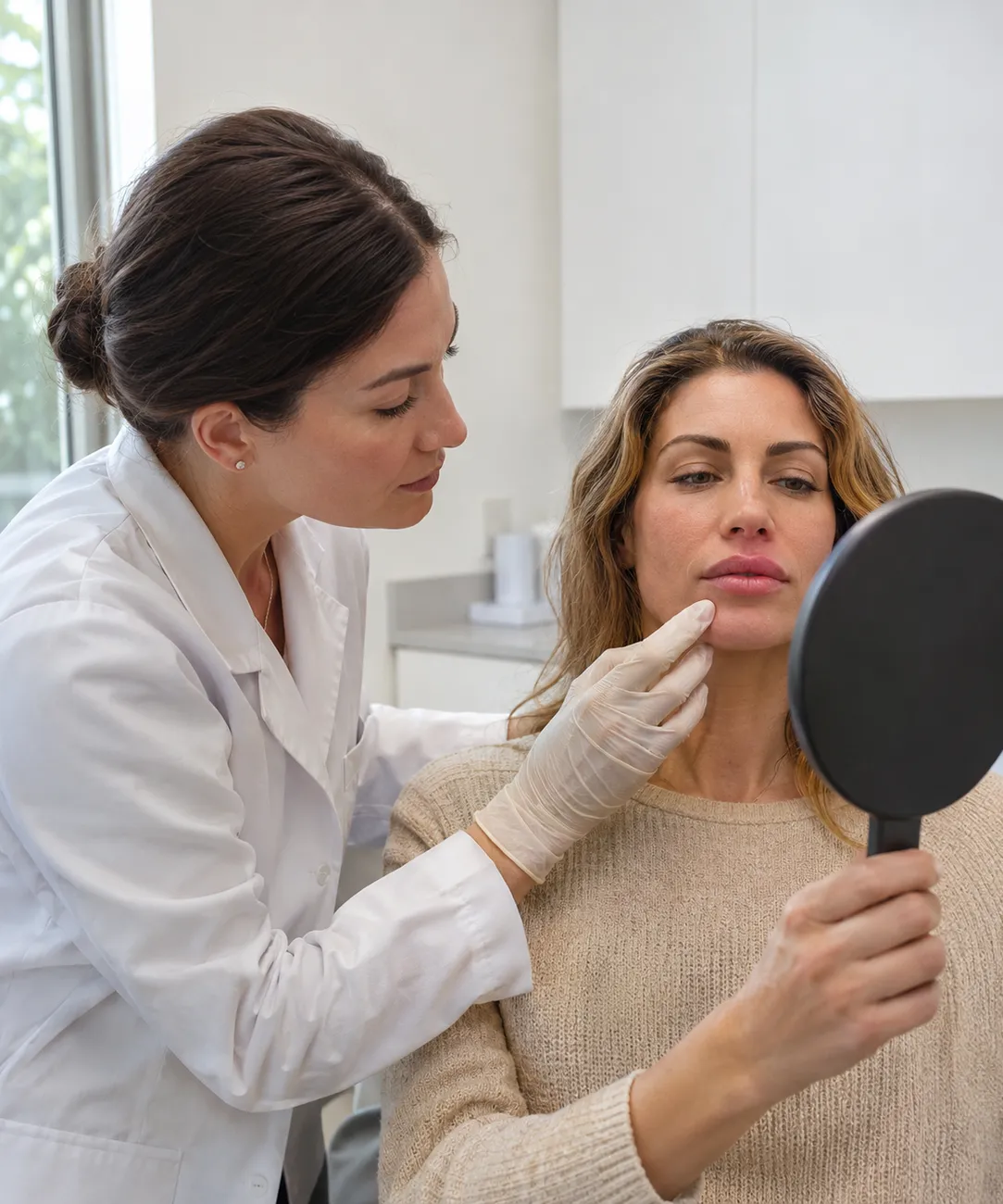
Doctor assessing the lips of a patient holding a hand mirror
Photograph of a consultation. The dots mark what the doctor is assessing.

Why it happens

What may lie behind thinner lips

There is almost always more than one cause at the same time. Choose a situation to see how it may contribute and what usually helps.

Ageing of the lip

In a study of upper lips from young and very elderly people, it was seen that the skin becomes thinner, the orbicularis muscle of the lips loses mass and the collagen and elastin fibres degenerate. The authors concluded that the aged appearance is due mainly to loss of elasticity and to the descent of the upper lip, and not only to a total loss of volume. That is why the pink part is less visible and the lip lengthens.

What weighs on it

Expecting that restoring volume alone will resolve everything, when part of the change is the lip descending and lengthening.

What helps

An assessment that distinguishes what is volume, what is skin and what is the length of the lip, before choosing what to do.

Normal or to be assessed

Expected change or something to assess

Most lips that lose volume change gradually, with age. But some situations call for an assessment before any treatment, because volume is only the visible part.

  • What it looks like. The lips have gradually become thinner over the years, in a similar way on both sides, with a softer outline, lines around the mouth and a longer upper lip.

  • When it is noticed. In photographs, when smiling, when putting on lipstick, or after a period of weight loss, the menopause or changes to the teeth.

  • What the clinic does. The doctor listens to the history, examines the lip from the front and in profile and confirms what has changed, before proposing whatever makes sense.

  • At home. Protecting from the sun, moisturising, reviewing habits and allowing time to decide, without hurry and without comparing your lips with those of other people.

Sudden swelling of the lip with difficulty breathing or swallowing, or, after a filler, severe pain, pale, dark or purplish skin, a change in vision, a severe headache or weakness in the face? Call 112 and contact immediately the clinic that carried out the treatment. If you have a sore that does not heal or a rapid change, out of hours you can call SNS 24: 808 24 24 24.

Book an assessment

What the clinic may consider

Options for restoring volume in the lips

First, what can be changed is looked after: sun protection, hydration, habits, teeth and any health causes. Only then, and after an assessment, is a procedure considered. For this topic, the clinic’s catalogue associates hyaluronic acid, PRF and skinbooster. Hyaluronic acid is what restores volume and outline, and it has the most studies: in a meta-analysis of randomised trials, about 60% improved in volume and 68% were satisfied, but half had some adverse effect, mainly swelling, firmness, bruising and tenderness, and serious ones were rare. PRF uses the person’s own blood to stimulate skin regeneration, and skinbooster serves mainly to hydrate the skin around the mouth. For these two, the specific evidence for the lips is scarce, and neither adds volume like hyaluronic acid. Results vary from person to person and are temporary.

Book an assessment
Dr Michelle Campagnoli, clinical director of Clínica Luxmed

First step

Assessment consultation

The doctor listens to what you are experiencing, examines your case and explains the suitable options. No treatment begins without this consultation.

May be considered when

you want to understand the cause and decide on the best path, with time and without commitment.

Book an assessment
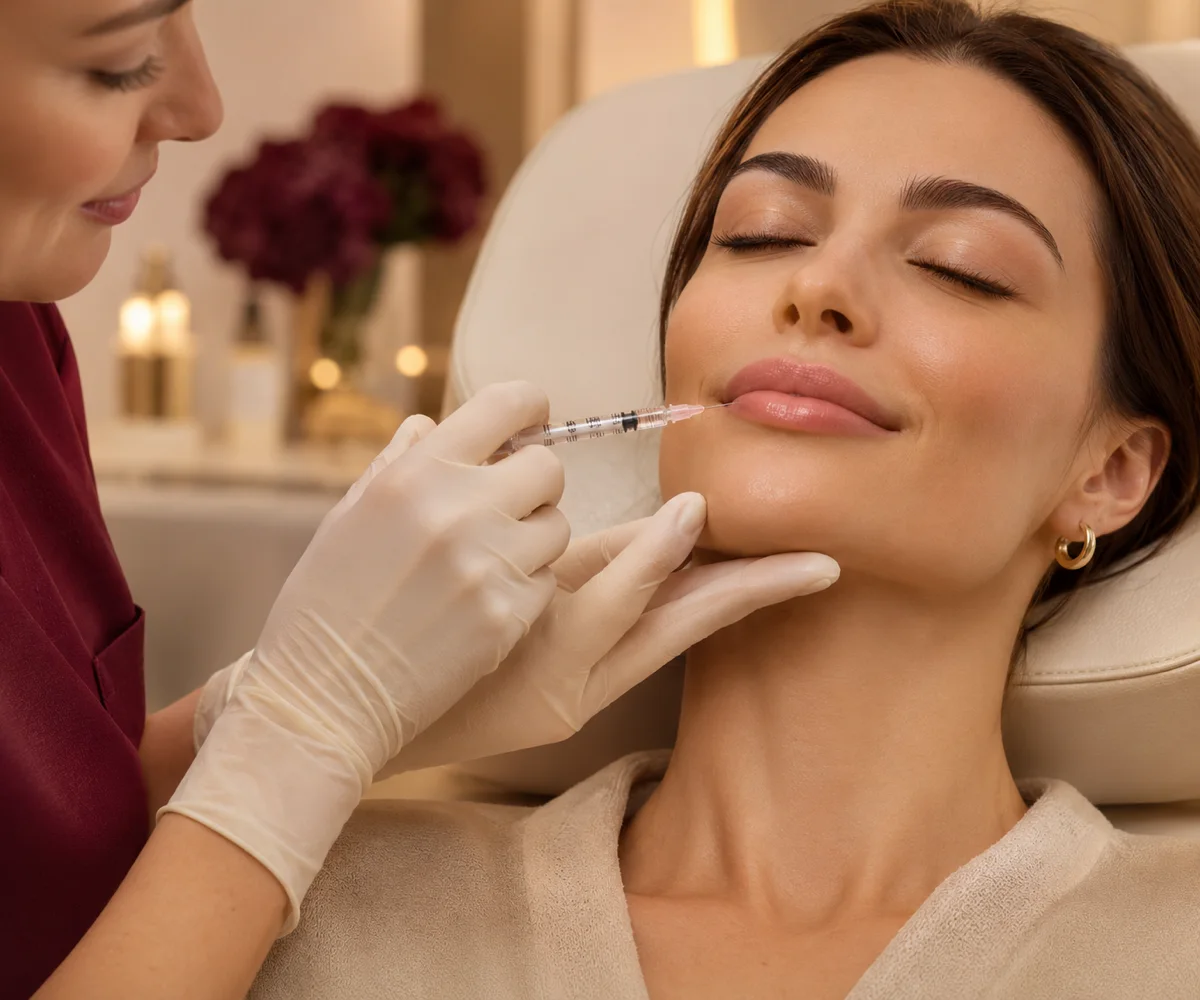
Doctor wearing gloves giving an injection beside the lip of a patient lying down, in a consulting room with warm light

Volume and contour

Hyaluronic acid

Hyaluronic acid gel injected in small amounts to restore volume, redefine the outline of the lip and soften the lines around the mouth, gradually. It is temporary, because the body absorbs it over time, and it can be dissolved by a doctor with hyaluronidase when a correction is needed. The aim is a lip that is in proportion to the face, and not a “big” lip.

May be considered when

the lip has lost volume and outline, the skin, habits and teeth have already been reviewed, there is no lesion, infection or active cold sore in the area, you are not pregnant or breastfeeding, and the doctor has explained the risks, including vascular ones, and what is realistic to expect.

Find out more
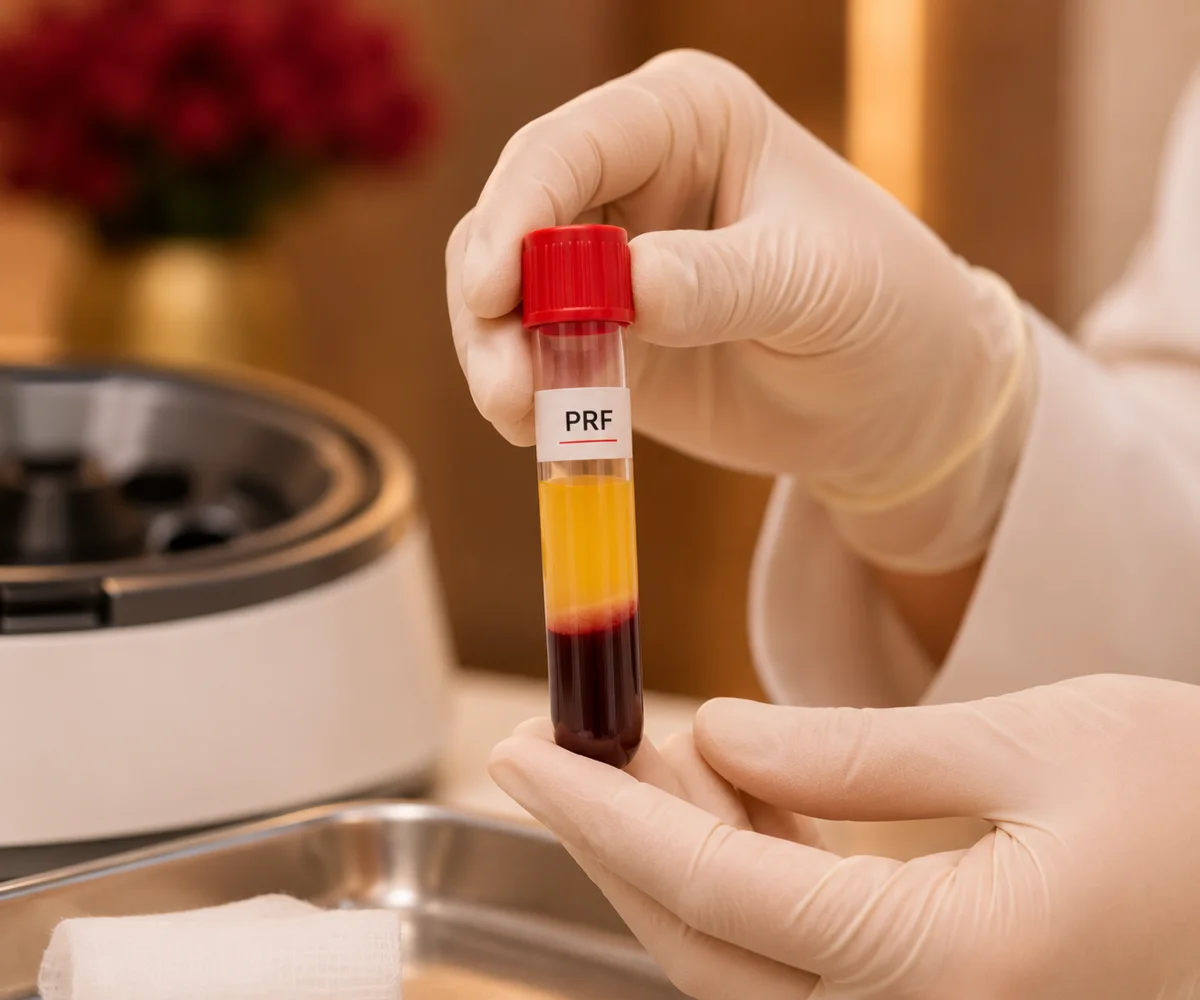
Gloved hands holding a PRF tube after centrifugation, beside the centrifuge, in warm light

Regeneration with your own blood

PRF

A small blood sample is taken and centrifuged to obtain platelet-rich fibrin, which is applied to the skin to stimulate natural regeneration and improve firmness and texture. Because it is made from the person’s own blood, it does not bring immediate volume as hyaluronic acid does, and specific data for the lips are scarce.

May be considered when

the concern is mainly the texture and firmness of the skin of the lip and of the area around the mouth, and not only a lack of volume, and the doctor has confirmed there is no contraindication, for example blood disorders or anticoagulant medication.

Find out more

What the journey looks like

From the first conversation to a plan tailored to you

No procedure begins without an assessment consultation with the doctor. Almost always, the simplest measures come first, and only then is anything more considered.

  1. 01At the clinic

    Telling your story

    The doctor asks what has changed in the lips, since when, what bothers you most, which treatments you have had and how they went, and what you expect. Habits, medication, cold sores, and pregnancy or breastfeeding are part of the conversation.

  2. 02At the clinic

    Examine the lips and the face

    The lips are observed from the front, in profile and when smiling, along with the skin, the mucosa, the length of the upper lip, the proportion between the two lips and the teeth. If there is a lesion or a change outside the norm, you are referred on before any treatment.

  3. 03At home

    Protect and care

    The first step is what is within your reach: sun protection for the lips, hydration, less tobacco and alcohol, and a dental consultation when the teeth or dentures play a part. In many cases this improves the appearance and prepares the skin.

  4. 04Over time

    Decide and follow up

    If restoring volume makes sense, the doctor explains the option, the amount, what to expect, how long it lasts and what the risks are, without promising results. We prefer to go slowly, in small amounts, and to follow up and adjust, including maintenance.

Day to day

What helps at home

What you do at home matters more than you might think. These are sensible measures to take while you wait for your consultation and alongside the clinic’s plan.

The golden rule

Protect and moisturise first, restore volume afterwards

Protecting and moisturising does not give back the volume that has already been lost, but it slows part of what is still to come and leaves the skin in better condition for any treatment. And a lip that has changed quickly, on one side only, or with a sore that does not heal should be seen by a doctor instead of being “filled”.

Protect from the sun

The lip has almost no natural protection, and the sun speeds up dryness and loss of elasticity.

In practice: a balm with a sun protection factor, applied in the morning and reapplied throughout the day, especially outdoors.

Moisturise the mouth

A dry lip looks thinner and more wrinkled.

In practice: an emollient balm, without fragrance or menthol, and drinking water throughout the day.

Review your habits

Tobacco and alcohol are associated with more lines and with an upper lip that droops more.

In practice: if you smoke, ask your GP for help to stop; if you drink, cut down.

Record and bring to the consultation

It helps the doctor see what has changed, and with what.

In practice: photographs from a few years ago and from now in the same light, and a list of previous treatments, medication and dental appointments.

Dr Michelle Campagnoli, clinical director of Clínica Luxmed

Who will look after you

An assessment carried out by the doctor

At Luxmed, in Algés, the first step is always an assessment with Dr Michelle Campagnoli. She is the one who examines the lips and the face, works out what has changed and whether there is anything to investigate, and decides with you what makes sense, before any procedure.

  • Physical examination and medical historyA conversation about what has changed, habits, teeth and previous treatments, and an examination of the lips from the front and in profile.
  • A plan tailored to youA clear plan, without promises, in stages, with follow-up over time.
  • No obligationThe cost of any treatment is confirmed only after the assessment.
Book an assessment

Book a consultation

Book your consultation

Choose how you prefer to get in touch. We will arrange the assessment consultation with Dr Michelle Campagnoli.

Booking through the websiteAssessment consultationTalk to our assistant on WhatsApp and ask for the current price of the assessment.

New Life Miraflores, Algés · Office Center, R. Santa Teresa do Menino Jesus n.º 6, 9.º C, 1495-048

Your details are used only for this contact. Any treatment depends on a prior medical assessment.

Request an appointmentIt takes less than a minute.
Speciality
You do not need to go into detail. The doctor will talk to you during the consultation.
Request received. Our team will contact you as soon as possible.
Why do the lips lose volume with age?

Because the lip changes from within: the skin becomes thinner, the muscle around it loses mass and the collagen and elastin fibres weaken, and the upper lip descends and lengthens. Added to this are sun, tobacco, dehydration, weight loss and changes in the teeth and bone, and, for many women, the menopause. That is why the first step is to understand what has changed in your case.

Is it just loss of volume, or does the lip also droop?

Studies suggest that the aged look of the lip is due more to loss of elasticity and descent of the upper lip than to a total loss of volume. In practice, the pink part is less visible, the upper lip becomes longer and the distance to the nose increases. Restoring volume helps with the pink part and the outline, but it does not shorten an upper lip that has lengthened, and for that case there are other approaches, which the doctor assesses with you.

Do sun, tobacco and teeth have anything to do with this?

Yes. The skin of the lip has little natural protection and the sun speeds up dryness and loss of elasticity. Tobacco is associated with more facial wrinkles, and in a study of men of the same age the upper lip drooped more in those who consumed a lot of tobacco and alcohol. When teeth are missing, worn or dentures no longer fit well, the lip loses support and looks thinner. For that reason, it is worth looking at these factors before thinking about volume.

How can volume be restored to the lips without overdoing it?

With an assessment of the proportions of your face, in small amounts, in stages, and accepting that the aim is a lip in proportion, and not the largest possible. An ultrasound study showed that, in many lips, the space under the skin is very small, and the product easily ends up in the muscle, which calls for technique and individual planning. Going slowly, adding only what is needed and reviewing after a few weeks is safer than doing everything at once.

Is hyaluronic acid the only option? What about PRF and skinbooster?

It is not the only one, but it is the one that restores volume and outline, and the one with the most studies. The clinic’s catalogue also associates PRF, which uses the person’s own blood to stimulate skin regeneration, and skinbooster, which hydrates the skin deeply. For these two, the specific evidence for the lips is scarce, and neither adds immediate volume as hyaluronic acid does. The doctor tells you, at the assessment, what makes sense in your case, and whether it makes sense to combine them or to wait.

How long does a lip filler last and how is it maintained?

Hyaluronic acid is temporary: the body gradually absorbs it. Duration varies from person to person and with the product, the amount and the area, and the lips, because they move a lot, tend to absorb it faster than other areas. Top-ups are needed to maintain the appearance, at intervals set by the doctor, and sun protection, hydration and habits count as much as the product. There are no guaranteed or permanent results.

What are the risks and when is it an emergency?

The most common effects are swelling, firmness, bruising and tenderness in the first few days, and in a meta-analysis of trials serious effects were rare. The most serious risk is the product entering a blood vessel, which can block circulation and, in rare cases, cause necrosis of the skin or loss of vision. Severe pain, pale, dark or purplish skin, a change in vision, a severe headache or weakness in the face after a filler are an emergency: call 112 and contact immediately whoever carried out the procedure. Hyaluronidase, which dissolves hyaluronic acid, should only be used by a doctor, and you should not self-medicate or massage the area on your own.

Are the results natural? And what if I end up with lumps or asymmetry?

They can be, when the volume is small and in proportion, but “natural” depends on the amount and the technique. A swollen, slightly uneven lip in the first few days is normal. If lumps, firmness, pain or asymmetry appear that do not improve, go back to the clinic that carried out the treatment: it is a reason to reassess and, if necessary, the doctor can dissolve the product with hyaluronidase. Do not ignore it or wait for months.

Can I have it done with a cold sore, or if I am pregnant or breastfeeding?

Always tell the doctor if you have cold sores: an active infection or sore postpones treatment, and if cold sores are frequent, it is worth discussing how to prevent them before any injection in the lip. Filler is not recommended during pregnancy and breastfeeding, owing to a lack of safety data. PRF and skinbooster are also postponed, and the doctor explains what can be expected.

When should I see a doctor first and what should I bring to the consultation?

Book a consultation if the lip has changed quickly or on one side only, if you have a sore, patch or crust that does not heal within three weeks or that bleeds, if your mouth is opening less and less, or if you have had a filler and have lumps, firmness or pain. Bring photographs from a few years ago and from now, and a list of previous treatments and medication. If in doubt, out of hours call SNS 24 (808 24 24 24); with sudden swelling of the lip and difficulty breathing, or signs of a complication after a filler, call 112.

We could not find that question. Ask us on WhatsApp

Scientific references

This page is based on the sources below and was reviewed by Dr. Michelle Campagnoli. Last updated on .

  1. Penna V, Stark GB, Eisenhardt SU, Bannasch H, Iblher N. The aging lip: a comparative histological analysis of age-related changes in the upper lip complex. Plastic and Reconstructive Surgery 124(2):624-628, 2009.
  2. Raschke GF, Rieger UM, Bader RD, Schaefer O, Guentsch A. Perioral aging: an anthropometric appraisal. Journal of Cranio-Maxillo-Facial Surgery 42(5):e312-e317, 2014.
  3. Koh JS, Kang H, Choi SW, Kim HO. Cigarette smoking associated with premature facial wrinkling: image analysis of facial skin replicas. International Journal of Dermatology 41(1):21-27, 2002.
  4. Stojanovič L, Majdič N. Effectiveness and safety of hyaluronic acid fillers used to enhance overall lip fullness: a systematic review of clinical studies. Journal of Cosmetic Dermatology 18(2):436-443, 2019.
  5. Edward Wen Y, Perez Rivera LR, Wyatt HP, Lee WY, et al. Efficacy and safety of hyaluronic acid lip fillers: a systematic review and meta-analysis of randomized controlled trials. Aesthetic Surgery Journal 46:NP24-NP32, 2026.
  6. Harris S, Schelke L, Orlovska M, Wortsman X, Cotofana S, et al. Ultrasound evaluation of lip anatomy and filler placement: a cross-sectional study of injection accuracy, migration, and demographic variation. Plastic and Reconstructive Surgery 158:65e-75e, 2026.
  7. Beleznay K, Carruthers JDA, Humphrey S, Carruthers A, Jones D. Update on avoiding and treating blindness from fillers: a recent review of the world literature. Aesthetic Surgery Journal 39(6):662-674, 2019.
  8. Urdiales-Gálvez F, Delgado NE, Figueiredo V, Lajo-Plaza JV, et al. Treatment of soft tissue filler complications: expert consensus recommendations. Aesthetic Plastic Surgery 42(2):498-510, 2018.
  9. U.S. Food and Drug Administration (FDA). Dermal fillers (soft tissue fillers). FDA, página de informação ao consumidor (conteúdo atualizado em 2023-07-06), 2023.
CallAssistantAvailableBook