


- Home
- Facial aesthetics
- Chin with an orange-peel look
- Orange-peel chin
Orange-peel chin: the muscle that wrinkles the skin
When speaking, drinking or making a doubtful expression, the chin can fill with dimples. The cause is almost always the mentalis muscle, and there is a simple treatment.
 Luxmed TeamAuthor
 Dr Michelle CampagnoliClinical review · OM no. 69467
In this article
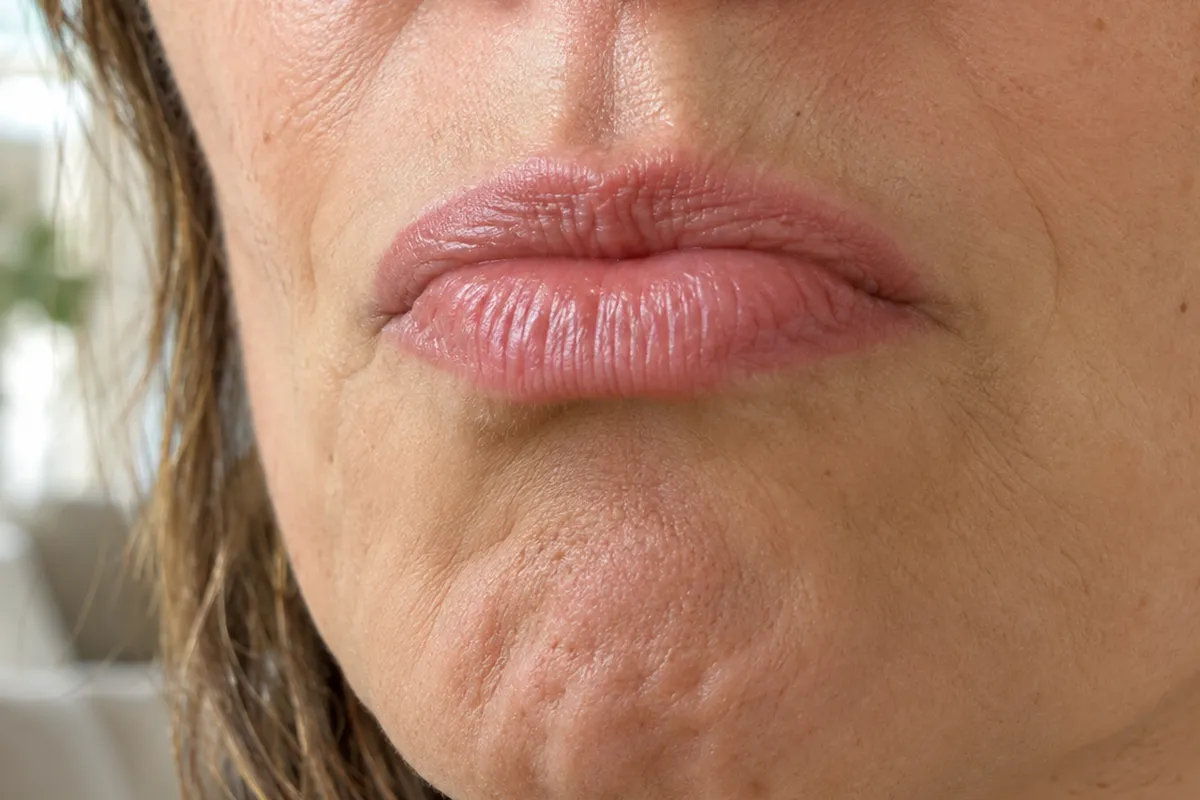
When speaking, drinking or making a doubtful expression, some people see their chin fill with small dimples, like the skin of an orange. In some people, this texture is visible even at rest. The cause is almost always the mentalis muscle, a small but strong muscle that pulls the skin of the chin upwards. It is a common problem, rarely talked about, and it has a simple treatment.
Three ideas to remember.
The mentalis muscle
The mentalis is a pair of small muscles in the centre of the chin. When it contracts, it lifts the skin of the chin and pushes the lower lip upwards and outwards, as in an expression of doubt or pouting. Because the fibres insert directly into the skin, the contraction creates small depressions on the surface, with an orange-peel appearance.
Why it is more visible in some people
Receding chin or lips that do not close well
In people with a receding chin, prominent front teeth or lips slightly apart at rest, the mentalis muscle has to work harder to close the mouth. It is contracted much of the time, and the dimples become almost permanent.
Loss of volume and bone
With age, the chin bone resorbs and the fat above it decreases (Mendelson and Wong, 2012). The skin has less support and the contractions of the muscle become more noticeable.
Habits
Facial tension, pressing the lips together when concentrating or stressed and some tics contribute to more frequent contraction.
How to recognise it
| What you notice | What it may indicate |
|---|---|
| Dimples only when speaking or drinking | Very active muscle, chin with good support |
| Dimples at rest | Permanently contracted muscle or lack of support |
| Deep horizontal wrinkle above the chin | Combination of muscle and loss of volume |
| Small or receding chin in profile | Lack of bony projection, which overloads the muscle |
How it is treated
- Botulinum toxin: small doses in the mentalis muscle reduce the contraction and smooth the skin of the chin. The efficacy of the toxin in dynamic facial wrinkles is well established (Camargo et al., 2021). There is a dedicated article: Botulinum toxin in the chin: how it smooths the skin.
- Hyaluronic acid: when the chin is receding or has little volume, giving the chin projection reduces the effort of the muscle and improves the profile. In a randomised trial, 56% of treated patients had improvement in chin retrusion at six months, compared with 28% in the control group (Beer et al., 2021).
- Combination: often the most effective solution. There is a dedicated article: Wrinkled and receding chin: when to combine treatments.
At Luxmed Clinic
At Luxmed, we assess the chin from the front and in profile, at rest and while speaking. Understanding whether the problem is only the muscle or also a lack of support determines whether toxin is enough or whether it makes sense to combine it with hyaluronic acid.
Talk to us
The assessment is a conversation, with no obligation. Tell us what concerns you and our team will reply.
This article is for information purposes and does not replace a consultation. The results of any treatment vary from person to person.
Frequently asked questions
Is an orange-peel chin cellulite?
No. It is caused by the muscle and has no relation to cellulite.
Is it a sign of ageing?
It can appear in young people, especially with a receding chin. With age, it tends to become more pronounced.
Do creams solve it?
No. The problem lies in the muscle and the support, which creams do not change.
Do braces or dental appliances have an influence?
The position of the teeth and jaw can influence the effort of the muscle. In some cases, an orthodontic assessment makes sense.
Is it a quick treatment?
Yes. Toxin in the chin takes a few minutes.
Scientific references 3
- Mendelson B, Wong CH. Changes in the facial skeleton with aging: implications and clinical applications in facial rejuvenation. Aesthetic Plast Surg. 2012;36(4):753-760. doi:10.1007/s00266-012-9904-3 Artigo
- Camargo CP, Xia J, Costa CS, et al. Botulinum toxin type A for facial wrinkles. Cochrane Database Syst Rev. 2021;7:CD011301. doi:10.1002/14651858.CD011301.pub2 Revisão Cochrane
- Beer K, Kaufman-Janette J, Bank D, et al. Safe and effective chin augmentation with the hyaluronic acid injectable filler, VYC-20L. Dermatol Surg. 2021;47(1):80-85. doi:10.1097/DSS.0000000000002795 Artigo
Editing and development: Rúben Brito · Operial Development
Keep exploring