


- Home
- Body aesthetics
- Body radiofrequency microneedling
- Radiofrequency microneedling for stretch marks
Radiofrequency microneedling for stretch marks
Radiofrequency microneedling combines the micro-injuries created by microneedling with radiofrequency heat in the dermis. See what the studies say and how it compares with other options.
 Luxmed TeamAuthor
 Dr Michelle CampagnoliClinical review · OM no. 69467
In this article
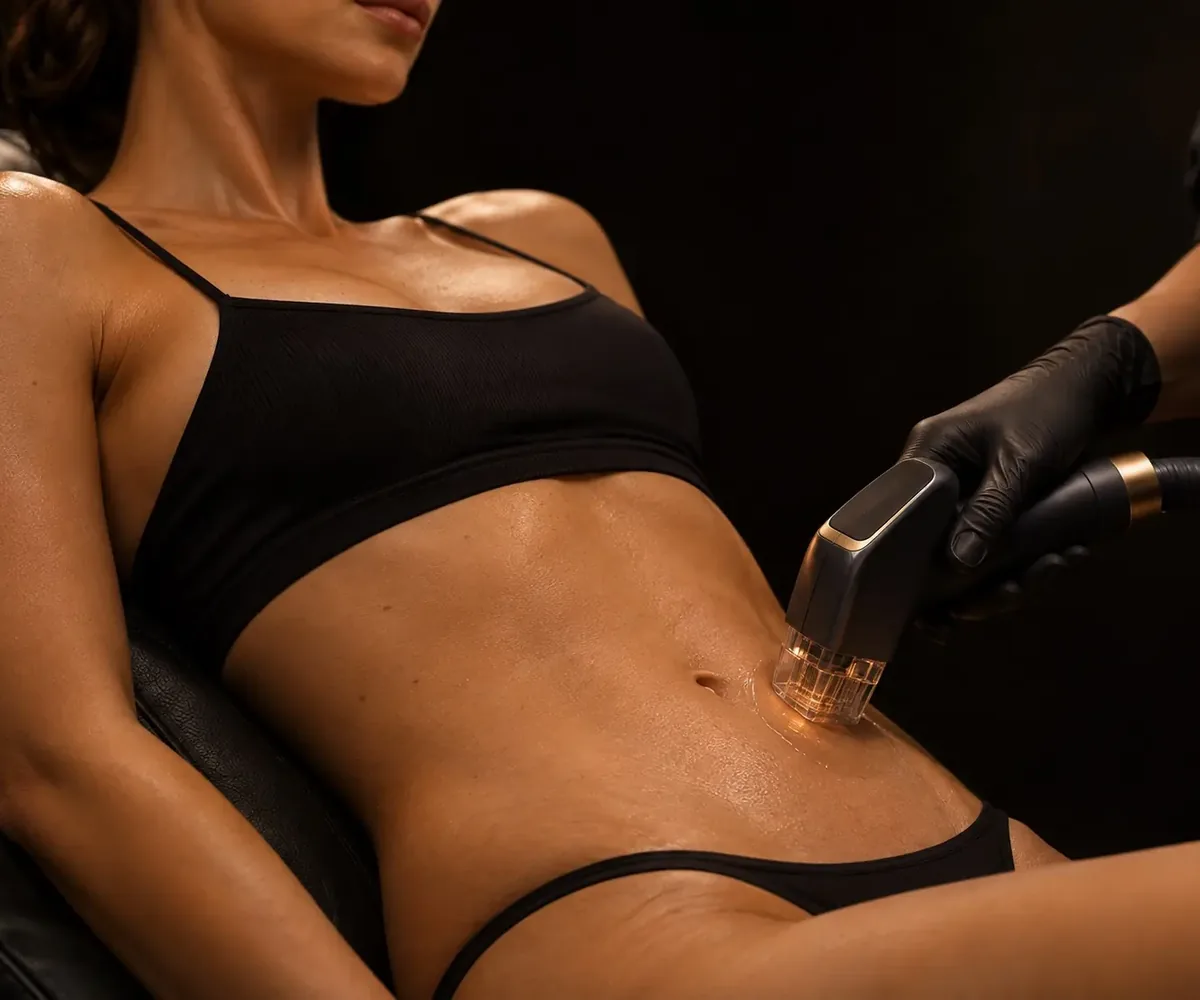
Radiofrequency microneedling for stretch marks combines two mechanisms which, even on their own, can improve stretch marks: the micro-injuries created by microneedling and radiofrequency heat. By delivering energy directly into the dermis, where the stretch-mark scar lies, it aims to achieve more intensive remodelling with little damage to the surface. We explain what the studies say and how it compares with other options.
Three ideas to remember.
Why it may work
In stretch marks, the problem lies in the dermis: broken and disorganised collagen and elastic fibres. Treatments that act only on the surface have a limited effect. Radiofrequency microneedling delivers heat directly to the dermis, causing collagen contraction and remodelling while largely sparing the skin surface.
What the studies say
| Study | Study design | Result |
|---|---|---|
| Fractional bipolar radiofrequency, 2016 (Harmelin et al., 2016) | Randomised trial with objective assessment, abdominal stretch marks | Improvement in recent and older stretch marks, particularly when combining techniques |
| Radiofrequency microneedling versus CO2 laser, 2019 (Sobhi et al., 2019) | Comparative study | Improvement with both techniques |
| Radiofrequency microneedling with and without CO2 laser, 2016 (Naeini et al., 2016) | White stretch marks | The combination was more effective |
| Systematic review, 2021 (Seirafianpour et al., 2021) | Various treatments | Combinations produce the best results for white stretch marks |
These are small studies using different devices and protocols. The overall findings are positive, but they do not establish that any one technique is clearly superior to the others.
Red and white
| Feature | Red stretch marks | White stretch marks |
|---|---|---|
| Expected response | Good | Moderate |
| Usual number of sessions | 2 to 3 | 3 to 4 |
| Useful complementary treatments | Microneedling | Microneedling, fractional laser |
Benefits and limitations
Advantages
- Works at depth with little injury to the surface.
- Also improves laxity in the skin around the stretch marks.
- Lower risk of pigmentation changes than ablative lasers, according to a review of skin phototypes III to VI (Syder et al., 2023).
Boundaries
- More uncomfortable than standard microneedling.
- Stretch marks do not disappear.
- Results vary considerably from person to person.
Recovery
- Redness and swelling for 2 to 5 days.
- Tiny dots or fine scabs.
- Avoid sun exposure, swimming pools and strenuous exercise for the first few days.
- The result develops gradually over 3 to 6 months.
At Luxmed Clinic
At Luxmed in Algés, near Lisbon, the assessment takes into account the stage of the stretch marks, surrounding skin laxity and skin phototype to decide between microneedling, radiofrequency microneedling, laser or a combination.
Talk to us
The assessment is a conversation, with no obligation. Tell us what concerns you and our team will reply.
This article is for information only and does not replace a medical consultation.
Frequently asked questions
Is radiofrequency microneedling better than standard microneedling for stretch marks?
It may produce more intensive remodelling and also address laxity, but there are few studies directly comparing the two techniques.
How many sessions are needed?
Usually 2 to 4, spaced 4 to 6 weeks apart.
Does it work on older stretch marks?
It may improve older white stretch marks, with more modest results than for recent ones.
Is it safe for darker skin?
In general, it carries a lower risk of pigmentation changes than ablative lasers, but the settings must be adjusted.
Scientific references 5
- Harmelin Y, Boineau D, Cardot-Leccia N, et al. Fractionated bipolar radiofrequency and bipolar radiofrequency potentiated by infrared light for treating striae: a prospective randomized, comparative trial with objective evaluation. Lasers Surg Med. 2016;48(3):245-253. doi:10.1002/lsm.22458 Artigo
- Comparative study between the efficacy of fractional micro-needle radiofrequency and fractional CO2 laser in the treatment of striae distensae. Lasers Med Sci. 2019;34(7):1295-1304. doi:10.1007/s10103-019-02792-7 Artigo
- Naeini FF, Behfar S, et al. Promising option for treatment of striae alba: fractionated microneedle radiofrequency in combination with fractional carbon dioxide laser. Dermatol Res Pract. 2016;2016:2896345. doi:10.1155/2016/2896345 Artigo
- Seirafianpour F, Sodagar S, Mozafarpoor S, et al. Systematic review of single and combined treatments for different types of striae: a comparison of striae treatments. J Eur Acad Dermatol Venereol. 2021;35(11):2185-2198. doi:10.1111/jdv.17374 Artigo
- Radiofrequency and radiofrequency microneedling in skin of color: a review of usage, safety, and efficacy. Dermatol Surg. 2023;49(5):489-493. doi:10.1097/DSS.0000000000003733 Artigo
Editing and development: Rúben Brito · Operial Development
Keep exploring