


- Home
- Body mesoaesthetics
- Gordura localizada
- Spot fat reduction
Spot fat reduction: myth or reality
Training one area does not burn the fat that lies above it. See what more than fifty years of studies show, what does not work and what really changes an area.
 Rúben BritoAuthor
 Dr Michelle CampagnoliClinical review · OM no. 69467
In this article
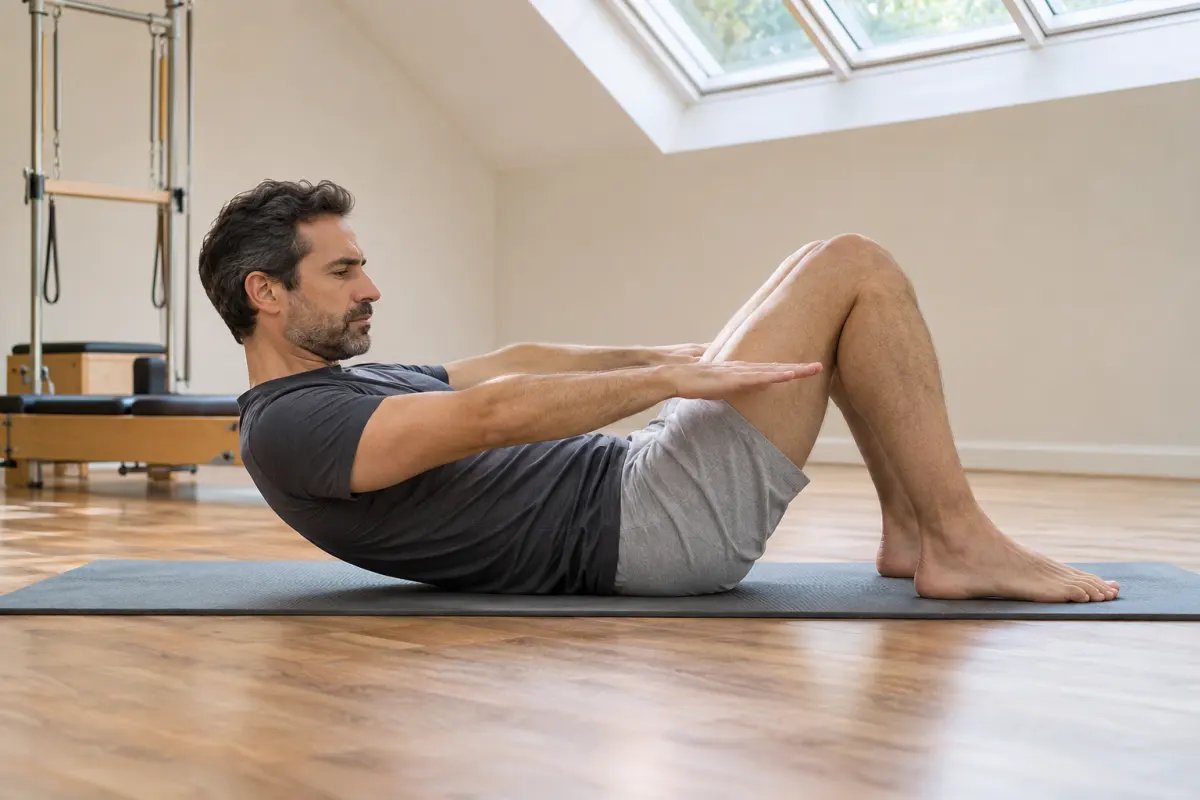
“100 sit-ups a day to get rid of belly fat”, “exercises to eliminate arm fat”, “specific training for saddlebags”. The idea that you can burn fat in an area by working the muscles of that area is one of the oldest and most persistent in the world of exercise. It even has a technical name in English: “spot reduction”.
It is an intuitive idea. Unfortunately, more than fifty years of research says that it does not work, at least not in any relevant way. But that does not mean it is impossible to change a specific area of the body. It means you have to use the right tools.
Three ideas to remember.
Fica por baixo do resumo, se existir uma segunda foto.
How the body uses fat
Fat is stored in cells (adipocytes) spread throughout the body, in the form of triglycerides. When the body needs energy, for example during exercise, the following happens:
- Hormonal signalAdrenaline, noradrenaline and the fall in insulin signal fat cells throughout the body to release their reserves.
- ReleaseTriglycerides are broken down into fatty acids and glycerol (lipolysis).
- TransportFatty acids enter the bloodstream and circulate around the body.
- UseThe muscles that are working take them up from the blood and use them as fuel.
The essential point is step 3: muscles do not “eat” the fat that lies above them. They use fat that comes from the blood, mobilised from many places at the same time, depending on each deposit's sensitivity to hormonal signals, genetics, sex and hormones.
That is why the order in which fat is lost is not chosen by the exercise you do. It is decided by the body itself, and the most “stubborn” areas are usually the last.
What the studies say
The classic studies
- Tennis players' arms (1971). Researchers (Gwinup et al., 1971) measured the subcutaneous fat of both arms in tennis players. The playing arm had more muscle, but the thickness of the fat above it was similar to that of the other arm. Years of intense work on one side only did not reduce the fat on that side.
- Sit-ups for 27 days (1984). One group did thousands of sit-ups over almost a month (Katch et al., 1984). Fat biopsies showed that the fat cells decreased in size similarly in the abdomen, buttocks and back. There was no preferential effect on the belly.
- Six weeks of abdominal exercise (2011). In a randomised trial (Vispute et al., 2011), abdominal exercise alone improved muscular endurance but did not reduce abdominal fat or waist circumference.
- Leg training for 12 weeks (2013). A leg-only training programme (Ramírez-Campillo et al., 2013) reduced body fat, but the loss was greater in the arms and trunk than in the trained legs.
The 2022 meta-analysis
Researchers (Ramirez-Campillo et al., 2022) pooled the results of 13 studies, with 1,158 participants aged between 14 and 71, comparing fat in trained and untrained limbs. The overall effect was practically zero and not statistically significant. Of the 37 comparisons, 17 favoured the trained limb and 20 the untrained one. The conclusion was clear: localised muscle training had no effect on localised fat, regardless of participants' characteristics or the exercise programme.
And the studies that found some effect?
There are some. A physiological study (Stallknecht et al., 2007) showed that blood flow and lipolysis increase slightly in the fat next to a contracting muscle, and some small trials reported modest local reductions. But the effects, when they exist, are small, inconsistent and insufficient to visibly change an area. When all the data are pooled, the signal disappears.
Why the myth persists
If the evidence is so consistent, why does the idea remain so alive?
- It is intuitive. It seems logical that a working muscle would “burn” what lies above it.
- The sensation is misleading. The muscle burn after many repetitions gives the impression that “something is happening there”. It is, but it is muscle fatigue, not local fat loss.
- The contour really does change. Training an area increases muscle tone and volume, and the area looks firmer and more defined. But it is not because fat has been lost locally.
- “Specific” programmes usually come with diet and general exercise. The overall fat loss that happens is attributed to the localised exercise.
- Marketing. The promise to “get rid of your belly in 30 days” sells more than “lose fat globally and be patient”.
So is localised exercise useless?
It is useful, and very much so, just for other things:
- Increases the strength and endurance of the muscles worked.
- It improves contour. Firmer buttocks, more defined arms, a stronger core, even with the same fat on top.
- It improves posture. A strong core and a well-aligned pelvis reduce the projection of the belly.
- It contributes to overall energy expenditure and to muscle mass, which help the whole body to lose fat.
- In abdominal diastasis, specific exercises, guided by a physiotherapist, are part of the treatment.
The message is not “do not do sit-ups”. It is “do not expect sit-ups to take fat off your belly”.
Girdles, sauna, creams and plants: what doesn't work
| Method | What it promises | What happens |
|---|---|---|
| Shaping girdles and “waist trainers” | Slimming the waist | They compress while worn. They do not eliminate fat. Worn very tight or for many hours, they can make breathing difficult and cause digestive discomfort |
| Thermal girdles and cling film during exercise | “Burning” fat with heat | They increase sweating and water loss, which is regained by drinking. They do not increase fat loss and can cause dehydration |
| Sauna | Eliminating fat | Water loss, not fat loss |
| “Fat-burning” creams | Reducing local fat | Some ingredients (such as caffeine derivatives) showed, in old, small studies, modest reductions in circumference; the results were not consistently reproduced and are, at best, small |
| “Thermogenic” supplements | Burning fat (sometimes “localised”) | There are no supplements that act on one area. Some have modest effects and risks (tachycardia, anxiety, interactions); avoid without medical advice |
| Vibration, home “muscle stimulation” | Toning and eliminating fat | They can activate muscles, but with no evidence of relevant local fat reduction |
A rule of thumb: if the method works mainly through sweating or compression, the result disappears when you drink water or take the girdle off.
What really changes an area
1. Losing fat from the whole body
The area that bothers you most will eventually change, even if it is one of the last. A moderate, sustained calorie deficit, with a protein-rich, minimally processed diet, is the foundation.
2. Full-body strength training, with attention to the area
It preserves muscle during fat loss and improves the contour of each area. Emphasising the muscles of the area that bothers you most (buttocks, core, arms) does not remove fat, but changes the shape.
3. Aerobic exercise
It increases energy expenditure and reduces visceral fat, even with little weight loss.
4. Sleep, stress and alcohol
Three factors that influence abdominal fat and appetite.
5. Body contouring treatments
Here is the exception to the rule: some treatments act directly on the subcutaneous fat of an area, rather than depending on global mobilisation. This is the case with cryolipolysis and some tissue-heating technologies, which can modestly reduce the thickness of fat in the treated area (Ingargiola et al., 2015), and with (surgical) liposuction, with more marked results. They make more sense in people close to their healthy weight, with localised deposits that resist, and should be preceded by an assessment that rules out visceral fat, diastasis or laxity as the main cause. See Flanks and belly that resist diet and exercise: why.
At Luxmed, we do not promise to “eliminate” fat from an area with exercises or creams. We assess what is causing the volume that bothers you and, when it makes sense, propose body contouring treatments with realistic expectations, alongside exercise and lifestyle guidance.
Talk to us
The assessment is a conversation, with no obligation. Tell us what concerns you and our team will reply.
Telephone 214 044 241 · info@luxmed.pt
This article is for information purposes and does not replace a consultation. The results of any treatment vary from person to person.
Frequently asked questions
Do sit-ups reduce belly fat?
Not directly. They strengthen the core and improve posture and contour, but belly fat only decreases with overall fat loss.
Can I lose fat only in my arms?
Not with exercise. You can lose fat globally and make the arms firmer with strength training.
Do shaping girdles slim the waist?
Only while you wear them. They do not eliminate fat.
Does sweating more in training burn more fat?
No. Sweat is water loss, which is regained by drinking.
Is there any way to lose fat in a specific area?
Body contouring treatments (such as cryolipolysis) and liposuction act directly on an area. Exercise, creams and girdles do not.
Why did I lose weight everywhere except the belly?
Because the order in which the body loses fat depends on genetics, sex and hormones. The belly and flanks are often among the last areas to change.
So is it not worth training the area that bothers me?
It is worth it, to improve strength, tone and contour. Just do not expect it, on its own, to take off the fat.
Scientific references 7
- Ramirez-Campillo R, Andrade DC, Clemente FM, Afonso J, Pérez-Castilla A, Gentil P. A proposed model to test the hypothesis of exercise-induced localized fat reduction (spot reduction), including a systematic review with meta-analysis. Human Movement. 2022;23(3):1-14. Artigo
- Gwinup G, Chelvam R, Steinberg T. Thickness of subcutaneous fat and activity of underlying muscles. Ann Intern Med. 1971;74(3):408-411. Artigo
- Katch FI, Clarkson PM, Kroll W, McBride T, Wilcox A. Effects of sit up exercise training on adipose cell size and adiposity. Res Q Exerc Sport. 1984;55(3):242-247. Artigo
- Vispute SS, Smith JD, LeCheminant JD, Hurley KS. The effect of abdominal exercise on abdominal fat. J Strength Cond Res. 2011;25(9):2559-2564. Artigo
- Ramírez-Campillo R, Andrade DC, Campos-Jara C, Henríquez-Olguín C, Alvarez-Lepin C, Izquierdo M. Regional fat changes induced by localized muscle endurance resistance training. J Strength Cond Res. 2013;27(8):2219-2224. Artigo
- Stallknecht B, Dela F, Helge JW. Are blood flow and lipolysis in subcutaneous adipose tissue influenced by contractions in adjacent muscles in humans? Am J Physiol Endocrinol Metab. 2007;292(2):E394-E399. Artigo
- Ingargiola MJ, Motakef S, Chung MT, Vasconez HC, Sasaki GH. Cryolipolysis for fat reduction and body contouring: safety and efficacy of current treatment paradigms. Plast Reconstr Surg. 2015;135(6):1581-1590. Artigo
Keep exploring