
Algés, Oeiras Mon to Sat · 09:00 to 13:00 and 14:00 to 19:00
WhatsApp Book a consultation

Aesthetic gynaecology

Drops of urine after urinatingOften simple to resolve, but worth understanding the cause

You urinated, wiped, stood up, and a few seconds later you feel a few drops wetting your underwear. This is called post-micturition dribble and, in women, it almost never has anything to do with the prostate: it is usually urine that stayed behind in the vagina or between the labia, the posture on the toilet or, less often, a weak pelvic floor, a prolapse or the changes of the menopause. Here we explain what may lie behind it, what helps at home, when to ask for an assessment and what the clinic can offer, with honesty about what the evidence says.

Reviewed by Dr Michelle Campagnoli, clinical director

  • 6possible causes, almost always simple to review
  • 1assessment consultation, always first
  • 70 €assessment booked through the website
Fotografia · gotas-de-urina-depois-de-urinar-hero800 × 1000 px · vertical 4:5Mulher de uns 42 anos, cabelo solto, de camisola clara, sentada junto a uma janela com luz natural, com uma chávena na mão e uma expressão tranquila, numa sala serena; fotografia de retrato, sem nudez nem qualquer zona íntima visível

How to recognise it

Could it be dribbling after urinating?

The clue is the timing: the urine comes out after you have finished, often when you stand up from the toilet, and not when coughing or with a sudden urge. What matters is when it happens, how you urinate and whether there are any other symptoms.

Tick what you recognise0/7

Tick the signs you recognise in your case. This is not a diagnosis, it is only meant to give you an idea.

Are you unable to pass urine, do you have a full, painful bladder, fever with lower back pain or burning when passing urine, blood in the urine, sudden loss of control with weakness in the legs, a “lump” or heaviness in the vagina, or does urine run out without effort or urge, or did this begin after surgery or pelvic radiotherapy? You need a prompt assessment. Out of hours, call SNS 24: 808 24 24 24.

Fotografia · gotas-de-urina-depois-de-urinar-consulta1083 × 1300 px · vertical 5:6Médica de bata branca sentada de frente para uma mulher de meia-idade, numa sala de consulta de luz natural, com um bloco de notas e um modelo anatómico da pelve em cima da secretária; ambiente acolhedor e reservado, sem qualquer imagem da zona íntima
Frame for a photograph of a consultation. The dots mark what the doctor assesses; the image does not show the intimate area.

Why it happens

What lies behind drops of urine after urinating

At the end of urination, whatever is left must all come out into the toilet. When some is held back, whether in the vagina, between the labia or in a “pouch” of the bladder, it runs out when you stand up. Choose a cause to see how it applies.

Urine that stays behind in the vagina

During urination, some of the urine can enter the vagina or stay between the labia instead of falling entirely into the toilet, and it runs out when you stand up. It happens more with the thighs together, with clothes tight around the knees, in women with fuller labia or with a more open vaginal entrance after births, and when there is excess weight.

What weighs on it

Standing up as soon as the stream slows, with thighs together and clothes at the knees.

What helps

Opening the knees, lowering clothes to the ankles and, if urine stays behind between the labia, parting them with the fingers.

Normal or to be assessed

Just drops at the end or another type of leakage

Not all urine leakage is dribbling. Understanding the type helps in choosing what to do, because the treatment depends on it.

  • What it looks like. A few drops just after finishing, often when standing up from the toilet, with no cough, no effort and no sudden urge beforehand.

  • When it happens. It usually depends on how you urinate: it gets worse with hurry, hovering and thighs together, and improves when you change posture and wait a few seconds.

  • What the clinic does. The doctor listens to how and when it happens, assesses the vulva, vagina and pelvic floor and confirms whether it is just dribbling.

  • At home. Sit properly, open your knees, lean your trunk forward, do not strain and wait a few seconds at the end, while you wait for the consultation.

Are you unable to pass urine with a full, painful bladder, or do you have a high fever with lower back pain, or sudden loss of control with weakness in the legs? Call 112 or go to the emergency department. If you have burning when passing urine, blood in the urine or doubts, out of hours you can call SNS 24: 808 24 24 24.

Book an assessment consultation

What can help

What helps with drops of urine after urinating

The first line is not a device: it is changing the way you urinate, treating whatever cause is found (a prolapse with pelvic floor training, a pessary or surgery; menopausal dryness with vaginal oestrogen, at a low dose and on prescription) and, if the pelvic floor is weak or poorly coordinated, training it with pelvic physiotherapy. A urethral diverticulum, when confirmed and causing symptoms, is generally treated with surgery. The treatments below are additional options, assessed case by case and without promising results: there are no studies testing them in post-micturition dribble and, in urine leakage in general, the evidence is limited.

Book an assessment consultation
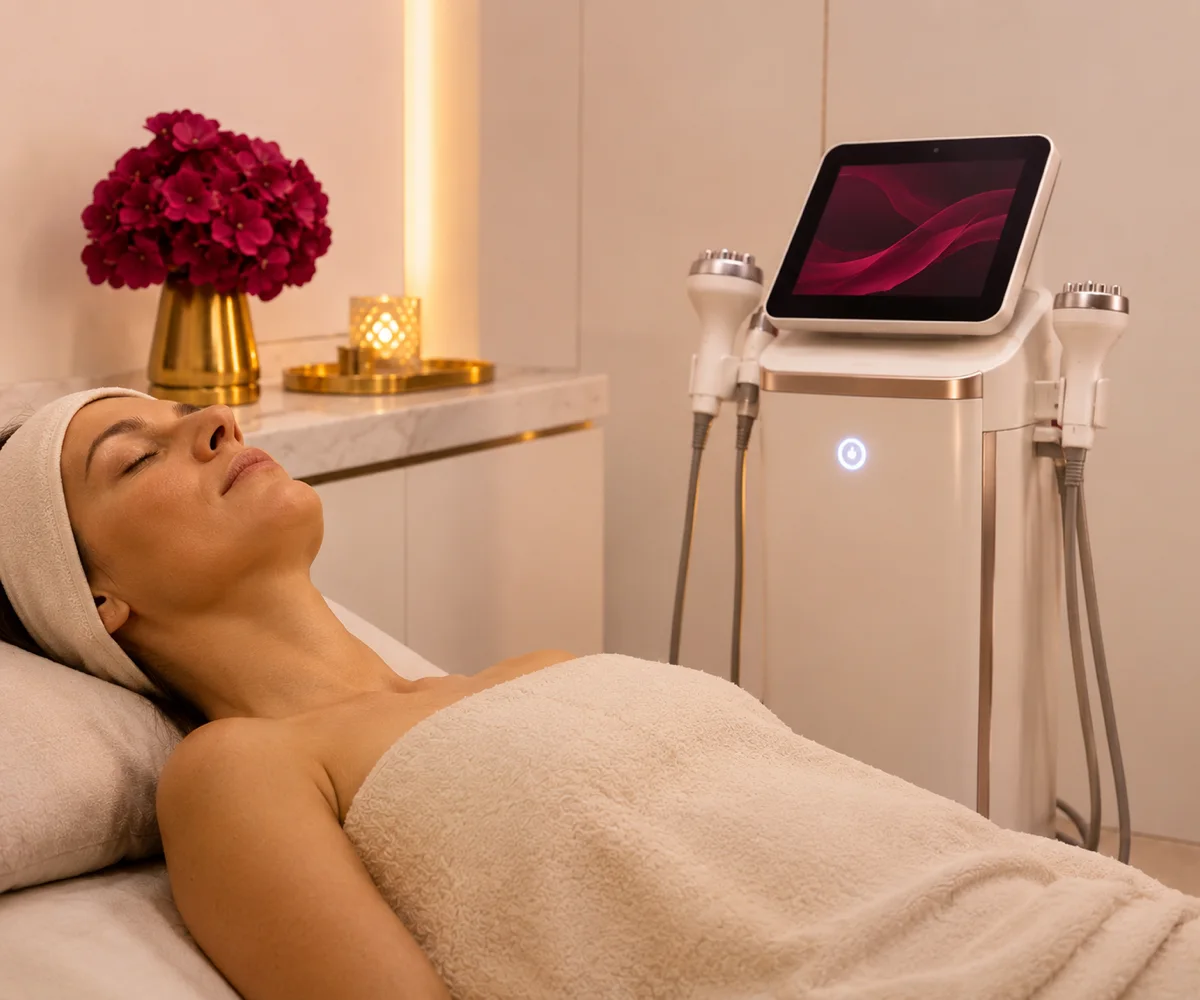
Private treatment room, with the device on an elegant trolley and a patient resting covered with a towel

Technology

Sectum, Neauvia radiofrequency (NRose Protocol)

Low-intensity radiofrequency energy, which aims to stimulate collagen in the intimate tissues. It does not treat the cause of the dribbling, does not replace posture or pelvic floor training and, in urine leakage in general, the evidence is still insufficient.

May be considered when

the cause has been assessed (prolapse, infection and incomplete emptying ruled out), the first-line measures have already been taken, there are other intimate complaints that the doctor considers treatable, and the decision is yours after hearing what is known and what is not known.

Find out more
The doctor preparing the laser device, with the protective glasses in the foreground

Technology

Fractional CO2 laser

Laser energy applied to the vaginal mucosa, which aims to renew the tissues. Results for urine leakage are inconsistent and in 2018 the FDA warned about the risks of these devices, which it has not approved for incontinence. There are no studies for post-micturition dribble.

May be considered when

the doctor has assessed your case, the first-line options have already been tried and the alternatives have been considered, after explaining the benefits and risks to you.

Find out more

And what does the evidence say? For post-micturition dribble, what helps is changing the way you urinate and treating the cause. For vaginal laser and radiofrequency, a review of sham-controlled trials (2026), carried out in stress urinary leakage, found a small, short-lived benefit: inconsistent with CO2 laser and still insufficient for radiofrequency, and there are no trials for dribbling. In 2018 the FDA (United States) warned that it had not approved these devices for treating urinary incontinence and that they can cause burns, scarring and pain. That is why the doctor explains all of this to you first, and none of these treatments replaces first-line care.

What the journey looks like

From the first consultation to the plan that suits you

No treatment starts without an assessment consultation with the doctor. This is how it works.

  1. 01At the clinic

    Assessment consultation

    The doctor listens to how and when the drops happen, how you urinate and whether you are left with the feeling of not emptying, asks about births, the menopause and infections, and lets you speak with privacy and without rushing.

  2. 02At the clinic

    Examination and urine test

    The vulva and vagina are observed, we look for prolapse, adhesions or a lump in the vaginal wall, the pelvic floor is assessed and a urine test is requested to rule out infection. If incomplete emptying is suspected, the urine left in the bladder is measured with an ultrasound scan.

  3. 03At the clinic and at home

    A plan tailored to you

    It starts with changing the way you urinate, treating whatever cause is found and, if it makes sense, pelvic floor training with pelvic physiotherapy. Only if appropriate does the doctor explain the other options.

  4. 04Over time

    Follow-up

    It is reassessed after a few weeks. If the drops continue, or if there is prolapse, suspicion of a diverticulum or incomplete emptying, you are referred to urology or urogynaecology.

Day to day

What helps in the toilet

Simple, free measures that usually resolve a large share of cases and help alongside the plan the doctor recommends.

It is not carelessness or hygiene

Changing the way you urinate is usually enough

Many women keep quiet about the problem because they think it is a lack of care, when it almost always has to do with the way the body empties the bladder: posture, hurry, urine that stays behind. Changing the way you urinate costs nothing, carries no risks and, in many women, resolves or improves it. If it does not resolve, do not stop at trying: ask for an assessment.

Sit properly, with feet supported

It lets the pelvic floor relax and the bladder empty completely.

In practice: sit fully on the toilet (use a seat cover or paper if you prefer), with your feet on the floor or on a small stool, and your trunk leaning slightly forward.

Open your knees and lower your clothes

It prevents urine from staying trapped between the thighs and the labia.

In practice: lower your clothes to your ankles and open your knees. If you notice that urine stays between the labia, part them with your fingers.

Do not strain, and wait at the end

It lets the bladder finish at its own pace and gives the last portion of urine time to come out.

In practice: relax your abdomen, breathe slowly and, when the stream ends, wait a few more seconds, lean a little further forward or gently rock your pelvis.

Urinating in two stages

It helps when you are left with a feeling of incomplete emptying.

In practice: after finishing, stand up slightly, sit down again and try once more. Wipe from front to back, with gentle dabs.

Dr Michelle Campagnoli, clinical director of Clínica Luxmed

Who will look after you

An assessment carried out by the doctor

At Luxmed, the first step is always an assessment consultation with Dr Michelle Campagnoli. She listens to how and when the drops happen, examines the vulva and vagina, assesses the pelvic floor, looks for prolapse or other causes and designs the plan with you, with privacy and without rushing, coordinating with pelvic physiotherapy or urology when needed.

  • Physical examination and medical historyConversation about how you urinate, examination of the vulva, vagina and pelvic floor, and urine test.
  • A plan tailored to youFirst posture and treating the cause; additional treatments only if appropriate, with the evidence explained.
  • No obligationThe cost of any treatment is confirmed only after the assessment.
Book an assessment consultation

Book a consultation

Book your consultation

Choose how you prefer to get in touch. We will arrange the assessment consultation with Dr Michelle Campagnoli.

Booking through the website100€70€Assessment consultationExclusive price for those who book the assessment through the website. Outside the website, the price is 100 €.

New Life Miraflores, Algés · Office Center, R. Santa Teresa do Menino Jesus n.º 6, 9.º C, 1495-048

Your details are used only for this contact. Any treatment depends on a prior medical assessment.

Request an appointmentIt takes less than a minute.
Speciality
You do not need to go into detail. The doctor will talk to you during the consultation.
Request received. Our team will contact you as soon as possible.
Why do I leak drops of urine after standing up from the toilet?

In most women, it is because some urine stayed behind in the vagina or between the labia during urination, and it runs out when you stand up. Changing posture usually solves it: sit properly, open your knees, do not hurry and wait a few seconds at the end. If it continues, there may be another cause, such as a prolapse, a weak pelvic floor or the changes of the menopause, and it is worth having it assessed.

Is it urinary incontinence?

Technically it is an involuntary loss of urine, called post-micturition dribble, but it has different causes from stress leakage (when coughing or laughing) and urgency leakage (sudden urge). That is why the treatment is also different, and telling the type apart is part of the assessment.

Is hovering when urinating harmful?

Now and then it is not serious, but as a habit it can prevent the pelvic floor from relaxing completely and the bladder from emptying fully. In a study of women at a gynaecology clinic, urinating while squatting reduced the flow by about 21% and increased the urine left in the bladder by about 149%. Whenever possible, sit down.

Do pelvic floor exercises (Kegel) help?

They help when the pelvic floor is weak or poorly coordinated, and they are the first treatment for stress urinary leakage. Contracting for a few seconds at the end of urination can help squeeze out the last drops, but it should not interrupt the stream midway, nor should the exercises be done in the toilet as a routine. If you are not sure you are contracting the right muscles, ask for an assessment by a pelvic physiotherapist.

What can I do to stop dripping after urinating?

Sit properly, with your feet supported, open your knees and lower your clothes to your ankles, lean your trunk slightly forward, do not strain, wait a few seconds after the stream ends and, if needed, urinate in two stages. If urine stays behind between the labia, part them with your fingers. If you still have it with these measures, book a consultation.

Can it be a sign of prolapse?

It can, especially if you also feel heaviness or a “lump” in the vagina, an urge to urinate again soon afterwards or if you have to push to pass urine. Bladder prolapse (cystocele) creates a “pouch” where urine is held back and can be treated, from pelvic floor training to a pessary and, in selected cases, surgery.

Do vaginal laser or radiofrequency solve drops of urine?

There is no evidence for post-micturition dribble, and in stress urinary leakage a review of sham-controlled trials found a small, short-lived benefit, inconsistent with CO2 laser and insufficient for radiofrequency. In 2018 the FDA warned that it had not approved these devices for treating urinary incontinence and that they can cause burns, scarring and pain. They do not replace changing the way you urinate or treating the cause, and the decision is always explained and shared with you.

Can the menopause be the origin?

It can contribute. The fall in oestrogen affects the tissues of the urethra and vagina and can cause urinary symptoms, and sometimes dribbling, alongside dryness and intimate discomfort. Low-dose vaginal oestrogen, on medical prescription, is the first line; women who have had breast cancer should decide with their oncologist.

Which tests are done?

A conversation about how and when it happens, the gynaecological examination, a urine test to rule out infection and, if incomplete emptying is suspected, an ultrasound scan to measure the urine left in the bladder after urinating. Magnetic resonance imaging only if a urethral diverticulum is suspected. A 3-day diary, in which you note what you drink, what time you urinate and when you leak urine, helps a great deal.

When should I book a consultation?

Book a consultation if the drops continue despite changing the way you urinate, if you have a feeling that the bladder does not empty, if you need to push a “lump” in the vagina to pass urine, if you have pain when passing urine or during sex, repeated urinary infections or a lump or painful area on the vaginal wall. If you have burning or blood in the urine, call SNS 24 (808 24 24 24). If you cannot pass urine, or have a high fever with lower back pain, call 112 or go to the emergency department.

We could not find that question. Ask us on WhatsApp

Scientific references

This page is based on the sources below and was reviewed by Dr. Michelle Campagnoli. Last updated on .

  1. Haylen BT, de Ridder D, Freeman RM, Swift SE, Berghmans B, Lee J, et al. An International Urogynecological Association (IUGA)/International Continence Society (ICS) joint report on the terminology for female pelvic floor dysfunction. Neurourology and Urodynamics 29(1):4-20, 2010.
  2. Abrams P, Cardozo L, Fall M, Griffiths D, Rosier P, Ulmsten U, et al. The standardisation of terminology of lower urinary tract function: report from the Standardisation Sub-committee of the International Continence Society. Neurourology and Urodynamics 21(2):167-178, 2002.
  3. Moore KH, Richmond DH, Sutherst JR, Imrie AH, Hutton JL. Crouching over the toilet seat: prevalence among British gynaecological outpatients and its effect upon micturition. British Journal of Obstetrics and Gynaecology 98(6):569-572, 1991.
  4. Wang K, Palmer MH. Women's toileting behaviour related to urinary elimination: concept analysis. Journal of Advanced Nursing 66(8):1874-1884, 2010.
  5. Greiman AK, Rolef J, Rovner ES. Urethral diverticulum: a systematic review. Arab Journal of Urology 17(1):49-57, 2019.
  6. National Institute for Health and Care Excellence (NICE). Urinary incontinence and pelvic organ prolapse in women: management (NG123). NICE guideline NG123, 2019.
  7. Dumoulin C, Cacciari LP, Hay-Smith EJC. Pelvic floor muscle training versus no treatment, or inactive control treatments, for urinary incontinence in women. Cochrane Database of Systematic Reviews 2018(10):CD005654, 2018.
  8. The NAMS 2020 GSM Position Statement Editorial Panel. The 2020 genitourinary syndrome of menopause position statement of The North American Menopause Society. Menopause 27(9):976-992, 2020.
  9. Milsom I, Gyhagen M. The prevalence of urinary incontinence. Climacteric 22(3):217-222, 2019.
  10. Modi RM, Hinton A, Pinkhas D, Groce R, Meyer MM, Balasubramanian G, et al. Implementation of a defecation posture modification device: impact on bowel movement patterns in healthy subjects. Journal of Clinical Gastroenterology 53(3):216-219, 2019.
  11. Lukanović D, Shah G, Matjašič M, Phillips C. The use of energy-based devices for the treatment of stress urinary incontinence: a systematic review and meta-analysis of the randomised sham-controlled trials. International Urogynecology Journal 37:2779-2790, 2026.
  12. Medsafe (Nova Zelândia), a retransmitir o alerta da U.S. FDA. Safety Information: energy-based devices used for vaginal 'rejuvenation' or vaginal cosmetic procedures (relays the USFDA safety communication of July 2018). Medsafe, New Zealand Medicines and Medical Devices Safety Authority, 2018.
CallAssistantAvailableBook
