
Algés, Oeiras Mon to Sat · 09:00 to 13:00 and 14:00 to 19:00
WhatsApp Book a consultation

Aesthetic gynaecology

Weak pelvic floorThe signs, the difference between weak and tense, and how it is assessed

The pelvic floor is the group of muscles that supports the bladder, the uterus and the bowel, helps to control urine, wind and stool and plays a part in sexual life. When it loses strength, the signs range from a small leak of urine when sneezing to a feeling of heaviness or reduced sensation, and many women live with them for years without knowing that treatment exists. Here we explain what you feel, why it happens, how the assessment tells a weak pelvic floor from one that is too tense and what the clinic can offer, with honesty about what the evidence says.

Reviewed by Dr Michelle Campagnoli, clinical director

  • 3months of supervised training: the recommended minimum
  • 1assessment consultation, always first
  • 70 €assessment booked through the website
Fotografia · pavimento-pelvico-fraco-hero800 × 1000 px · vertical 4:5Mulher de uns 42 anos, cabelo apanhado, de roupa de desporto clara e confortável, sentada num tapete de ioga numa sala luminosa, a respirar com calma e um sorriso sereno; fotografia de retrato, sem nudez nem qualquer zona íntima visível

How to recognise it

Could it be a weak pelvic floor?

Not all the signs are always present, and the first one is usually subtle. The signs divide by area: bladder, bowel, vagina and sexual life. What matters is what you feel, when and for how long.

Tick what you recognise0/7

Tick the signs you recognise in your case. This is not a diagnosis, it is only meant to give you an idea.

Do you feel a “lump” or heaviness in the vagina, are you unable to pass urine or empty the bladder, do you have blood in the urine or stool, fever with lower back pain or burning when passing urine, leakage without effort or with very marked urgency, or leakage after pelvic surgery or radiotherapy? You need an assessment, without waiting or trying to sort it out on your own. Out of hours, call SNS 24: 808 24 24 24.

Fotografia · pavimento-pelvico-fraco-consulta1083 × 1300 px · vertical 5:6Médica de bata branca sentada de frente para uma mulher de meia-idade, numa sala de consulta de luz natural, com um bloco de notas e um modelo anatómico da pelve em cima da secretária; ambiente acolhedor e reservado, sem qualquer imagem da zona íntima
Frame for a photograph of a consultation. The dots mark what the doctor assesses; the image does not show the intimate area.

Why it happens

What lies behind a weak pelvic floor

The pelvic floor works together with the abdominal muscles, the diaphragm and the back muscles. It loses strength for several reasons, almost always combined. Choose a situation to see how it applies.

Pregnancy and childbirth

During pregnancy the weight of the baby overloads the pelvic floor, and vaginal birth, especially with forceps or vacuum, stretches and can damage muscles, nerves and supporting tissues. The effect may only be noticed years later.

What weighs on it

Thinking that only a recent birth counts, or that a caesarean gives complete protection.

What helps

Pelvic floor training from pregnancy onwards and an assessment after the birth, even if the signs seem small.

Weak or tense

Pelvic floor weak or too tense

Not all pelvic floor problems are weakness. The muscles can also be too tense and unable to relax, and the two situations can coexist. They have different treatments.

  • What it looks like. Leakage of urine or wind with effort, heaviness in the vagina and reduced sexual sensation.

  • What usually happens. The signs are more noticeable at the end of the day, with coughing, exercise or constipation.

  • What the clinic does. The doctor assesses the strength, endurance and ability of the muscles to relax and looks for signs of prolapse.

  • What usually helps. Supervised pelvic floor training for at least 3 months, adapted to the result of the assessment.

Are you unable to pass urine, do you have sudden, severe pelvic pain, or have you suddenly lost control of urine or stool with weakness in the legs? Call 112 or go to the emergency department. If you have blood in the urine or stool, or doubts, out of hours you can call SNS 24: 808 24 24 24.

Book an assessment consultation

What can help

Treatments for a weak pelvic floor

The first line is training of the pelvic floor muscles, preferably supervised by pelvic physiotherapy and lasting at least 3 months, after an assessment that confirms there is weakness. It can include biofeedback or electrical stimulation for those who have difficulty contracting, and correcting constipation, cough and weight. If there is tension, the plan is different: relaxation, breathing and specific physiotherapy. If there is prolapse, there are the pessary and, in some cases, surgery. The treatments below are additional options, assessed case by case, without promising results, and are not suitable for a tense pelvic floor.

Book an assessment consultation
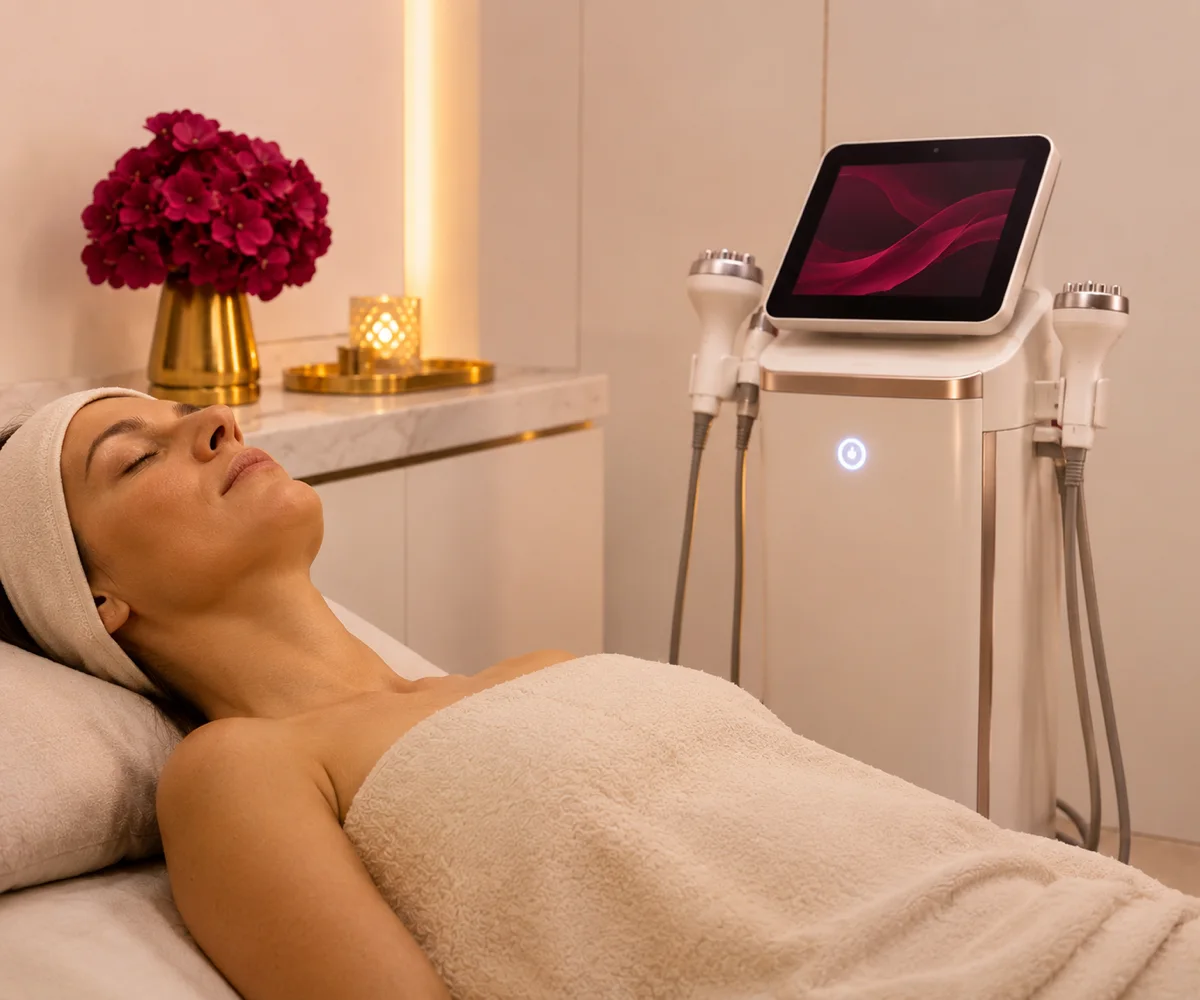
Private treatment room, with the device on an elegant trolley and a patient resting covered with a towel

Technology

Sectum, Neauvia radiofrequency (NRose Protocol)

Low-intensity radiofrequency energy, which aims to stimulate collagen in the intimate tissues. There is no evidence that it strengthens the pelvic floor muscles, and for urine leakage the evidence is still insufficient.

May be considered when

the assessment has confirmed weakness and not tension, supervised training has been done regularly and the symptoms persist, the doctor has explained what is known and what is not known, and the decision is yours.

Find out more
The doctor preparing the laser device, with the protective glasses in the foreground

Technology

Fractional CO2 laser

Laser energy applied to the vaginal mucosa, which aims to improve the quality of the tissues. It does not train the pelvic floor muscles, results for urine leakage are inconsistent and in 2018 the FDA warned about the risks of these devices, which it has not approved for incontinence.

May be considered when

the doctor has assessed your case, the first-line options have already been tried and the alternatives have been considered, after explaining the benefits and risks to you.

Find out more

And what does the evidence say? What has the most evidence for a weak pelvic floor is muscle training, especially when it is supervised and done regularly. For vaginal laser and radiofrequency, a review of sham-controlled trials (2026) assessed urine leakage and found a small, short-lived benefit: inconsistent with CO2 laser and still insufficient for radiofrequency. There is no evidence that they strengthen the muscle. In 2018 the FDA (United States) warned that it had not approved these devices for treating urinary incontinence or sexual function and that they can cause burns, scarring and pain. That is why the doctor explains all of this to you first, and none of these treatments replaces pelvic floor training.

What the journey looks like

From the first consultation to the training plan

No treatment starts without an assessment consultation with the doctor. This is how it goes, and you can interrupt or decline any part of the examination.

  1. 01At the clinic

    Assessment consultation

    The doctor listens to the urinary, bowel, sexual and prolapse symptoms, asks about births, surgery and habits, and lets you speak with privacy and without rushing.

  2. 02At the clinic

    Assessing the muscles

    The perineum is observed at rest, while contracting and while bearing down. With your consent, the strength, the time and the repetitions you can sustain and the ability to relax are assessed, and the position of the vaginal walls is measured to look for prolapse. The examination should not hurt, and it can be stopped.

  3. 03At the clinic and at home

    A plan tailored to you

    If there is weakness, it starts with supervised training, coordinated with pelvic physiotherapy. If there is tension, the plan is one of relaxation. Only if appropriate does the doctor explain the other options.

  4. 04Over time

    Follow-up

    It is reassessed after about 3 months. If the symptoms do not improve, or if there is prolapse, urogynaecology, the pessary or other routes are considered.

Day to day

What helps while you wait for the consultation

Simple measures that ease the load on the pelvic floor, alongside the plan the doctor recommends.

Before strengthening, understand what you have

More strength is not always the answer

Many women start doing Kegel exercises on their own, without knowing whether the muscles are weak or tense, or whether they are contracting the right ones. In a classic study, only about half contracted correctly after a brief verbal explanation, and some bore down. A quick assessment avoids months of badly directed training.

Feeling the muscles, gently

Understanding whether you can contract is the first step, but it does not replace the assessment.

In practice: lying down, with your knees bent, gently contract as if to hold back urine and wind, without holding your breath or squeezing your buttocks. If you feel nothing, feel pain or bear down, do not insist: ask for an assessment.

Contract before effort

It reduces leakage at the moments when the pressure in the abdomen rises.

In practice: contract the pelvic floor an instant before coughing, sneezing or lifting a weight.

Look after your bowel

Constipation and straining to pass a stool overload the pelvic floor.

In practice: drink water, eat fibre, rest your feet on a small stool at the toilet and do not strain.

Lifting weights with proper technique

It avoids pressure peaks on the pelvic floor.

In practice: breathe out as you make the effort, instead of holding your breath, and ask for help with heavy loads.

Dr Michelle Campagnoli, clinical director of Clínica Luxmed

Who will look after you

An assessment carried out by the doctor

At Luxmed, the first step is always an assessment consultation with Dr Michelle Campagnoli. She listens to what is happening, assesses the pelvic floor at rest and during contraction, checks whether there is weakness, tension or prolapse, rules out other causes and explains what she has found, with privacy and without rushing. The plan is tailored to you and coordinates with pelvic physiotherapy for guided training.

  • Physical examination and medical historyConversation about the symptoms, observation of the perineum and assessment of the muscles and of prolapse, with your consent.
  • A plan tailored to youSupervised training first; additional treatments only if appropriate, with the evidence explained.
  • No obligationThe cost of any treatment is confirmed only after the assessment.
Book an assessment consultation

Book a consultation

Book your consultation

Choose how you prefer to get in touch. We will arrange the assessment consultation with Dr Michelle Campagnoli.

Booking through the website100€70€Assessment consultationExclusive price for those who book the assessment through the website. Outside the website, the price is 100 €.

New Life Miraflores, Algés · Office Center, R. Santa Teresa do Menino Jesus n.º 6, 9.º C, 1495-048

Your details are used only for this contact. Any treatment depends on a prior medical assessment.

Request an appointmentIt takes less than a minute.
Speciality
You do not need to go into detail. The doctor will talk to you during the consultation.
Request received. Our team will contact you as soon as possible.
How do I know whether I have a weak pelvic floor?

The most common signs are urine leakage with effort, difficulty holding in wind, a feeling of heaviness or of a “lump” in the vagina, air coming out of the vagina and reduced sexual sensation. None of them is exclusive, and a pelvic floor that is too tense also causes symptoms. Confirmation comes from an assessment by a professional, who measures the strength, endurance and ability of the muscles to relax.

Can a weak pelvic floor be cured?

In most cases it improves a great deal with suitable, supervised training, lasting at least 3 months, and several signs, such as urine leakage, have good evidence of improvement with training. Results vary, and depend on whether the assessment has confirmed weakness, on how regularly you train and on other factors, such as weight, bowel and hormones. A cure is not promised, but there is a great deal that can be done.

Can I have a weak pelvic floor without having had children?

Yes. Age, the menopause, excess weight, chronic strain (constipation, cough, weights), pelvic surgery and genetic factors, such as more elastic tissues, also contribute. Pregnancy and childbirth are the best-known factor, but not the only one.

Weak or tense pelvic floor: how to tell the difference?

A weak one tends to cause leakage of urine or wind with effort, heaviness in the vagina and reduced sensation. A tense one tends to cause pain during sex at the entrance, difficulty starting to urinate, constipation, pelvic pain and pain when inserting a tampon. They can coexist, and only the examination tells them apart reliably. It matters because, with a tense pelvic floor, strengthening can make symptoms worse.

How do you strengthen the pelvic floor?

With pelvic floor muscle training (Kegel exercises) done with correct technique, preferably supervised by pelvic physiotherapy and lasting at least 3 months, with slow and quick contractions several times a day and contraction before effort. Biofeedback or electrical stimulation can be added for those who have difficulty contracting. Before starting, an assessment is advisable to confirm that there is weakness and that the right muscles are being contracted.

Can doing Kegel exercises do harm?

If the pelvic floor is tense, strengthening can worsen pain or difficulty urinating, and if it is done with the wrong technique (bearing down, holding your breath, squeezing your buttocks) it does not help. That is why the assessment is important before starting. If you feel pain during or after the exercises, stop and ask for an assessment.

Does the pelvic floor assessment hurt? Does there have to be an internal examination?

It should not hurt. It is a gentle examination, done at your pace, and it can be stopped at any time. It includes observation of the perineum and, with your consent, a vaginal examination, which is the most complete way of assessing the muscles, but it is not compulsory: you can decline, and the assessment and treatment can be carried out in other ways.

Do vaginal laser or radiofrequency strengthen the pelvic floor?

There is no evidence that they strengthen the muscles. A review of sham-controlled trials assessed urine leakage and found a small, short-lived benefit, inconsistent with CO2 laser and insufficient for radiofrequency. In 2018 the FDA warned that it had not approved these devices for treating urinary incontinence or sexual function and that they can cause burns, scarring and pain. They do not replace pelvic floor training, and the decision is always explained and shared with you.

I feel a “lump” or heaviness in the vagina: is it serious?

It may be a prolapse, in which an organ of the pelvis descends into the vagina. It is common and, when mild, pelvic floor training can reduce the symptoms, and for larger cases there is the pessary and, in some cases, surgery. But a “lump” sensation should be assessed: book a consultation without waiting. If you cannot pass urine, or have severe pain, fever or bleeding, call 112 or go to the emergency department.

When should I book a consultation?

Book a consultation if you have leakage of urine, wind or stool, if you feel heaviness or a “lump” in the vagina, if you have pain during sex or pelvic pain, if you have noticed changes in sexual sensation that bother you or if you want to know whether you are doing the exercises correctly. If you have blood in the urine or stool, or doubts, call SNS 24 (808 24 24 24). If you cannot pass urine or suddenly lose control of urine or stool with weakness in the legs, call 112.

We could not find that question. Ask us on WhatsApp

Scientific references

This page is based on the sources below and was reviewed by Dr. Michelle Campagnoli. Last updated on .

  1. Messelink B, Benson T, Berghmans B, Bø K, Corcos J, Fowler C, et al. Standardization of terminology of pelvic floor muscle function and dysfunction: report from the pelvic floor clinical assessment group of the International Continence Society. Neurourology and Urodynamics 24(4):374-380, 2005.
  2. Bump RC, Hurt WG, Fantl JA, Wyman JF. Assessment of Kegel pelvic muscle exercise performance after brief verbal instruction. American Journal of Obstetrics and Gynecology 165(2):322-327, 1991.
  3. Bump RC, Mattiasson A, Bø K, Brubaker LP, DeLancey JO, Klarskov P, et al. The standardization of terminology of female pelvic organ prolapse and pelvic floor dysfunction. American Journal of Obstetrics and Gynecology 175(1):10-17, 1996.
  4. Bø K, Frawley HC, Haylen BT, Abramov Y, Almeida FG, Berghmans B, et al. An International Urogynecological Association (IUGA)/International Continence Society (ICS) joint report on the terminology for the conservative and nonpharmacological management of female pelvic floor dysfunction. Neurourology and Urodynamics 36(2):221-244, 2017.
  5. National Institute for Health and Care Excellence (NICE). Pelvic floor dysfunction: prevention and non-surgical management (NG210). NICE guideline NG210, 2021.
  6. National Institute for Health and Care Excellence (NICE). Urinary incontinence and pelvic organ prolapse in women: management (NG123). NICE guideline NG123, 2019.
  7. Dumoulin C, Cacciari LP, Hay-Smith EJC. Pelvic floor muscle training versus no treatment, or inactive control treatments, for urinary incontinence in women. Cochrane Database of Systematic Reviews 2018(10):CD005654, 2018.
  8. Hagen S, Stark D, Glazener C, Dickson S, Barry S, Elders A, et al; POPPY Trial Collaborators. Individualised pelvic floor muscle training in women with pelvic organ prolapse (POPPY): a multicentre randomised controlled trial. The Lancet 383(9919):796-806, 2014.
  9. Morin M, Dumoulin C, Bergeron S, Mayrand MH, Khalifé S, Waddell G, et al; Provoked Vestibulodynia Study Group. Multimodal physical therapy versus topical lidocaine for provoked vestibulodynia: a multicenter, randomized trial. American Journal of Obstetrics and Gynecology 224(2):189.e1-189.e12, 2021.
  10. Woodley SJ, Lawrenson P, Boyle R, Cody JD, Mørkved S, Kernohan A, Hay-Smith EJC. Pelvic floor muscle training for preventing and treating urinary and faecal incontinence in antenatal and postnatal women. Cochrane Database of Systematic Reviews 2020(5):CD007471, 2020.
  11. Miller JM, Ashton-Miller JA, DeLancey JO. A pelvic muscle precontraction can reduce cough-related urine loss in selected women with mild SUI. Journal of the American Geriatrics Society 46(7):870-874, 1998.
  12. Lukanović D, Shah G, Matjašič M, Phillips C. The use of energy-based devices for the treatment of stress urinary incontinence: a systematic review and meta-analysis of the randomised sham-controlled trials. International Urogynecology Journal 37:2779-2790, 2026.
  13. Medsafe (Nova Zelândia), a retransmitir o alerta da U.S. FDA. Safety Information: energy-based devices used for vaginal 'rejuvenation' or vaginal cosmetic procedures (relays the USFDA safety communication of July 2018). Medsafe, New Zealand Medicines and Medical Devices Safety Authority, 2018.
CallAssistantAvailableBook
