
Algés, Oeiras Mon to Fri · 09:00 to 13:00 and 14:00 to 19:00 · Sat · 09:00 to 14:00
WhatsApp Book a consultation

Facial aesthetics

Excessive sweating on the faceWhen the forehead, face or scalp sweat without heat explaining it and you want to understand why

Sweating on the face when it is hot, when you exert yourself or when you are nervous is normal. The problem begins when sweat runs down the forehead, wets the hair, ruins make-up and the neck of your clothes for no reason that explains it, and happens too often, or every day. In most people the cause is so-called primary craniofacial hyperhidrosis, in which the sweat glands respond too much, but there are also medical, medicine-related and hormonal causes that should be looked for first. Here we explain how to tell normal sweating from sweating that needs investigating, what helps in everyday life, what botulinum toxin can and cannot do and when it is necessary to speak to a doctor, at Clínica Luxmed, in Algés.

Reviewed by Dr Michelle Campagnoli, clinical director

  • 1option the clinic may consider
  • 1assessment, always first
  • Nocommitment
Fotografia · suor-excessivo-na-cara-hero800 × 1000 px · vertical 4:5Mulher de uns 40 anos, de costas e a três quartos, junto a uma janela aberta numa sala luminosa, com um lenço de papel na mão e o cabelo apanhado; retrato discreto e de meio-corpo, sem close do rosto

How to recognise it

Is it too much sweat on the face or normal sweating?

Not all facial sweating is the same: there is the kind that goes with heat and exertion, and the kind that appears for no reason, in bursts or in one area only. These signs help you understand what is going on before the assessment.

Tick what you recognise0/7

Tick the signs you recognise in your case. This is not a diagnosis, it is only meant to give you an idea.

Did the sweating start recently, is it at night or does it come with fever, unintentional weight loss, palpitations, tremor, new anxiety or great thirst? Does only one side of the face sweat or go red, with a drooping eyelid or a smaller pupil? You need a medical assessment before any treatment. Cold sweat with chest pain or tightness, shortness of breath, dizziness or fainting: call 112 straight away. Out of hours, for other doubts, call SNS 24: 808 24 24 24.

Fotografia · suor-excessivo-na-cara-consulta1083 × 1300 px · vertical 5:6Mãos da médica de bata branca a escrever num bloco de notas, com um termómetro e uma garrafa de água sobre a secretária e uma paciente desfocada em primeiro plano, numa sala de luz natural; enquadramento discreto, sem close do rosto
Frame for the consultation photograph. The dots mark what the doctor assesses.

Why it happens

What may be behind facial sweating

Sweating of the face has several origins, which can add up. Choose a situation to see how it fits into the story and what usually helps.

Primary craniofacial hyperhidrosis

It is the most frequent cause: the sweat glands respond excessively to normal stimuli, with no underlying disease. It usually begins in childhood, adolescence or youth, affects well-defined areas, such as the forehead, scalp and face, and is often symmetrical and hereditary. It has good days and bad days, and gets worse with heat and emotions.

What weighs on it

Staying in hot environments, wearing a lot of clothing and, for many people, the tension of a social situation.

What helps

Understanding that it is common and treatable, avoiding what triggers it and, with the doctor, considering targeted treatments when it affects your life.

Normal or to be assessed

Primary sweating or something to assess

Most excessive facial sweating is primary and is not dangerous. But some situations call for an assessment before any treatment, because the sweating is only the visible part.

  • How it looks. Sweating of the forehead, scalp or face, equally on both sides, beginning in childhood or youth, with no other symptoms and with a frequent family history.

  • When it is noticed. With heat, emotions or food. In general, it does not wake the person during sleep.

  • What the clinic does. The doctor listens to your history, examines the skin, checks that there are no signs of another cause and explains what can be proposed and with what expectations.

  • At home. Cool environments, light clothing, avoiding what triggers it and looking after the skin of the face.

Cold sweat with chest pain or tightness, shortness of breath or fainting? Call 112. If you have new sweating, at night or on one side of the face only, or doubts, out of hours you can call SNS 24: 808 24 24 24.

Book an assessment

What the clinic may consider

Options for excessive facial sweating

Before any procedure comes the assessment: ruling out a medical or medication-related cause and seeing what already helps, such as the environment, clothing and skin products. Antiperspirants and, on prescription, certain topical or oral drugs are, in general, the first line, and nerve surgery is kept for severe cases, because of the risk of compensatory sweating in other areas. For this complaint, the clinic associates botulinum toxin. In the armpits the evidence is solid, but on the face and scalp what exists is mainly small case series, and use in this area is less studied and calls for experience. Toxin reduces sweating for a few months, typically between 4 and 9 months in studies, and then the effect wears off and it has to be repeated. The doctor will tell you, at the assessment, whether it makes sense in your case.

Book an assessment
Dr Michelle Campagnoli, clinical director of Clínica Luxmed

First step

Assessment consultation

The doctor listens to what you are experiencing, examines your case and explains the suitable options. No treatment begins without this consultation.

May be considered when

you want to understand the cause and decide on the best path, with time and without commitment.

Book an assessment
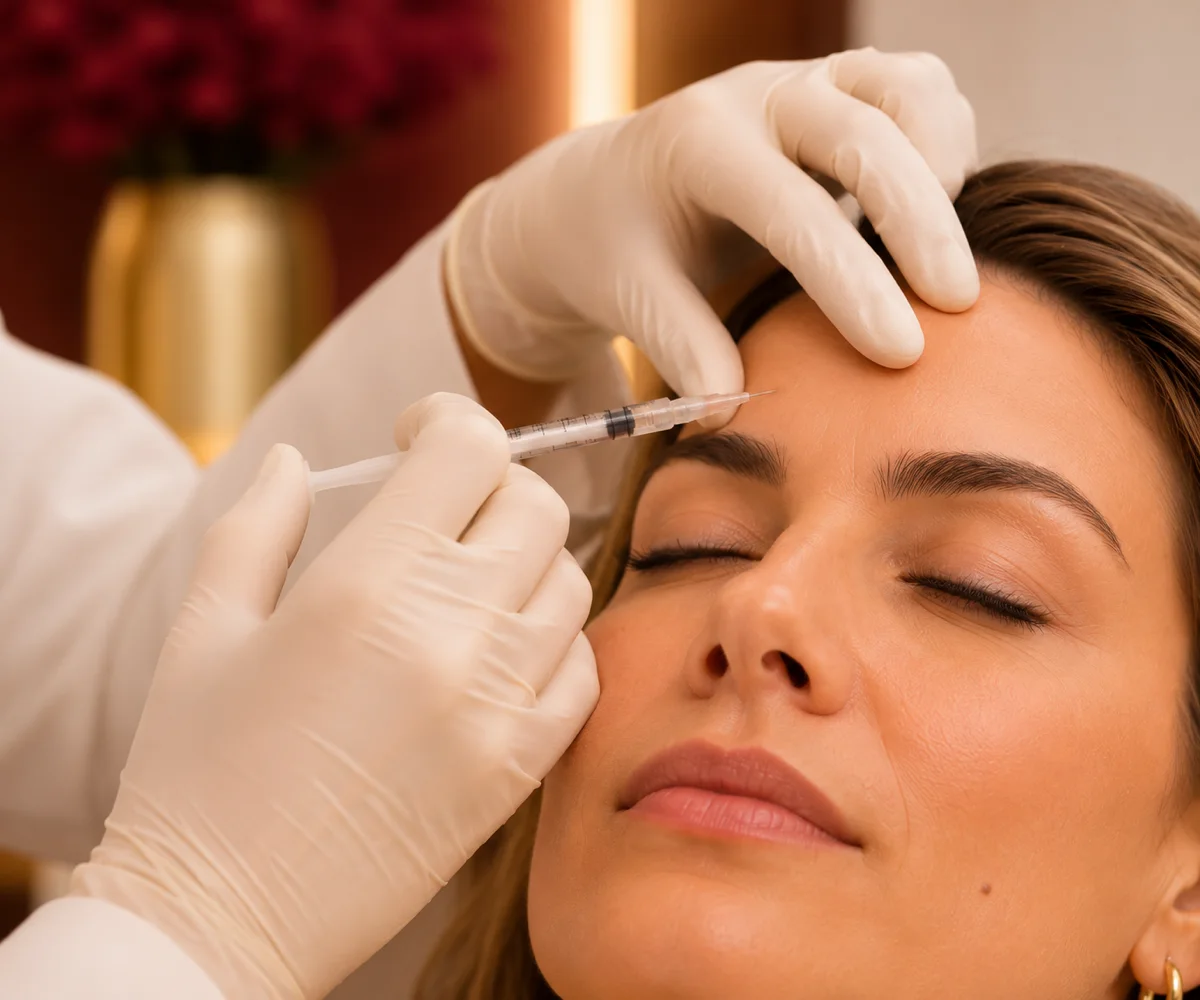
Application to the forehead with a fine syringe, in clear consulting-room light

Reducing sweating

Botulinum toxin

Very small injections into the skin of the forehead or scalp that, for a time, block the signals that lead the glands to sweat. In studies, sweating decreases after one to two weeks and generally lasts 4 to 9 months. On the forehead, the neighbouring muscle can also become weaker: the most frequent effect is a less mobile forehead, with a risk of a lower eyebrow or eyelid and of asymmetry, which passes in weeks or months. The evidence on the face comes from small series, and the effect is not permanent.

May be considered when

the sweating is focal and primary, medical and medication-related causes have been assessed and ruled out, simple measures have not been enough, you are neither pregnant nor breastfeeding, you do not have a neuromuscular condition and the doctor has explained the risks and what is realistic to expect.

Find out more

What the journey looks like

From the first conversation to a plan tailored to you

No procedure begins without an assessment by the doctor. Most people start with the simplest approach, and only then is anything further considered.

  1. 01At the clinic

    Telling your story

    The doctor asks since when you have sweated, in which areas, what triggers the episodes, whether there are night sweats, which medicines you take and how much the sweating affects work, sleep and social life.

  2. 02At the clinic

    Examine and rule out causes

    Where you sweat and whether it is symmetrical are looked at. If there are signs of another cause, such as the thyroid, diabetes, the menopause or a medicine, blood tests are requested or you are referred to the right doctor before any procedure.

  3. 03At home

    Adjust everyday life

    Choosing suitable clothing and products, avoiding what triggers it and keeping the skin clean and dry. In many cases this is what brings relief, alongside whatever the doctor prescribes.

  4. 04Over time

    Decide and follow up

    If the sweating persists and affects your life, the doctor explains whether toxin makes sense, what can be expected, when to repeat and what the risks are, without promising results. The assessment is repeated and the plan adjusted.

Day to day

What helps at home

What you do at home counts for more than it seems. These are the measures that make sense while you wait for the consultation and alongside the clinic’s plan.

The golden rule

Understand why you sweat before treating the face

New sweating, at night or on one side only may be a sign of something else, and in that case treating the skin does not resolve the cause. When it is primary sweating, there is a great deal that can be done, but the first step is to rule out the rest.

Choose clothing and fabrics that breathe

Heat trapped around the neck and head makes facial sweating worse.

In practice: cotton and light fabrics, layers that are easy to remove, and clothing with a loose neck.

Keep the environment cool

Heat is one of the main triggers of facial sweating.

In practice: a fan or air conditioning, cool water to drink and a tissue or wipe to hand.

Record the triggers

It helps to see whether the sweating comes from heat, food, a situation or a medicine.

In practice: a short diary, with the time, what you were doing, what you ate and what you took.

Look after the skin and hair

Skin that is always damp can become irritated and, with products on top, pores become blocked more easily.

In practice: wash with a gentle product, dry without rubbing, use waterproof make-up and a light moisturiser.

Dr Michelle Campagnoli, clinical director of Clínica Luxmed

Who will look after you

An assessment carried out by the doctor

At Luxmed, in Algés, the first step is always an assessment with Dr Michelle Campagnoli. She listens to the history, examines the skin, works out whether the sweating is primary or whether there is a cause to investigate and works with you to decide what makes sense before any procedure, referring to another specialty whenever that is the way forward.

  • Physical examination and medical historyA conversation about sweating, triggers, health and medication, and an examination of the skin of the face and scalp.
  • A plan tailored to youA clear plan, without promises, in which the cause is assessed first and your progress is monitored over time.
  • No obligationThe cost of any treatment is confirmed only after the assessment.
Book an assessment

Articles about excessive facial sweating

From our blog
Fotografia · suor-excessivo-na-cara-blog-11200 × 800 px · horizontal 3:2Mulher de uns 35 anos, de costas e a três quartos, a passar um lenço de papel pela nuca numa sala luminosa, cabelo apanhado; enquadramento discreto, sem close do rosto

Facial aesthetics

Excessive sweating of the face and scalp

How normal sweating is distinguished from excessive sweating on the forehead, face and scalp, what usually triggers it and what helps in everyday life.

Fotografia · suor-excessivo-na-cara-blog-21200 × 800 px · horizontal 3:2Secretária de consulta com um bloco de notas, um termómetro e um copo de água, em luz suave de fim de tarde; só objetos, sem rostos

Facial aesthetics

Craniofacial hyperhidrosis: causes and when to investigate

The primary and secondary causes of sweating of the head and face, the signs that call for investigation and what the medical assessment looks for.

Fotografia · suor-excessivo-na-cara-blog-31200 × 800 px · horizontal 3:2Bancada clara de consultório com uma seringa fina ainda embalada, compressas e uma folha de consentimento informado, em luz suave; só objetos, sem rostos

Facial aesthetics

Botulinum toxin in facial hyperhidrosis: results and care

What the evidence shows about toxin in facial sweating, how long the effect lasts, the risks in the forehead and which precautions it is worth taking in preparation and recovery.

Book a consultation

Book your consultation

Choose how you prefer to get in touch. We will arrange the assessment consultation with Dr Michelle Campagnoli.

Booking through the websiteAssessment consultationTalk to our assistant on WhatsApp and ask for the current price of the assessment.

New Life Miraflores, Algés · Office Center, R. Santa Teresa do Menino Jesus n.º 6, 9.º C, 1495-048

Your details are used only for this contact. Any treatment depends on a prior medical assessment.

Request an appointmentIt takes less than a minute.
Speciality
You do not need to go into detail. The doctor will talk to you during the consultation.
Request received. Our team will contact you as soon as possible.
Why do I sweat so much from my face?

In most people it is primary hyperhidrosis: the sweat glands respond too much to heat and emotions, with no underlying disease, often since youth and with relatives with the same problem. Less often, excessive sweating of the face is secondary: it comes from the menopause, thyroid changes, diabetes, infections, certain medicines or other conditions. This is why the first step is to work out the cause in your case.

How do I know whether my sweating is normal or whether I have hyperhidrosis?

There is no number that decides. What counts is whether the sweating is out of proportion to the heat or exertion, whether it happens often and whether it affects work, sleep, make-up, social life or wellbeing. Primary hyperhidrosis is typical in well-defined areas, symmetrical and with an early onset. New sweating, at night, on one side only or with other symptoms is suspected of a secondary cause.

I feel I sweat more with anxiety: is that the cause?

Anxiety makes you sweat, but it can also be a consequence of sweating: the fear that it will show makes the sweating worse and this feeds the cycle. It is not always the cause. Speaking to the doctor helps to work out what weighs in each case and to break the cycle, with simple measures, psychological support when necessary and, if indicated, treatments for the sweating.

Is facial sweating a sign of the menopause?

It can be. In the perimenopause and menopause, hot flushes come with sweating of the face, neck and chest, often at night. But the thyroid, diabetes or a medicine can give similar symptoms, so if the sweating is new or very bothersome, a consultation is advisable before assuming that it is just age.

Sweating on the forehead and scalp: what can I do at home?

Light clothing, a cool environment, avoiding what triggers the sweating (spicy food, alcohol, very hot drinks), keeping the skin and hair clean and dry, and using water-resistant make-up. These measures bring relief, but may not be enough. Ask the doctor or pharmacist for advice before using antiperspirants on the face and never apply them near the eyes.

Does botulinum toxin resolve facial sweating?

It reduces sweating for a few months, but does not cure it. In studies on the face and scalp, the effect begins in one to two weeks and lasts, in general, between 4 and 9 months; then it returns and the treatment is repeated. The evidence comes mainly from small case series, and not from large trials as in the armpits. Not everyone is a good candidate, and the doctor decides after assessing the cause.

What are the risks of botulinum toxin in the forehead?

Because toxin also weakens the forehead muscle, there may be a less mobile forehead, a lower eyebrow or eyelid and asymmetry, which pass over the weeks or months as the effect ends. There may be pain, bruising and redness at the injection points. If the eyelid droops or there is double vision, contact the clinic; if there is difficulty swallowing or breathing, call 112. It is not carried out in pregnancy or breastfeeding, nor in people with a neuromuscular condition.

Are there other treatments besides toxin?

Yes, and many come first. Reviews point, for facial sweating, to topical or oral anticholinergics, prescribed by a doctor, and botulinum toxin; nerve surgery is kept for severe and resistant cases, because of the risk of compensatory sweating in other areas. Drugs have adverse effects, such as dry mouth, and are not for everyone. The clinic proposes toxin; the other options are decided with the doctor who is following your case.

Is the result permanent? How many sessions are needed?

It is not permanent. Toxin reduces sweating for a few months and then the effect wears off, so it has to be repeated. The number of sessions, the areas treated and the interval depend on each person and are set at the assessment, without promising results.

When should I see a doctor first?

Book a consultation if the sweating is new, if it began after 40 or 50, if it is at night, if it is on one side of the face only or if it comes with fever, unintentional weight loss, palpitations, tremor, thirst or tiredness. If the sweating appeared after a new medicine or after surgery to the face, also. If in doubt, out of hours call SNS 24 (808 24 24 24). With cold sweat and chest pain or tightness, shortness of breath or fainting, call 112.

We could not find that question. Ask us on WhatsApp

Scientific references

This page is based on the sources below and was reviewed by Dr. Michelle Campagnoli. Last updated on .

  1. Tsiogka A, Peponi D, Tsiogka E, Campanati A, Vakirlis E, Agiasofitou E, Gregoriou S. Management of Craniofacial Hyperhidrosis with Botulinum Toxin: A Systematic Review. Skin Appendage Disord, 2026.
  2. Farah J, Hanna E, Aad S, Karam C, Ghanem A. Beyond the axilla: The evolving role of botulinum toxin in the treatment of facial, scalp, and focal hyperhidrosis. Clin Dermatol, 2026.
  3. Nicholas R, Quddus A, Baker DM. Treatment of Primary Craniofacial Hyperhidrosis: A Systematic Review. Am J Clin Dermatol, 2015.
  4. Campanati A, Martina E, Gregoriou S, Kontochristopoulos G, Paolinelli M, Diotallevi F, Radi G, Bobyr I, Marconi B, Gualdi G, Amerio P, Offidani A. Botulinum Toxin Type A for Treatment of Forehead Hyperhidrosis: Multicenter Clinical Experience and Review from Literature. Toxins (Basel), 2022.
  5. Nawrocki S, Cha J. The etiology, diagnosis, and management of hyperhidrosis: a comprehensive review: etiology and clinical work-up. J Am Acad Dermatol, 2019.
  6. Nawrocki S, Cha J. The etiology, diagnosis, and management of hyperhidrosis: a comprehensive review: therapeutic options. J Am Acad Dermatol, 2019.
  7. NHS. Excessive sweating (hyperhidrosis). (NHS, acedido 2026-11-11)
  8. American Academy of Dermatology Association. Hyperhidrosis: overview. (AAD, acedido 2026-11-11)
  9. DermNet NZ. Hyperhidrosis. (DermNet, acedido 2026-11-11)
CallAssistantAvailableBook