


- Home
- Facial aesthetics
- Acne on the face
- Adult acne
Adult acne: causes and when to seek help
Acne is not just a problem of adolescence. Many adults, especially women, have spots after the age of 25. See the causes and when to seek help.
 Luxmed TeamAuthor
 Dr Michelle CampagnoliClinical review · OM no. 69467
In this article
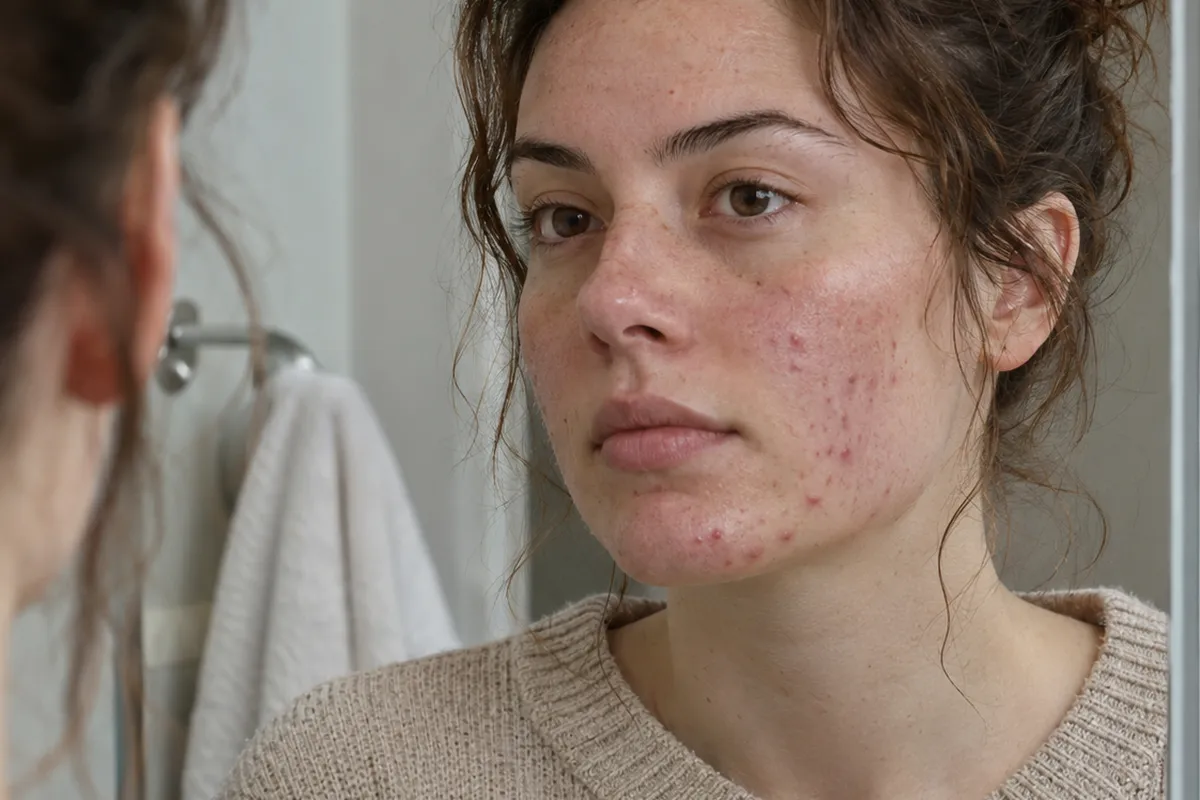
Acne is not just a problem of adolescence. Many adults, especially women, continue to have spots after the age of 25, or start having them at that point without ever having had them before. Adult acne has its own characteristics: it often appears on the chin and jawline, worsens before menstruation and tends to leave marks that take a long time to fade. And it has effective treatment.
Three ideas to remember.
What adult acne looks like
A European review described adult female acne as an entity with its own characteristics: inflammatory lesions mainly on the lower face, a tendency to worsen with the menstrual cycle and a major impact on quality of life (Dréno et al., 2013). Adult men get acne too, often as a continuation of teenage acne.
| Feature | Teenage acne | Adult female acne |
|---|---|---|
| Typical location | Forehead, nose, cheeks | Chin, jawline, neck |
| Type of lesions | Comedones and inflammatory lesions | More inflammatory, sometimes deep |
| Link with the cycle | Variable | Frequent worsening before menstruation |
| Residual marks | Common | Very common and persistent |
Causes and contributing factors
- Hormones: androgens stimulate the sebaceous glands. Changes over the cycle, stopping the pill and some conditions, such as polycystic ovary syndrome, can trigger or worsen acne.
- Genetics: having relatives with acne increases the risk.
- Stress: it can make acne worse, although the mechanism is not fully understood.
- Cosmetics and skincare: very oily or comedogenic products, heavy make-up and picking at lesions.
- Medicines: some corticosteroids, anticonvulsants, high-dose B vitamin supplements and anabolic steroids can cause or worsen acne.
- Diet: there is some evidence of an association with high glycaemic index diets and with some dairy products, but the effect varies.
When to seek help
See a doctor, preferably a dermatologist, if:
- the spots are deep, painful or leave scars;
- the acne does not improve with over-the-counter care after 2 to 3 months;
- there are persistent dark marks after the lesions;
- the acne affects your wellbeing or how you relate to other people;
- there are signs of excess androgens: excess hair on the face or body, hair loss, irregular periods. In these cases, the hormonal cause may need to be investigated.
The most recent American Academy of Dermatology guidelines give a strong recommendation to treatments such as benzoyl peroxide, topical retinoids, topical antibiotics, oral doxycycline and, in selected cases, oral isotretinoin (Reynolds et al., 2024). There is a dedicated article on treatments: Acne: medical treatment and in-clinic treatments.
What to do right now
- Gentle cleansing twice a day.
- Non-comedogenic products, including sunscreen and make-up.
- Do not squeeze spots, to reduce marks and scars.
- Introduce one active at a time, such as benzoyl peroxide, salicylic acid or azelaic acid, to see what your skin tolerates.
- Sunscreen, to stop marks from darkening.
At Luxmed Clinic
At Luxmed, we assess adult acne in the context of each person: history, cycle, medication, skincare routine. We work alongside medical treatment and suggest in-clinic treatments that help to control lesions and marks.
Talk to us
The assessment is a conversation, with no obligation. Tell us what concerns you and our team will reply.
This article is for information purposes and does not replace a consultation. The results of any treatment vary from person to person.
Frequently asked questions
Is it normal to have acne at 30 or 40?
It is common, especially in women. It does not mean that something is wrong, but it deserves treatment if it bothers you.
Is adult acne always hormonal?
There is often a hormonal influence, but not always a hormonal condition. Investigation is carried out when there are other signs.
Does the pill help?
Some combined oral contraceptives have a beneficial effect on acne. The choice is a medical one and depends on each woman.
Does make-up cause acne?
Oily or comedogenic products can contribute. Prefer products labelled non-comedogenic and remove make-up thoroughly.
Will acne go away on its own?
It may improve with time, but treating it early reduces the risk of scars and marks.
Scientific references 2
- Dréno B, Layton A, Zouboulis CC, et al. Adult female acne: a new paradigm. J Eur Acad Dermatol Venereol. 2013;27(9):1063-1070. doi:10.1111/jdv.12061 Artigo
- Reynolds RV, Yeung H, Cheng CE, et al. Guidelines of care for the management of acne vulgaris. J Am Acad Dermatol. 2024;90(5):1006.e1-1006.e30. doi:10.1016/j.jaad.2023.12.017 Guideline
Editing and development: Rúben Brito · Operial Development
Keep exploring