


- Home
- Hair medicine
- Female alopecia
- Female hair loss
Female hair loss: what it is and how to recognise it
Thinner hair on top and a wider parting? See what female hair loss is, how it is told apart from other causes, how it is diagnosed and which treatments have evidence.
 Rúben BritoAuthor
 Dr Michelle CampagnoliClinical review · OM no. 69467
In this article
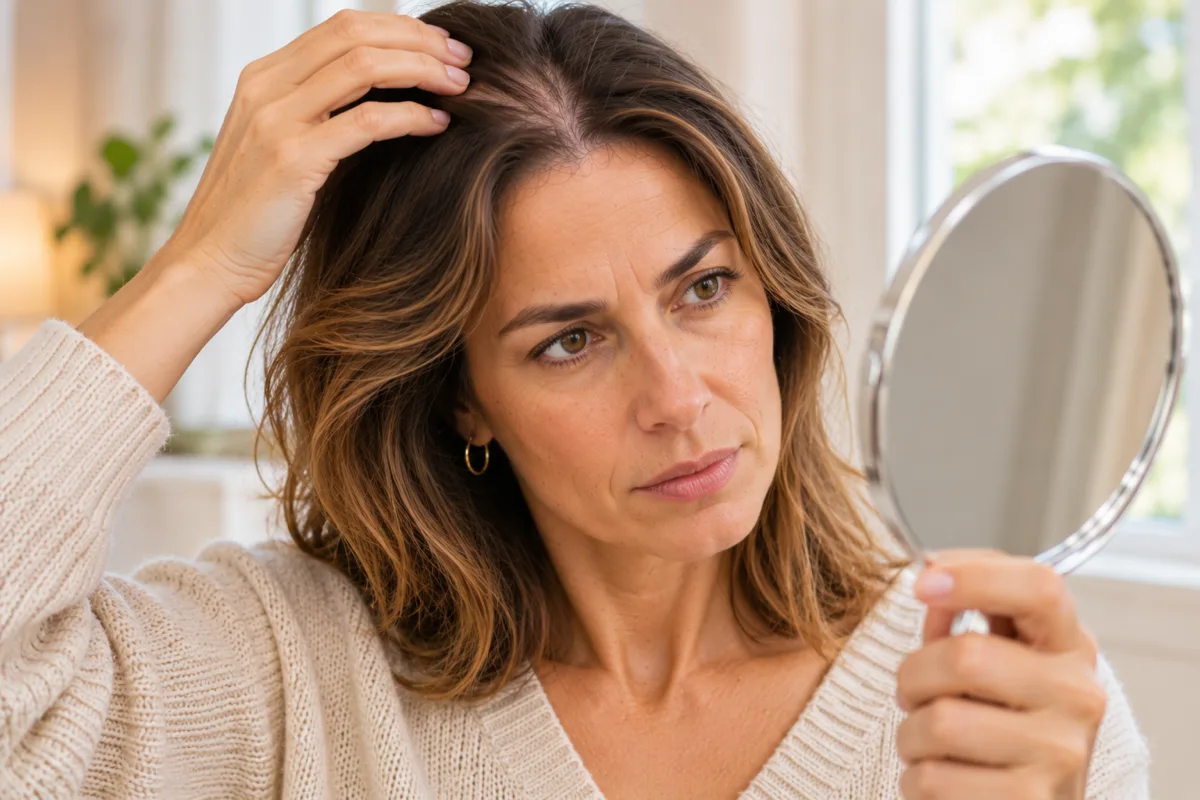
Female hair loss, also called female pattern hair loss or female androgenetic alopecia, is the most common cause of thin hair in women. It is not a "baldness" like men's: it rarely leaves areas with no hair. What happens is that, over years, the hairs on top of the head become progressively thinner and shorter, the parting widens and the scalp becomes more visible.
Because it is slow and silent, it is often mistaken for temporary hair loss, stress or "a lack of vitamins", and the diagnosis comes late. Recognising it early matters, because treatments work better at halting progression than at recovering lost hair.
Three ideas to remember.
Fica por baixo do resumo, se existir uma segunda foto.
What female hair loss is
Miniaturisation: the follicle shrinks
In female hair loss, the follicles do not die suddenly. Over several cycles, the growth phase (anagen) shortens and the follicle itself gradually becomes smaller. Each new hair grows slightly thinner and shorter than the last, until some follicles produce only a fine, almost transparent hair, similar to facial down. Between one cycle and the next, the follicle may also stay "empty" for longer (the kenogen phase). The result is less volume, even if the number of follicles stays the same for a long time.
Genetics and hormones
The cause is multifactorial and not yet fully understood. There is a clear genetic component: between 40% and 54% of affected women have a family history, on the mother's or father's side. Androgen hormones play a part, but less clearly than in men: most women with female hair loss have normal hormone levels, and the medicines that block the conversion of testosterone into dihydrotestosterone have less consistent results in women. That is why many specialists prefer the term "female pattern hair loss" to "androgenetic alopecia".
In some women there is, in fact, an excess of androgens, for example in polycystic ovary syndrome. In these cases, hair loss usually comes with other signs, such as acne, excess body hair or irregular periods.
How many women it affects
It is much more common than people think and increases with age. Two population studies give an idea:
| Age | Australia (Gan and Sinclair, 2005; 717 women) | USA (Norwood, 2001; 1,008 women) |
|---|---|---|
| 20 to 29 years | 12% | 3% |
| 30 to 39 years | 17% | 17% |
| 40 to 49 years | 25% | 16% |
| 50 to 59 years | 28% | 23% |
| 60 to 69 years | 41% | 25% |
| 70 or over | 56% | 29% |
Source: Gan and Sinclair, 2005; Norwood, 2001.
The differences between studies reflect different criteria and populations, but the message is the same: it is not rare, it can start early and it becomes more common after the menopause. For more on this stage, see Menopause and hair loss: what is known.
How to recognise it
Signs that women usually notice
- The parting is wider than before, especially at the front and on top. See Wider parting: when it is worth assessing.
- The ponytail is thinner: the hair tie goes round more times.
- The scalp shows more on top of the head, especially in strong light, from above or in photographs.
- The hair does not grow as long as before and the ends look thinner.
- Many short, fine hairs near the parting, which do not reach the length of the rest.
The front hairline, at the forehead, normally stays. Unlike in men, deep temple recession is rare. Daily shedding may be increased, but many women with female hair loss notice no shedding at all: they only notice that "there is less hair".
The patterns and the scales
Doctors use scales to classify severity and track progress:
- Ludwig scale (1977): three grades of diffuse thinning on top of the head, from mild to marked, with the front hairline preserved. It is the best known, but not very sensitive to small changes (Ludwig, 1977).
- Sinclair scale: five reference photographs of the central parting, from normal (grade 1) to the most advanced (grade 5). It is simple and useful for tracking progress.
- Olsen pattern (Christmas tree): the thinning is more pronounced at the front and narrows towards the back, forming a triangle with its base at the frontal hairline (Olsen, 1999).
- Male pattern (Hamilton-Norwood): temples and crown. It is rare in women and, when it appears, it justifies looking for excess androgens.
The pull test
At the consultation, the doctor may gently pull a small lock of hair. In female hair loss, more hairs than normal come out only on top; if they come out in all areas, telogen effluvium or another cause becomes more likely.
What can look like female hair loss and is not
Several conditions cause thin hair in women. Telling them apart is essential, because the treatment is different.
| Condition | How to tell them apart |
|---|---|
| Telogen effluvium | Diffuse hair loss, across the whole scalp, which starts relatively suddenly 2 to 3 months after a trigger (childbirth, illness, diet, stress). The hairs are of normal thickness. It can coexist with female hair loss and make it visible. See Hair loss: why it happens and what to do. |
| Diffuse alopecia areata | Rapid hair loss, sometimes with patches; trichoscopy with its own signs (yellow and black dots, exclamation-mark hairs). See Alopecia areata: what it is and how to recognise it. |
| Frontal fibrosing alopecia | Receding front hairline and loss of eyebrows, especially after the menopause. It is scarring: lost hair does not grow back, so early diagnosis is important. |
| Traction alopecia | Thinning at the temples and front hairline, in those who wear tight hairstyles. See Traction alopecia: what it is and how to recognise it. |
| Central centrifugal cicatricial alopecia | It starts on top of the head and widens in a circle; more common in women of African descent; there may be itching or pain. |
| Thyroid problems, low iron, medicines | They usually cause a diffuse effluvium, sometimes with other symptoms. Blood tests help. |
| Normal hair ageing | With age, all hairs become slightly thinner and density decreases uniformly, without the pattern on top. See Thinner hair with age: what is normal. |
Intense itching, pain, redness, scaling around the follicles or smooth, shiny skin without follicular openings are signs that rule out simple female hair loss and justify a prompt assessment.
How the diagnosis is made
Clinical history
The doctor asks when it started, how it has progressed, whether there is hair loss or only less volume, whether there is a family history, what the menstrual cycles are like, whether there is acne or excess body hair, what medicines you take (including the pill and hormone therapy), what your diet is like and whether there were recent triggers.
Examination and trichoscopy
The diagnosis is essentially clinical. Trichoscopy, a magnified examination of the scalp, helps to confirm it and rule out other causes. The key sign is the variability in hair thickness: in female hair loss, thick and thin hairs coexist, in greater proportion at the front and top than at the back of the head. See Trichoscopy: the examination that shows the scalp.
Rakowska and colleagues (2009) proposed trichoscopic criteria that compare the frontal area with the occipital area:
- Major criteria: more than four yellow dots in four images of the frontal area; average hair thickness lower at the front than at the back; more than 10% of fine hairs (under 0.03 mm) at the front.
- Minor criteria: at the front, compared with the back, more follicular units with a single hair, more fine (vellus) hairs and more discolouration around the follicles.
Two major criteria, or one major and two minor, allow a diagnosis with high specificity (about 98%).
Blood tests
There is no single test that confirms female hair loss, but tests are useful for finding factors that make it worse or other causes: a full blood count and ferritin, thyroid function, vitamin D and, when there are signs of excess androgens (acne, body hair, irregular periods), a hormone work-up. See Blood tests for hair loss: what to ask for.
Biopsy
It is rarely needed. It is reserved for atypical cases or when a scarring alopecia is suspected.
Treatments with evidence and realistic expectations
Female hair loss is chronic and progressive: without treatment, it tends to advance slowly. The realistic aim is to halt progression and, in some women, to recover some volume. Results are only assessed after six to twelve months, and maintenance is needed to keep them. The plan is always individual and set at the consultation.
Topical minoxidil
It is the treatment with the most evidence and the only one specifically approved for female hair loss in Europe. The Cochrane review (van Zuuren et al., 2016) confirmed that it is more effective than placebo. In the first weeks there may be a temporary increase in shedding, a sign that the follicles are re-entering growth. The most common adverse effects are scalp irritation and increased facial hair. It should not be used in pregnancy or during breastfeeding.
Low-dose oral minoxidil
Used outside its approved indications (off-label), it has gained ground in recent years. In a randomised trial of 52 women, 1 mg a day had similar efficacy to 5% topical minoxidil after 24 weeks (Ramos et al., 2020). It can cause increased body hair, fluid retention and, rarely, changes in blood pressure or heart rhythm. It should only be taken with a prescription and under medical supervision.
Antiandrogens
Medicines such as spironolactone or certain contraceptive pills may be considered, especially when there are signs of excess androgens. The evidence comes from studies of moderate to low quality. They are used off-label for this indication, require effective contraception (because of risk to the foetus) and monitoring with blood tests.
Other treatments
- Platelet-rich plasma (PRP): studies suggest benefit, but with very different protocols and limited quality of evidence.
- Low-level laser: some trials have shown increased density; modest results.
- Correction of deficiencies: iron, vitamin D or thyroid, when abnormal, should be corrected. They do not treat female hair loss, but may reduce any associated hair loss.
- Camouflage: hair fibres, coloured scalp sprays, cuts and hairstyles with more volume. They are a legitimate aid, especially in the first months of treatment.
- Hair transplant: it may be an option in selected cases, with a stable donor area.
Be wary of products or clinics that promise to "cure" female hair loss or guarantee results.
When you should ask for an assessment
The earlier the diagnosis, the more hair there is to preserve. At Luxmed, the hair medicine consultation includes a detailed clinical history, examination of the scalp, trichoscopy with follow-up photographs and, when indicated, blood tests. The treatment plan is agreed at the consultation and followed up over time.
Talk to us
The assessment is a conversation, with no obligation. Tell us what concerns you and our team will reply.
Telephone 214 044 241 · info@luxmed.pt
This article is for information purposes and does not replace a medical consultation. The results of any treatment vary from person to person.
Frequently asked questions
Is female hair loss the same as baldness?
Not exactly. In women, hair becomes thinner on top, but completely bald areas rarely appear, and the front hairline usually stays.
At what age does it start?
It can start from puberty, but it is more common after the age of 40 and above all after the menopause.
Is it hereditary?
There is an important genetic component, which may come from the mother's or the father's side. Having relatives with thin hair increases the risk, but does not make it certain.
My hormones are normal. Can I have female hair loss?
Yes. Most women with female hair loss have normal hormone tests.
Does the hair grow back?
Treatments can halt progression in most women and recover some volume in some of them. The earlier you start, the better. Follicles that have already disappeared do not return.
If I stop the treatment, do I lose what I gained?
As a rule, yes: after a few months, the progression resumes. That is why treatment is long term.
Do supplements help?
Only if there is a deficiency. They do not treat female hair loss.
Does colouring or straightening hair make female hair loss worse?
It does not affect the follicles, but it can break the hairs, which are already thinner, and accentuate the feeling of low volume. With care, you can continue.
Scientific references 9
- Ramos PM, Miot HA. Female pattern hair loss: a clinical and pathophysiological review. An Bras Dermatol. 2015;90(4):529-543. doi:10.1590/abd1806-4841.20153370 Artigo
- Gan DCC, Sinclair RD. Prevalence of male and female pattern hair loss in Maryborough. J Investig Dermatol Symp Proc. 2005;10(3):184-189. Artigo
- Norwood OT. Incidence of female androgenetic alopecia (female pattern alopecia). Dermatol Surg. 2001;27(1):53-54. Artigo
- Ludwig E. Classification of the types of androgenetic alopecia (common baldness) occurring in the female sex. Br J Dermatol. 1977;97(3):247-254. Artigo
- Olsen EA. The midline part: an important physical clue to the clinical diagnosis of androgenetic alopecia in women. J Am Acad Dermatol. 1999;40(1):106-109. Artigo
- Rakowska A, Slowinska M, Kowalska-Oledzka E, Olszewska M, Rudnicka L. Dermoscopy in female androgenic alopecia: method standardization and diagnostic criteria. Int J Trichology. 2009;1(2):123-130. Artigo
- van Zuuren EJ, Fedorowicz Z, Schoones J. Interventions for female pattern hair loss. Cochrane Database Syst Rev. 2016;(5):CD007628. Artigo
- Ramos PM, Sinclair RD, Kasprzak M, Miot HA. Minoxidil 1 mg oral versus minoxidil 5% topical solution for the treatment of female-pattern hair loss: a randomized clinical trial. J Am Acad Dermatol. 2020;82(1):252-253. Artigo
- Kanti V, Messenger A, Dobos G, et al. Evidence-based (S3) guideline for the treatment of androgenetic alopecia in women and in men – short version. J Eur Acad Dermatol Venereol. 2018;32(1):11-22. Guideline
Keep exploring