


- Home
- Hair medicine
- Female alopecia
- Wider parting
Wider parting: when it is worth assessing
Is your parting wider than before? See how to check at home without obsessing, what the causes may be and when it makes sense to ask for an assessment.
 Rúben BritoAuthor
 Dr Michelle CampagnoliClinical review · OM no. 69467
In this article
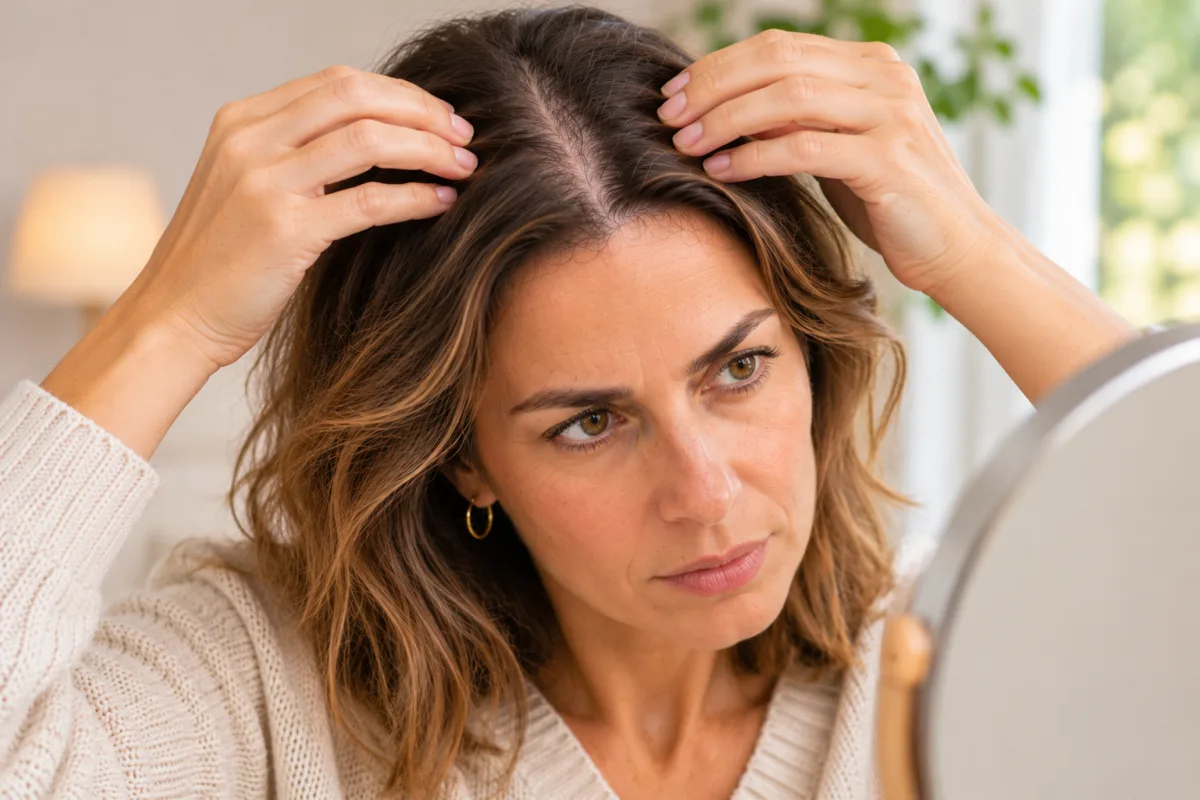
Many women first come across the problem in a photograph taken from above, in the bathroom mirror under strong light, or when the hairdresser comments that "the parting is more open". The question that follows is almost always the same: is this normal or is it the start of something?
The parting is one of the best indicators of hair density on top of the head, which is why dermatologists use it as a reference. A progressively widening parting is the most typical sign of female hair loss, but it is not the only possible reason. In this article we explain how to assess your parting at home without becoming obsessive, what causes there may be and when it makes sense to ask for an assessment.
Three ideas to remember.
Fica por baixo do resumo, se existir uma segunda foto.
Why the parting is a good indicator
In female hair loss, the loss of density is concentrated on top of the head, between the front hairline and the crown, and spares the back (the occipital area). The central parting crosses precisely this area and works as a "window" onto the scalp: when there are fewer hairs, or finer hairs, the skin shows more and the parting looks wider.
In 1999, Elise Olsen drew attention to the parting as "an important clue" in diagnosis (Olsen, 1999) and described the Christmas-tree pattern: the parting is wider near the forehead and narrows towards the back. Rodney Sinclair developed a five-grade scale based on the appearance of the central parting, now widely used:
| Grade (Sinclair) | What you see |
|---|---|
| 1 | Normal parting |
| 2 | Wider central parting |
| 3 | Wider parting and loss of volume on both sides of the parting |
| 4 | A thinner area visible at the front of the top |
| 5 | Advanced thinning on top |
Two details make the parting especially useful. First, it is easy to photograph and compare over time. Second, it allows you to compare the front with the back: if the parting is clearly wider near the forehead than at the back of the head, the pattern points to female hair loss; if it is the same everywhere, other causes become more likely.
Sinclair also notes that women tend to underestimate the degree of their loss. Comparing the current ponytail with one from a few years ago is another simple and reliable sign.
How to check your parting at home
Perception can be misleading: light, angle, wet or freshly washed hair and even your mood greatly change the way we see the scalp. To compare objectively, the secret is to repeat the same conditions every time.
Standardised photographs
- Dry hair, washed the day before, without volumising products or fibres.
- Parting in the usual place, made with a fine comb, perfectly straight, from the forehead to the crown.
- Same light: preferably natural light by a window, without flash. Avoid strong light directly overhead, which exaggerates thinning.
- Same angle and distance: ask someone to photograph from above, with the phone parallel to the head, about 30 centimetres away. If you are alone, use the timer and always rest the phone in the same place.
- Three photographs: the parting near the forehead, the parting at mid-top and a parting made at the back of the head (for comparison).
- Repeat every three months, not every week. Hair changes slowly, and very frequent photographs only increase anxiety.
Keep the photographs in a folder with the date. If you ever go to a consultation, they are valuable information.
Other simple signs
- The ponytail: how many times does the hair tie go round now, and how many did it go round two or three years ago?
- Old photographs: look for photographs from a few years ago in which the parting is visible and compare.
- Short, fine hairs along the parting, which do not reach the length of the rest, may be miniaturised hairs (or, after hair loss, new hair growing).
What not to do
- Measuring the parting with a ruler every day.
- Comparing photographs taken with different lights or cameras.
- Drawing conclusions from a single bad day.
If checking becomes a source of constant anxiety, it is more useful to book an assessment and leave the measuring to someone who does it systematically. See also Photos every 3 months: how to track the crown, in which the method is similar.
Causes of a wider parting
Female hair loss
It is the most common cause. The parting widens slowly, over months or years, mainly at the front, with the back of the head spared and the forehead line preserved. There may or may not be increased shedding. See Female hair loss: what it is and how to recognise it.
Telogen effluvium
Intense diffuse hair loss, 2 to 3 months after childbirth, illness, a diet or a period of stress, also makes the parting look wider, but the widening is similar across the whole scalp, including the back. It usually recovers in 6 to 12 months. Often, an effluvium reveals female hair loss that was already there in a discreet form.
Hair ageing
With age, hairs become slightly thinner and density decreases across the whole scalp. The parting may look more visible, but without the pattern on top. See Thinner hair with age: what is normal.
Traction and hairstyle habits
Always parting the hair in the same place, with the hair pulled hard to the sides, or wearing tight hairstyles for years, can thin the hair along the parting and at the temples. Switching the side of the parting and relieving the tension helps. See Traction alopecia: what it is and how to recognise it.
Scarring alopecias
Less common, but important, because lost hair does not grow back:
- Central centrifugal cicatricial alopecia: it starts in the centre of the top of the head and widens in a circle; more common in women of African descent; there may be itching, burning or pain.
- Lichen planopilaris: redness and scaling around the follicles, itching or pain, irregular patches.
- Frontal fibrosing alopecia: the forehead line recedes and the eyebrows thin, especially after the menopause (Kossard, 1994). It can coexist with female hair loss.
Other situations
Iron deficiency, thyroid changes, excess androgens (with acne, excess body hair or irregular periods) and some medicines may contribute. Blood tests help to clarify.
When it is worth getting assessed
If you have none of these signs
A parting that looks more visible to you one day, with no change in photographs over months, is no cause for alarm. Keep tracking every three months.
What happens at the consultation and why earlier is better
A hair medicine consultation usually includes:
- Clinical history: when it started, family history, periods, pregnancies, medicines, diet, recent triggers. Bring your photographs.
- Examination: the parting at the front, top and back, the forehead line, the eyebrows, the pull test.
- Trichoscopy: magnified examination that shows the variability in hair thickness, the proportion of thin hairs, and signs of inflammation or scarring. It is the examination that does most to distinguish the causes.
- Standardised photographs to compare at later consultations.
- Blood tests, when indicated: ferritin, thyroid, vitamin D and, if there are signs, a hormone work-up.
Why it is not worth waiting
Female hair loss is progressive. Treatments with evidence, such as minoxidil, are mainly effective at halting progression; recovery is, at best, partial. According to Sinclair, most women who are treated improve by about one grade on the scale. In other words: starting at grade 2 is very different from starting at grade 4. Results are assessed after six to twelve months and require maintenance.
Disguise while treating
Treatments take months, and it is legitimate to want to feel good in the meantime:
- Move the parting: a side or zigzag parting hides central thinning better.
- A layered cut and a slightly shorter length give volume on top.
- Dry with your head upside down or with a round brush at the root.
- Hair fibres and coloured scalp sprays reduce the contrast between hair and skin. They are safe for most people and do not interfere with treatments, as long as the scalp is washed normally.
- Hair colour closer to skin colour reduces the contrast and disguises the parting.
- Avoid pulled-back hairstyles and tight hair ties.
At Luxmed, the hair medicine consultation assesses your parting methodically, with trichoscopy and follow-up photographs, and agrees a realistic plan with you.
Talk to us
The assessment is a conversation, with no obligation. Tell us what concerns you and our team will reply.
Telephone 214 044 241 · info@luxmed.pt
This article is for information purposes and does not replace a medical consultation. The results of any treatment vary from person to person.
Frequently asked questions
What is the normal width of a parting?
There is no universal measure: it depends on the density, thickness and colour of the hair. More important than the absolute width is the comparison between the front and the back of the head and the progression over time.
Could a wide parting just be my hair type?
It can. Fine, straight, dark hair over fair skin shows the scalp more. If the parting has always been like this and has not changed, it is probably just how your hair naturally is.
Does always parting in the same place make it widen?
Pulling the hair hard to the sides for years can contribute. Changing the parting from time to time and avoiding tight hairstyles is good practice.
It widened after childbirth. Will it go back to normal?
In most cases, yes, in 6 to 12 months. If after that time it is still wider, it is worth getting assessed. See Hair loss after childbirth: what is normal.
Are hair fibres harmful?
No, they are cosmetic and come out with washing. Wash your scalp as often as usual.
At what age does the parting start to widen?
It can start in your 20s or 30s, but it is more common from the age of 40 and after the menopause.
If my parting widens, will I go bald?
In female hair loss, completely bald areas rarely appear. Progression is slow and can be halted with treatment.
Scientific references 6
- Olsen EA. The midline part: an important physical clue to the clinical diagnosis of androgenetic alopecia in women. J Am Acad Dermatol. 1999;40(1):106-109. Artigo
- Sinclair R. Is bilateral recession and major hair loss in the central scalp region in a postmenopausal woman a case of female pattern hair loss? Medicine Today. 2012;13(10):53-55. Artigo
- Ramos PM, Miot HA. Female pattern hair loss: a clinical and pathophysiological review. An Bras Dermatol. 2015;90(4):529-543. Artigo
- Rakowska A, et al. Dermoscopy in female androgenic alopecia: method standardization and diagnostic criteria. Int J Trichology. 2009;1(2):123-130. Artigo
- Kanti V, et al. Evidence-based (S3) guideline for the treatment of androgenetic alopecia in women and in men, short version. J Eur Acad Dermatol Venereol. 2018;32(1):11-22. Guideline
- Kossard S. Postmenopausal frontal fibrosing alopecia: scarring alopecia in a pattern distribution. Arch Dermatol. 1994;130(6):770-774. Artigo
Keep exploring