


- Home
- Facial aesthetics
- Sebaceous hyperplasia
- Yellowish bumps that do not go away
Yellowish bumps that will not come out: sebaceous hyperplasia
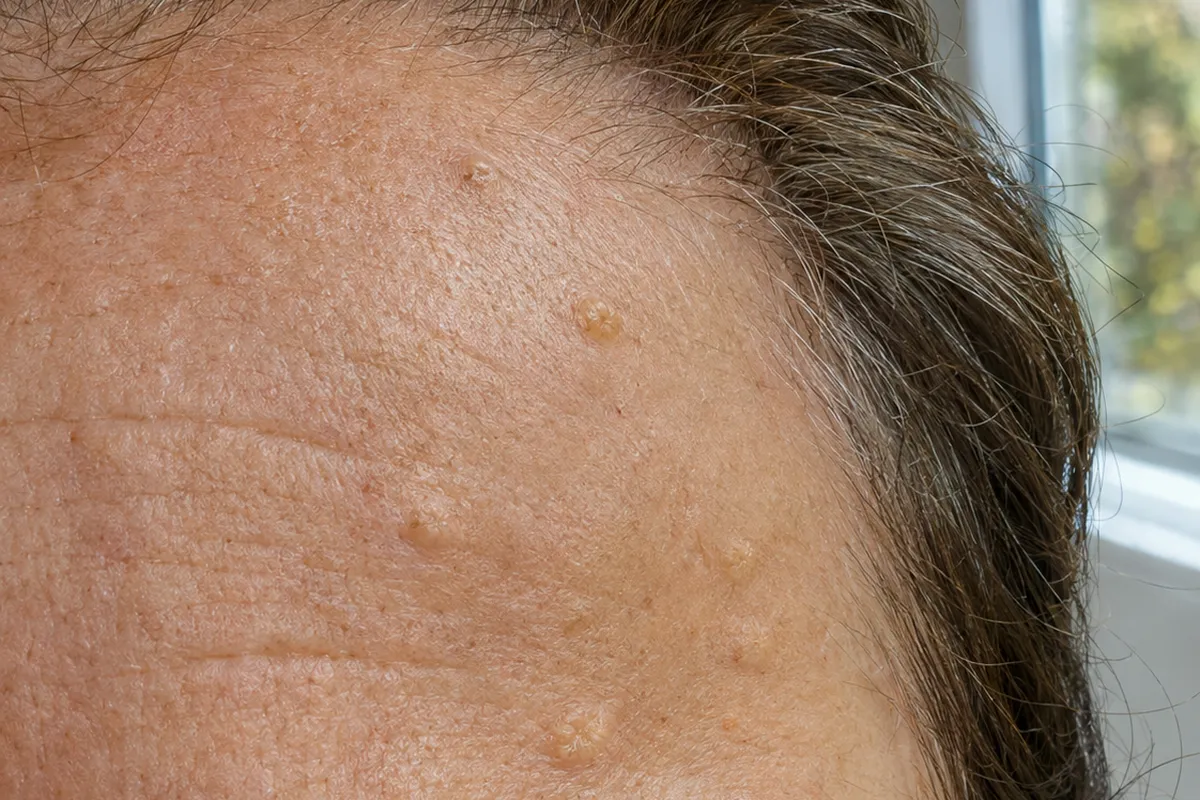
Small yellowish or skin-coloured bumps with a central pore that do not go away when squeezed are very likely to be sebaceous hyperplasia, which is benign and common from middle age onwards.
 Luxmed TeamAuthor
 Dr Michelle CampagnoliClinical review · OM no. 69467
In this article
Small yellowish or skin-coloured bumps with a central pore, particularly on the forehead, nose and cheeks, that do not go away when squeezed are very likely to be sebaceous hyperplasia. They are not spots or cysts, but enlarged sebaceous glands. They are benign and very common from middle age onwards.
Three ideas to remember.
How to recognise it
According to a review of sebaceous lesions, sebaceous hyperplasia presents as firm, skin-coloured or yellowish-white papules with a central depression, generally less than 1 cm in diameter, often multiple and on the face (Papadimitriou et al., 2023).
Why it appears
- Age: more common from the age of 40 to 50 onwards.
- Genetics and oily skin.
- Sun exposure.
- Some medicines, such as ciclosporin.
What not to do
- Squeezing: no contents come out and it may leave marks.
- Treating it at home with acids or cautery devices.
- Assuming it is hyperplasia without an assessment if the lesion differs from the others or is growing.
At Luxmed Clinic
At Clínica Luxmed, we assess these lesions before treating them and, if there is any doubt, refer the person to dermatology.
Talk to us
The assessment is a conversation, with no obligation. Tell us what concerns you and our team will reply.
This article is for information purposes and does not replace a consultation. The results of any treatment vary from person to person.
Frequently asked questions
Is it contagious?
No.
Is it dangerous?
No, but it should be distinguished from other lesions.
Can it disappear on its own?
Generally not.
Can it be treated?
Yes, there are several options, as explained in Sebaceous hyperplasia: treatment and recurrence.
Scientific references 1
- Papadimitriou I, Vakirlis E, Sotiriou E, Bakirtzi K, Lallas A, Ioannides D. Sebaceous neoplasms. Diagnostics (Basel). 2023;13(10):1676. doi:10.3390/diagnostics13101676 Artigo
Editing and development: Rúben Brito · Operial Development
Keep exploring