


- Home
- Facial aesthetics
- Sebaceous hyperplasia
- Sebaceous hyperplasia or skin cancer
Sebaceous hyperplasia or skin cancer: how to tell them apart
Sebaceous hyperplasia is benign and very common, but basal cell carcinoma can look similar on the face. Telling the two apart is important and is not always possible with the naked eye.
 Luxmed TeamAuthor
 Dr Michelle CampagnoliClinical review · OM no. 69467
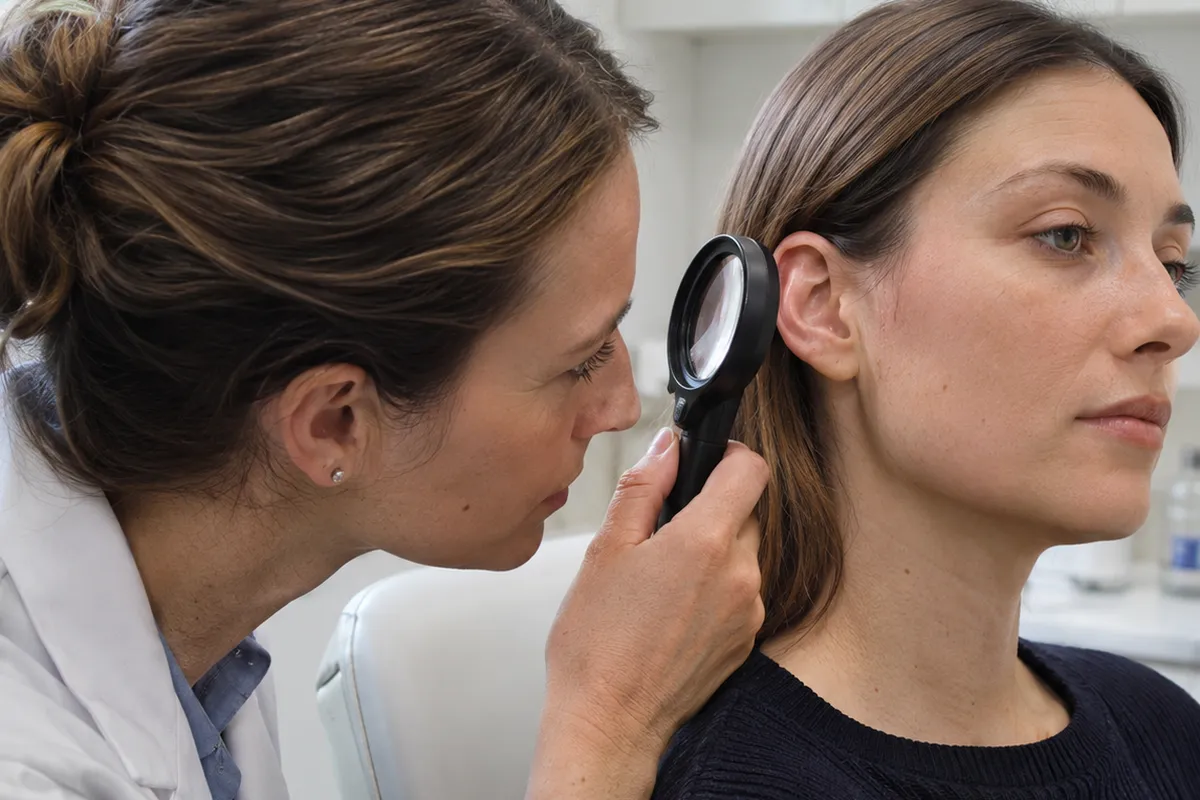
Sebaceous hyperplasia is benign and very common. However, basal cell carcinoma, the most common type of skin cancer, can look similar: a small bump on the face, sometimes shiny and with small blood vessels. Telling the two apart is important and is not always possible with the naked eye alone.
Three ideas to remember.
Typical differences
| Sebaceous hyperplasia | Basal cell carcinoma | |
|---|---|---|
| Colour | Yellowish or skin-coloured | Pink, pearly, sometimes pigmented |
| Centre | Central depression | Sometimes ulcerated or crusted |
| Number | Often multiple | Often solitary |
| Course | Stable or slow-growing | Grows, may bleed and does not heal |
| Dermoscopy | Cloud-like yellowish globules, with crown vessels around them | Branching blood vessels and other characteristic structures |
A review of sebaceous lesions includes basal cell carcinoma among the diagnoses to exclude and recommends a biopsy when the diagnosis is unclear (Papadimitriou et al., 2023).
Warning signs
- A lesion that is growing.
- A lesion that bleeds, forms a crust or does not heal.
- A solitary lesion that differs from the others.
- A pearly appearance with visible blood vessels.
At Luxmed Clinic
At Luxmed, we only treat lesions that appear to be sebaceous hyperplasia after they have been assessed. If there is any doubt, we refer the person to dermatology.
Talk to us
The assessment is a conversation, with no obligation. Tell us what concerns you and our team will reply.
This article is for information purposes and does not replace a consultation. The results of any treatment vary from person to person.
Frequently asked questions
Can sebaceous hyperplasia turn into cancer?
It is not considered a premalignant lesion.
Do I always need a biopsy?
No. Only when the diagnosis is unclear.
Is basal cell carcinoma serious?
It rarely spreads, but grows locally and should be treated.
Who should examine it?
A dermatologist, particularly for suspicious lesions.
Scientific references 1
- Papadimitriou I, Vakirlis E, Sotiriou E, Bakirtzi K, Lallas A, Ioannides D. Sebaceous neoplasms. Diagnostics (Basel). 2023;13(10):1676. doi:10.3390/diagnostics13101676 Artigo
Editing and development: Rúben Brito · Operial Development
Keep exploring