


- Home
- Facial aesthetics
- Acne scars
- Acne scars
Acne scars: the types and why they matter
Acne scars are permanent marks left when inflammation from a spot damages the deeper layers of the skin. The type of scar determines which treatment works best.
 Luxmed TeamAuthor
 Dr Michelle CampagnoliClinical review · OM no. 69467
In this article
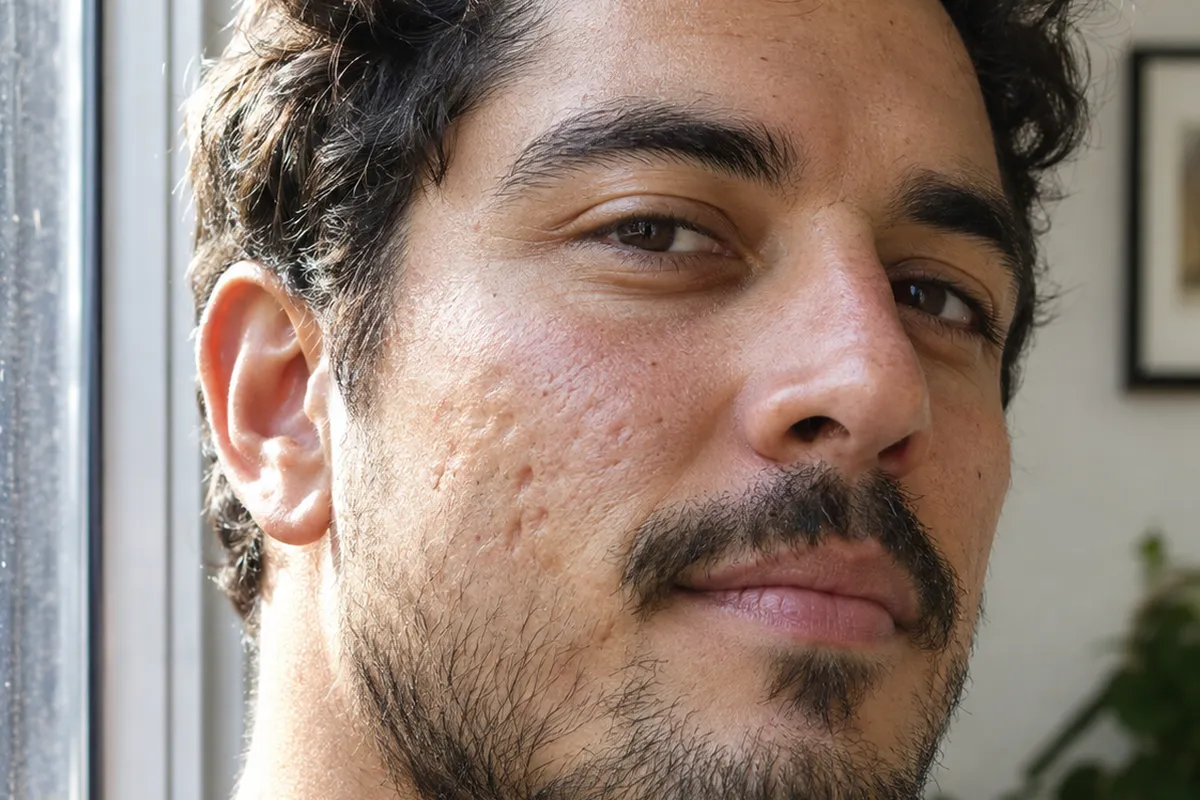
Acne scars are permanent marks left when inflammation from a spot damages the deeper layers of the skin. Unlike discolouration, they do not disappear on their own. But they are not all the same, and the type of scar determines which treatment works best.
Three ideas to remember.
Types of atrophic scar
The most widely used classification divides atrophic scars into three types (Jacob et al., 2001):
| Type | What it is like | Most useful treatments |
|---|---|---|
| Ice-pick | Narrow and deep, like a small hole | Focal techniques, such as concentrated trichloroacetic acid or excision |
| Rolling | Wide, with gently sloping edges, creating an undulating surface | Subcision, filler, microneedling |
| Boxcar | Well-defined edges and a flat base | Fractional laser, peels, excision or elevation |
Raised scars
- Hypertrophic scars: raised and confined to the area of the original lesion.
- Keloids: extend beyond the boundaries of the original lesion; more common on the torso, shoulders and jawline.
Marks are not scars
Flat brown or red marks that gradually fade are post-inflammatory discolouration, not scars. They require their own treatment.
Prevention is most important
- Treat acne early, particularly inflammatory and nodular acne.
- Do not squeeze spots.
- Seek medical advice if acne leaves marks.
At Luxmed Clinic
At Clínica Luxmed, we begin by identifying each person's scar types, as the treatment plan depends on them.
Talk to us
The assessment is a conversation, with no obligation. Tell us what concerns you and our team will reply.
This article is for information purposes and does not replace a consultation. The results of any treatment vary from person to person.
Frequently asked questions
Do acne scars disappear over time?
Discolouration does; scars do not, although they may soften slightly.
Can I have treatment while I still have acne?
It is preferable to control the acne first.
Do creams solve it?
They may improve the texture slightly, but not deep scars.
Why do some people develop scars while others do not?
It depends on the severity of the acne, genetics and the habit of picking at spots.
Scientific references 1
- Jacob CI, Dover JS, Kaminer MS. Acne scarring: a classification system and review of treatment options. J Am Acad Dermatol. 2001;45(1):109-117. doi:10.1067/mjd.2001.113451 Artigo
Editing and development: Rúben Brito · Operial Development
Keep exploring