


- Home
- Hair medicine
- Receding hairline at the temples
- Tracking the temples
How to track your temples at home
The mirror, the light and memory deceive. A protocol of photographs and measurements at home to understand whether your temples have really changed.
 Rúben BritoAuthor
 Dr Michelle CampagnoliClinical review · OM no. 69467
In this article
"Are my temples bigger or is it my imagination?" The question is repeated in the mirror, after a shower, in a group photograph in overhead light. And the answer changes with the day. The problem is not a lack of attention: it is that the mirror, the light and memory are poor measuring instruments.
Clinical trials of treatments for hair loss solve this with standardised photographs: same position, same light, same distance, same hairstyle. At home it is not possible to have the same rigour, but you can get close enough to tell whether there is a real change.
Three ideas to remember.
Fica por baixo do resumo, se existir uma segunda foto.
Why the mirror deceives
Perception changes with everything
- Light: strong overhead light, as in a bathroom or a lift, makes the scalp show more. Side or diffuse light hides it.
- Wet hair: water clumps the hairs into strands and increases the reflection from the skin, making it look as if there is less hair. The review by Rubin and colleagues (2023) on hair assessment methods stresses precisely that hair should be washed, dry and combed, without products.
- Hairstyle and cut: short hair, pulled back or with gel shows the temples more than long hair or a fringe.
- The angle: tilting the head by just a few degrees changes the apparent depth of the temple recession.
- Your state of mind: on an anxious day, everything looks worse.
The change is slow
Baldness advances slowly. In addition, it is estimated that loss of density only becomes evident to the naked eye when a significant proportion of hairs in an area has already been lost, sometimes about half. In other words, by the time someone is sure their temples have receded, the process may have been under way for some time.
What the clinical trials do
In treatment studies, "standardised global photography" is used: the head fixed on a support, the camera and flash at the same distance, four always-identical views (front, temples, top and crown), hair prepared in the same way (Canfield, 1996). Assessors who do not know which is the before photograph and which is the after compare the images. The home method in this article is inspired by these rules.
A protocol for photographs at home
What you need
- A phone with a rear camera (better quality than the front one).
- A simple tripod or a fixed support (a shelf, a pile of books) and the timer; or someone to help you.
- A smooth wall in a neutral colour as a background.
- A window with natural light, preferably in the daytime but without direct sun.
- A small piece of adhesive tape to mark on the floor where to stand.
Preparing the hair
- Hair washed the day before and dry, with no gel, wax, hairspray or fibres.
- Hairstyle pulled back, moving the hair away from the forehead and temples, with a fine comb. If your hair is long, tie it loosely at the back.
- If you have a fringe, use a wide hairband, always the same one, to keep it back.
The photographs
Always take the same three, preferably four:
| View | How |
|---|---|
| Front | Face towards the camera, looking straight ahead, chin parallel to the floor. The camera at forehead height, about 40 to 50 cm away. |
| Right temple at 45 degrees | Turn your body (not just your head) about 45 degrees to the left, keeping the camera in the same place. |
| Left temple at 45 degrees | The same, for the other side. |
| From above (optional) | Head tilted slightly forward, camera above, to see the front hairline and the top. |
Rules to make them comparable
- Same place, same window, same time of day.
- No flash (or always with flash, if that is your choice).
- No digital zoom; move the phone closer or further away rather than zooming.
- Same expression: relaxed face, without raising the eyebrows (except for the measurement below).
- Same haircut: always try to photograph with a similar hair length, for example two weeks after a haircut.
- Save with the date in a folder of its own.
How often
Every three months. More often gives no useful information, because changes are slow, and it feeds anxiety.
Measuring the depth of the temple recession
Photographs show shape; a simple measurement helps to understand progress. The secret is to use points on the face that do not change.
The ruler method
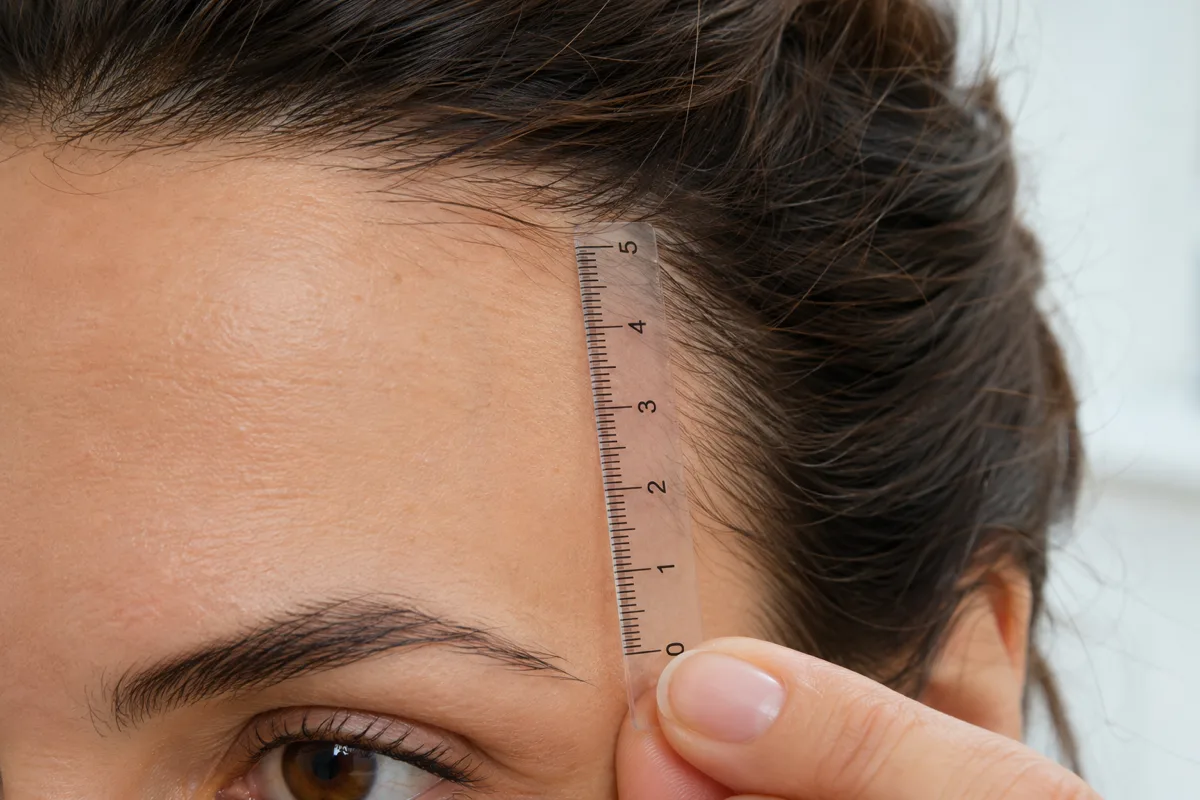
- In front of the mirror, with your hair pulled back, imagine a vertical line rising from the outer corner of the eye.
- Along that line, use a flexible ruler or tape measure to measure the distance between the top of the eyebrow and the point where terminal hair begins (hairs of normal thickness, not the fine fuzz).
- Do the same on the other side.
- Also measure at the centre of the forehead, from the point between the eyebrows to the hairline, as a reference.
- Record the values with the date.
Repeat every six months or once a year. Differences of a few millimetres are within the margin of error of home measurement; what matters is a consistent trend across several measurements.
The finger rule
A quick reference, used in clinical practice: raise your eyebrows and place a finger flat above the highest crease of the forehead. In a mature hairline, the hair usually begins up to about one finger above that crease. It is not a diagnosis, just a clue. See Temples: natural or receding?.
What about the hairs at the margin?
Look closely, in good light and, if possible, with your phone's macro function, at the hairs furthest forward at the temples. Many fine, short, pale hairs at the margin may indicate miniaturisation. Phone magnifying lenses give an idea, but do not replace trichoscopy at a consultation.
How to compare and interpret
Compare over the long term
- Place the most recent photograph side by side with the one from 6, 12 and 24 months ago, not last month's.
- Also compare with old photographs, from adolescence or your 20s, in which your forehead is visible.
- If possible, ask someone to compare the photographs without knowing the order: it is the home equivalent of the "blind assessor" in studies.
What suggests a real change
- The temples are clearly deeper in several comparisons in a row.
- The measurements show a consistent upward trend.
- The "M" shape is more marked and the hairs at the margin are finer.
- The crown is also thinning.
Common mistakes
- Compare a photograph with wet hair with one with dry hair.
- Compare bathroom light with natural light.
- Drawing conclusions from a single photograph or a single day.
- Photographing every day or every week.
- Mistaking the normal mature hairline, which forms at the end of adolescence, for baldness.
When monitoring becomes anxiety
If you spend a lot of time at the mirror checking your temples, if photographs ruin your day, or if the worry interferes with work, sleep or social life, it is better to stop measuring and book an assessment. Leaving the measuring to a professional, using a method, is often a relief. And if the concern about appearance is very intense, it is worth talking to your GP or a psychologist.
When to bring the photographs to the consultation
Your photographs are very useful at the consultation: they show a progression that a single examination cannot show.
At Luxmed, the Hair Medicine consultation includes examination, trichoscopy of the temples compared with the back of the head and standardised photographs, which serve as a reference for later consultations. That way, you no longer depend on the mirror.
Talk to us
The assessment is a conversation, with no obligation. Tell us what concerns you and our team will reply.
Telephone 214 044 241 · info@luxmed.pt
This article is for information only and does not replace a medical consultation.
Frequently asked questions
How often should I photograph my temples?
Every three months. Compare photographs at least 6 to 12 months apart.
Should I photograph with wet hair?
No. Wet hair clumps into strands and shows more skin, making it look as if there is less hair.
Can a phone app measure hair loss?
Some help to standardise photographs, but they do not replace an assessment with trichoscopy. Use them as an aid, not as a diagnosis.
How far do the temples have to recede for it to be baldness?
There is no fixed number. What counts is whether the recession continues beyond the mature line of early adulthood, and whether the hairs at the margin become thinner.
Are old photographs useful?
Yes, they are very useful, especially those that show your forehead with the hair pushed back. Take into account the light and angle of each one.
I am always checking my hairline in the mirror. Is that normal?
The concern is understandable, but if you spend a lot of time checking or it causes you distress, it is better to book an assessment and talk about it.
Scientific references 5
- Rubin A, Shah RR, Khan S, Haroon A, Rao B. Imaging tools for noninvasive hair assessment. Cutis. 2023;112(1):E52-E57. doi:10.12788/cutis.0834 Artigo
- Canfield D. Photographic documentation of hair growth in androgenetic alopecia. Dermatol Clin. 1996;14(4):713-721. Artigo
- Evaluating subjective versus objective measures of changes in hair density using standardized scalp photography. J Am Acad Dermatol. 2023. Artigo
- Norwood OT. Male pattern baldness: classification and incidence. South Med J. 1975;68(11):1359-1365. Artigo
- Kanti V, et al. Evidence-based (S3) guideline for the treatment of androgenetic alopecia in women and in men, short version. J Eur Acad Dermatol Venereol. 2018;32(1):11-22. Guideline
Keep exploring