


- Home
- Hair medicine
- Receding hairline
- Measuring the hairline
How to measure your hairline at home
A simple measurement, always repeated in the same way, says more than the mirror. What to measure, how to photograph and how to interpret the numbers without misleading comparisons.
 Rúben BritoAuthor
 Dr Michelle CampagnoliClinical review · OM no. 69467
In this article
Looking at your forehead in the mirror and thinking it is bigger is not enough to know whether your hairline is receding. Light, hairstyle and memory can deceive. A simple measurement, repeated in the same way over time, gives a more objective answer, and it is especially useful when a slowly advancing alopecia that does not reverse is suspected, such as frontal fibrosing alopecia.
This article explains what to measure, how to measure and photograph, and above all how to read the numbers without misleading comparisons.
Three ideas to remember.
Fica por baixo do resumo, se existir uma segunda foto.
Why measure
What doctors measure
At the consultation, the front hairline is assessed by examination, standardised photographs and, in some situations, ruler measurements. In frontal fibrosing alopecia, for example, there are severity scales, such as the FFASI (Holmes et al., 2016), which grades the recession of the front hairline and temples, and the loss of eyebrows and other body hair, from photographs and examination. These scales showed good agreement between doctors in assessing the hairline.
Why home measurement helps
- It makes perception objective: a number recorded six months ago does not change with your mood.
- It detects slow changes: in frontal fibrosing alopecia, the average rate of recession described is about 0.9 mm a month, or about 1 centimetre a year. In the mirror, that goes unnoticed for a long time; in a measurement every six months, it does not.
- It helps the doctor: previous results and photographs show the progression before the first consultation.
An important limitation
The authors of the FFASI themselves note that measuring the distance between the face and the hairline is a poor way to compare different people, because everyone started from a different line. It works well for comparing the same person over time. That is how you should use your measurement.
Step-by-step measurement
Material
- A transparent flexible ruler or a sewing tape measure (in millimetres).
- A mirror in good natural light, or someone to help you.
- An eye pencil or washable pen, optional, to mark points.
- A notebook or a spreadsheet to keep records.
Preparation
- Dry hair, without products, pulled back with a fine comb or a wide ribbon, always the same one.
- Relaxed face, without frowning or raising the eyebrows.
- Same time of day and same light for all measurements.
The reference points
Use points on the face that do not change over time:
- Glabella: the point between the eyebrows, above the nose.
- Top of the eyebrow, above the centre of each eye. Note: if the eyebrows are thinning or have been plucked, this point becomes less reliable.
- Outer corner of each eye, as a vertical reference for the temples.
What to measure
| Measurement | From where to where |
|---|---|
| Centre | From the glabella to the start of the hair, along the midline |
| Right | From the top of the right eyebrow, over the centre of the eye, to the hair |
| Left | The same on the left side |
| Temples (optional) | Vertically from the outer corner of the eye, from the top of the eyebrow to the hair |
Where does the hair begin?
This is the hardest part. Count from the first hair of normal thickness (terminal hair), not from the fine fuzz. If there are isolated hairs in front of the line, record them separately: in frontal fibrosing alopecia, these "lonely hairs" are an important sign.
Record
Note the date, the values in millimetres and any observation (eyebrows, redness, itching, spots on the face). Measure twice and use the average.
Photograph with a ruler
A photograph complements the measurement and shows the shape of the line.
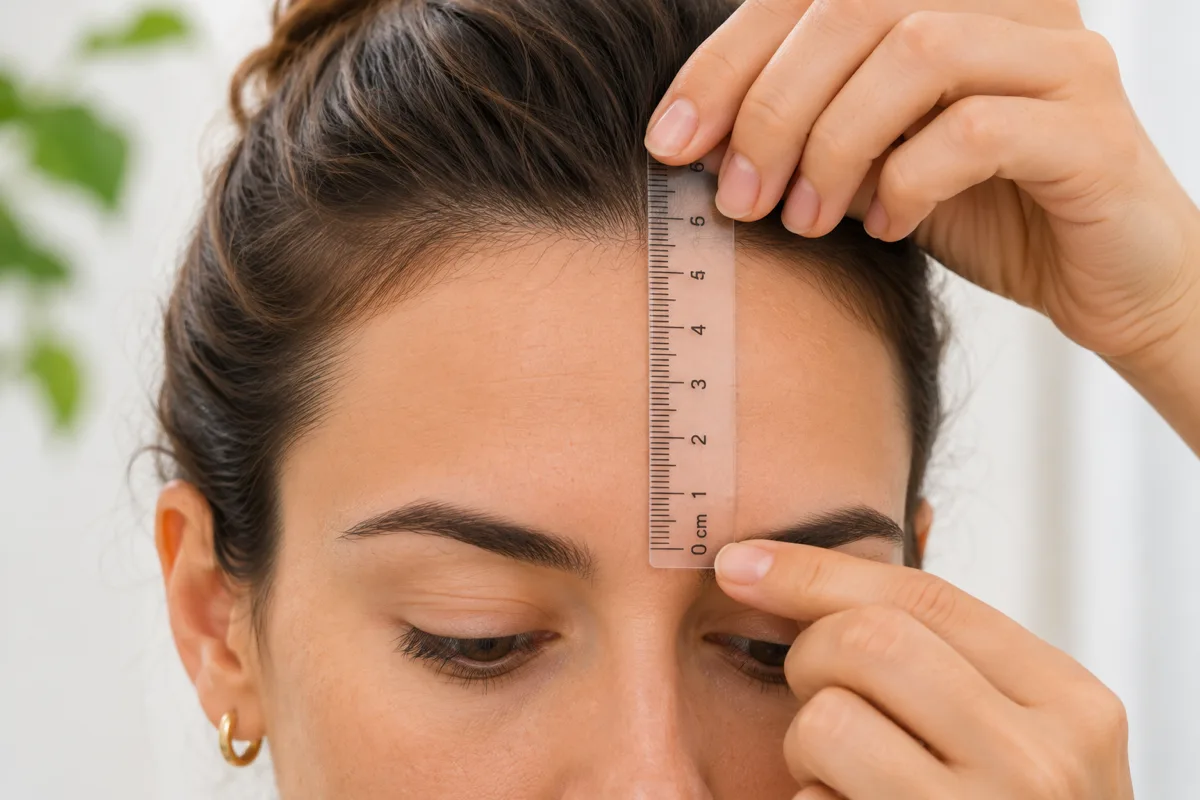
- Front view: with your hair pulled back, hold the ruler vertically against the centre of the forehead, with the zero at the glabella. The camera at forehead height, 40 to 50 cm away, without zoom and without flash.
- Side views at 45 degrees: for the temples, turning your body and not just your head.
- Eyebrows close up: one photograph of each eyebrow, in good light, to track density. In frontal fibrosing alopecia, eyebrow loss may appear before the hairline recedes.
- The hairline up close: with your phone's macro function, to see redness or scaling around the hairs at the margin.
General rules: same place, same natural light, same time, same hairstyle, save with the date. See also the protocol in How to track your temples at home.
How to interpret
Compare with yourself, not with others
Forehead height varies greatly between people, depending on genetics, sex, ancestry and skull shape. Published average values vary between studies and populations, and a high forehead can be perfectly normal. What matters is the change compared with your previous measurements.
Measurement error
In a home measurement, differences of 1 to 3 mm may result only from small variations in the chosen point, expression or posture. So:
- do not draw conclusions from a single measurement;
- look for a trend over three or more consecutive measurements;
- compare at intervals of six to twelve months.
What suggests real recession
- A consistent increase in distance across several measurements, in the order of several millimetres a year.
- Increase at the centre and at the sides at the same time (band pattern).
- Thinning eyebrows, isolated hairs in front of the line, pale smooth skin in the area where there was hair.
- Redness or scaling around the hairs at the margin.
What is probably not recession
- Stable values over a year, with small fluctuations.
- A high forehead that was already like that in adolescent photographs.
If measuring becomes anxiety
Measuring every week gives no more information and feeds worry. If that happens, stop measuring and book an assessment.
When the numbers call for a consultation
These signs suggest frontal fibrosing alopecia, in which lost hair does not grow back. See Higher forehead: normal or worth checking?.
Scheduled consultation
- Slight but consistent increase, without other signs.
- Temples or crown also changing.
- Doubt about whether it is recession or natural shape.
Bring your measurements and photographs: they are very useful. At Luxmed, the hair medicine consultation includes examination of the front hairline, eyebrows and face, trichoscopy, measurements and standardised photographs that serve as a reference for the future.
Talk to us
The assessment is a conversation, with no obligation. Tell us what concerns you and our team will reply.
Telephone 214 044 241 · info@luxmed.pt
This article is for information only and does not replace a medical consultation.
Frequently asked questions
What is the normal height of the forehead?
It varies greatly between people. More important than a "normal" value is knowing whether your measurement is changing.
How often should I measure?
Every three months, comparing with measurements from six to twelve months ago.
How many millimetres of difference are significant?
Differences of 1 to 3 mm may be measurement error. A consistent trend of several millimetres a year deserves attention.
What if my eyebrows are also falling out?
Measure from the glabella (between the eyebrows) and ask for an assessment: loss of eyebrows with a receding front hairline is a warning sign.
Does this method work for men?
Yes. For the temples, see also the specific protocol in How to track your temples at home.
Can I trust an app?
Some help to standardise photographs, but they do not make a diagnosis. Use them as an aid.
Scientific references 4
- Holmes S, Ryan T, Young D, Harries M. Frontal Fibrosing Alopecia Severity Index (FFASI): a validated scoring system for assessing frontal fibrosing alopecia. Br J Dermatol. 2016;175(1):203-207. doi:10.1111/bjd.14445 Artigo
- Starace M, Cedirian S, Rapparini L, et al. Enhanced insights into frontal fibrosing alopecia. Dermatol Ther (Heidelb). 2024;14(6):1457-1477. Artigo
- Saceda-Corralo D, Moreno-Arrones ÓM, Fonda-Pascual P, et al. Development and validation of the Frontal Fibrosing Alopecia Severity Score. J Am Acad Dermatol. 2018;78(3):522-529. Artigo
- Rubin A, Shah RR, Khan S, Haroon A, Rao B. Imaging tools for noninvasive hair assessment. Cutis. 2023;112(1):E52-E57. Artigo
Keep exploring