


- Home
- Hair medicine
- Receding hairline
- Hairstyles and the hairline
Tight hairstyles and the hairline
How to keep the habits you enjoy, or need, without losing your hairline, and how to tell traction from another important cause of recession in women.
 Rúben BritoAuthor
 Dr Michelle CampagnoliClinical review · OM no. 69467
In this article
The front hairline, next to the forehead, frames the face, and it is also one of the most fragile areas of the scalp. The hairs there are finer and bear a lot of tension when hair is pulled back, held with headbands, covered with tight headscarves or when a wig is glued on. Over time, the line can recede and the fine hairs at the margin (the "baby hairs") disappear.
This article is not meant to condemn styles, religions or professions: it is meant to show how to keep the habits you enjoy, or need, without losing your hairline. And to help tell traction from another important cause of recession in women, frontal fibrosing alopecia.
Three ideas to remember.
Fica por baixo do resumo, se existir uma segunda foto.
What pulls on the front hairline
Hair pulled back tightly
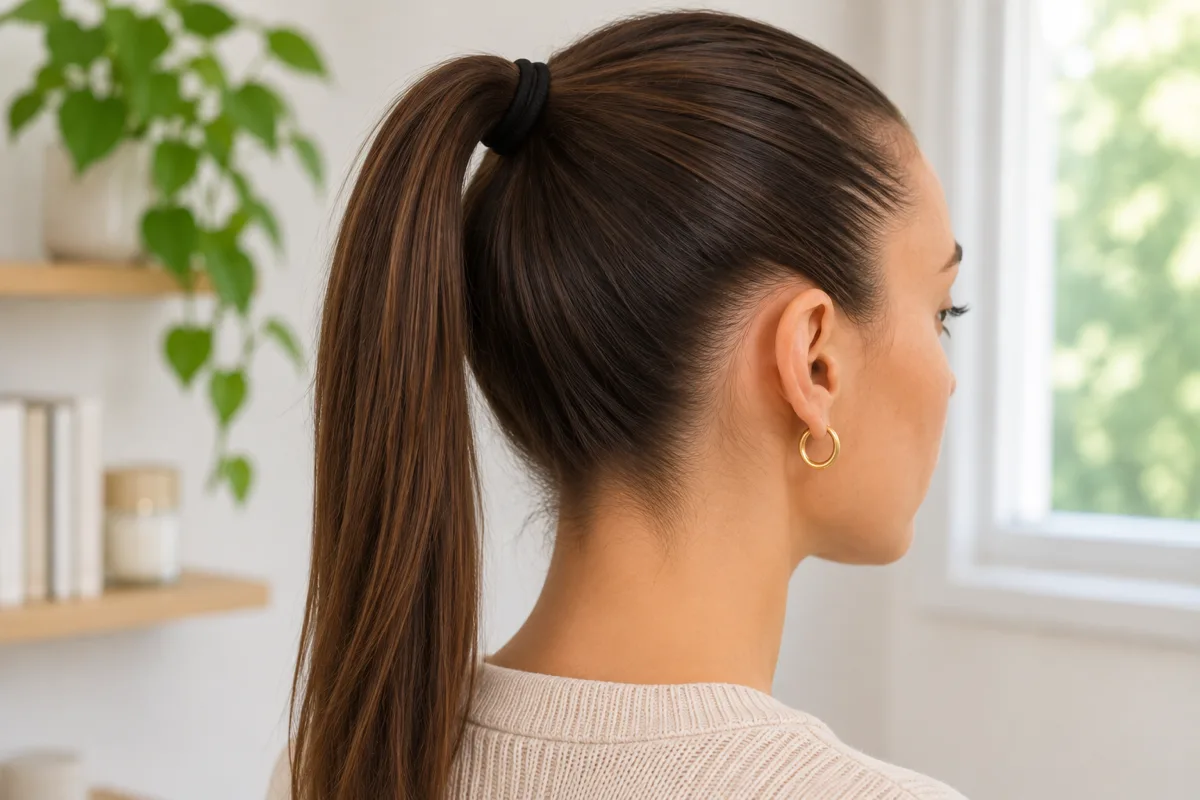
High, sleek buns and ponytails, with the hair pulled hard from the forehead, often with gel or hairspray, are common at work, in sport and in dance. Worn every day, for years, they concentrate tension on the front margin.
Headbands, clips and ribbons
Rigid headbands with teeth, clips always in the same place and tight elastic bands press and pull on the line. The effect is greater if they are worn every day, for many hours, or to sleep.
Headscarves, hijab and caps
The headscarf or hijab, on its own, does not cause hair loss. What can cause it is the way the hair is fastened underneath (tight bun, hair ties, clips) and the tension of the fabric on the forehead. A review of alopecia in Muslim women (Niazi et al.) reported traction alopecia in 10.4% of women who wear the hijab, compared with 7.5% of those who do not, and noted that very few seek medical help. The same applies to professional caps and hairnets fastened with clips.
Glued wigs (lace front) and prostheses
Wigs with a lace front are often fixed with glue or adhesive tape directly on the hairline. The glue can irritate the skin, cause allergy and, on removal, pull out the hairs at the margin. Tight wig caps and fixing combs also pull.
Costume and sports wigs
Even wigs worn only in competitions can cause traction. In 2026, a research letter described three children, aged 7 to 8, with hair loss on top of the head, where Irish dance wigs were fastened, with recovery after changing how they were worn (Bilimoria et al., 2026).
Brushing and shaping the margins
Repeatedly brushing the short hairs at the forehead ("baby hairs" or "edges") with stiff brushes, gel and heat to shape them every day can break and weaken these hairs, which are already the most fragile.
The signs at the front hairline
Traction: what to look for
- Thinner margins along the forehead and at the temples, where the hairstyle or accessory pulls.
- Short, broken hairs at different lengths.
- Fringe sign: a fine band of short hairs that stays at the margin, in front of the thin area (Samrao et al., 2011).
- Pain, burning, itching or small spots after wearing the hairstyle or accessory.
- Redness or irritation where glue or tape is applied.
- A clear relationship with the habit: worse when you use it more, better during breaks.
Traction or frontal fibrosing alopecia?
In women, the other important cause of front hairline recession is frontal fibrosing alopecia, a scarring alopecia. Telling them apart is essential, because traction recovers if caught early and frontal fibrosing alopecia does not.
| Traction alopecia | Frontal fibrosing alopecia | |
|---|---|---|
| Relationship with hairstyles | Clear | None |
| Typical age | Any, from childhood | Especially after the menopause |
| Fringe sign | Often present | Absent; isolated hairs may remain in front |
| Eyebrows | Normal | Thinned in 50% to 75% of cases |
| Skin where there was hair | Normal or with small spots | Pale, smooth, shiny |
| Margin | Broken hairs | Redness and scaling around the hairs |
| Face | Normal | Sometimes small skin-coloured bumps |
| Reversible | Yes, in the early stage | No; treatment aims to stabilise |
The two can coexist, and trichoscopy helps to clarify. See Higher forehead: normal or worth checking?.
How to protect the front hairline
Hair tied up
- Tie it lower and looser, without stretching the front margin.
- Alternate between hairstyles and have days with your hair loose.
- Use fabric hair ties, without metal.
- Do not tie up wet hair; it shrinks as it dries and increases tension.
- Let it down to sleep.
Headbands, clips and ribbons
- Prefer wide, soft headbands, without teeth, or fabric ribbons.
- Change the position of the clips.
- Do not sleep in a headband.
Headscarves and hijab
- Underneath, tie your hair loosely and low, without a tight bun.
- Use an inner cap of soft, breathable fabric, preferably satin or silk, instead of tight hair ties.
- Avoid pins or clips always in the same place on the hairline.
- Relieve the tension of the fabric on the forehead, when possible, and leave your hair loose at home.
- Keep the scalp clean and dry.
Wigs and prostheses
- Prefer glue-free attachments, such as adjustable bands or clips placed away from the margin.
- If you use glue or tape, apply it to the skin and not to the hair, test the product on a small area, and remove it with a proper remover, without pulling.
- Give your hairline breaks and do not sleep with the wig glued on.
- Satin wig caps reduce friction.
Margins (baby hairs)
- Brush them gently, with a soft brush, and not every day.
- Use less gel and less heat on that area.
Recovery: what to expect
- In the early stage, once the tension is relieved, the inflammation settles within weeks and the first new hairs usually appear in three to six months. The result is assessed at six to twelve months.
- New hairs are short and fine at first; over time, they thicken.
- The doctor can treat the inflammation and, in some cases, propose topical minoxidil to help the follicles that are still active.
- If the tension has been maintained for many years, some of the follicles may have been replaced by scar tissue. In that area, hair does not return with medicines; camouflage or, in selected and stable cases, a transplant may be considered.
- If there is no recovery after a year without tension, or if the line keeps receding without hairstyles, there may be another cause, such as frontal fibrosing alopecia, and it needs to be reassessed.
When to assess
At Luxmed, the hair medicine consultation includes a conversation about your habits, respecting your cultural, religious and professional choices, examination of the front hairline and eyebrows, trichoscopy to distinguish traction from frontal fibrosing alopecia and follow-up photographs. We agree with you practical ways to protect your hair without giving up what matters to you.
Talk to us
The assessment is a conversation, with no obligation. Tell us what concerns you and our team will reply.
Telephone 214 044 241 · info@luxmed.pt
This article is for information only and does not replace a medical consultation.
Frequently asked questions
Does the hijab make hair fall out?
On its own, no. What can cause hair loss is the way the hair is fastened underneath and the tension on the fabric. With simple precautions, the risk falls greatly.
Is wearing a headband every day harmful?
Rigid, tight headbands, worn for many hours, can pull on the hairline. Prefer wide, soft ones and alternate.
Do lace front wigs damage the hairline?
They can, especially if glued onto the hair, worn without breaks or removed by pulling. Glue-free attachments and breaks reduce the risk.
Do falling baby hairs mean alopecia?
They may be a sign of traction or of excessive brushing. If the margin is receding, it is worth getting assessed.
Does the hairline go back to where it was?
If it is recent traction, as a rule yes, in six to twelve months. If there is scarring, not completely.
How do I know whether it is traction or frontal fibrosing alopecia?
A clear link with hairstyles, the fringe sign and normal eyebrows favour traction. Loss of eyebrows, pale skin and age after the menopause favour frontal fibrosing alopecia. Trichoscopy helps to confirm it.
Scientific references 6
- Billero V, Miteva M. Traction alopecia: the root of the problem. Clin Cosmet Investig Dermatol. 2018;11:149-159. Artigo
- Samrao A, Price VH, Zedek D, Mirmirani P. The «fringe sign»: a useful clinical finding in traction alopecia of the marginal hair line. Dermatol Online J. 2011;17(11):1. Artigo
- Niazi MA, Sohail N, Sohail A, Alkul S. Assessing alopecia in Muslim women: a review. Artigo
- Bilimoria SN, et al. Traction alopecia from Irish dancing wigs in children (carta clínica). Pediatr Dermatol. 2026. doi:10.1111/pde.70347 Artigo
- Starace M, Cedirian S, Rapparini L, et al. Enhanced insights into frontal fibrosing alopecia. Dermatol Ther (Heidelb). 2024;14(6):1457-1477. Artigo
- Haskin A, Aguh C. All hairstyles are not created equal. J Am Acad Dermatol. 2016;75(3):606-611. Artigo
Keep exploring