


- Home
- Body aesthetics
- Body microneedling
- Stretch marks after pregnancy
Stretch marks after pregnancy: when to start and what to expect
Stretch marks respond better to treatment while they are still red. Learn when to start after giving birth, what changes during breastfeeding, which treatments have evidence and what to expect.
 Luxmed TeamAuthor
 Dr Michelle CampagnoliClinical review · OM no. 69467
In this article
Pregnancy stretch marks (striae gravidarum) develop in a large proportion of pregnant women, especially on the abdomen, breasts, hips and thighs. Many women want to treat them after giving birth but are unsure when to start and what is safe while breastfeeding. We explain what is known and how to plan treatment.
Three ideas to remember.
Why they appear
During pregnancy, the skin stretches rapidly while hormones alter collagen and elastic fibres. Biopsy studies have shown that even in very recent stretch marks, the collagen and elastic fibres are already disorganised. Risk factors include genetics, young maternal age, marked weight gain, large babies and multiple pregnancies (Farahnik et al., 2017).
During pregnancy
Reviews of topical prevention show that the evidence is weak (Korgavkar and Wang, 2015). Some studies suggest that creams containing Centella asiatica extract or hyaluronic acid, or daily massage, may provide some benefit, but no product guarantees that stretch marks will not appear. Moisturising the skin and keeping weight gain within the range recommended by the obstetrician are reasonable measures.
Topical retinoids and aesthetic procedures targeting stretch marks are not used during pregnancy.
After childbirth: when to start
| Stage | What can be done | Notes |
|---|---|---|
| First few weeks | Moisturising, general care | Recovery from childbirth is the priority |
| During breastfeeding | Moisturisers; some procedures, following an individual assessment | Avoid tretinoin and other retinoids; use caution with topical anaesthetics over large areas and avoid the breast area |
| After breastfeeding | Topical tretinoin, microneedling, laser, radiofrequency microneedling | Stage at which more comprehensive treatment is possible |
Because red stretch marks respond better, there is an advantage to not waiting too long. On the other hand, it is prudent to allow the skin and weight to stabilise and to take breastfeeding into account. The balance between these factors is decided on a case-by-case basis.
Which treatments are supported by evidence
| Treatment | Evidence | Best for |
|---|---|---|
| Topical tretinoin (0.05% or higher) | Improvements of up to around 47% in studies of recent pregnancy stretch marks | Red stretch marks, after breastfeeding |
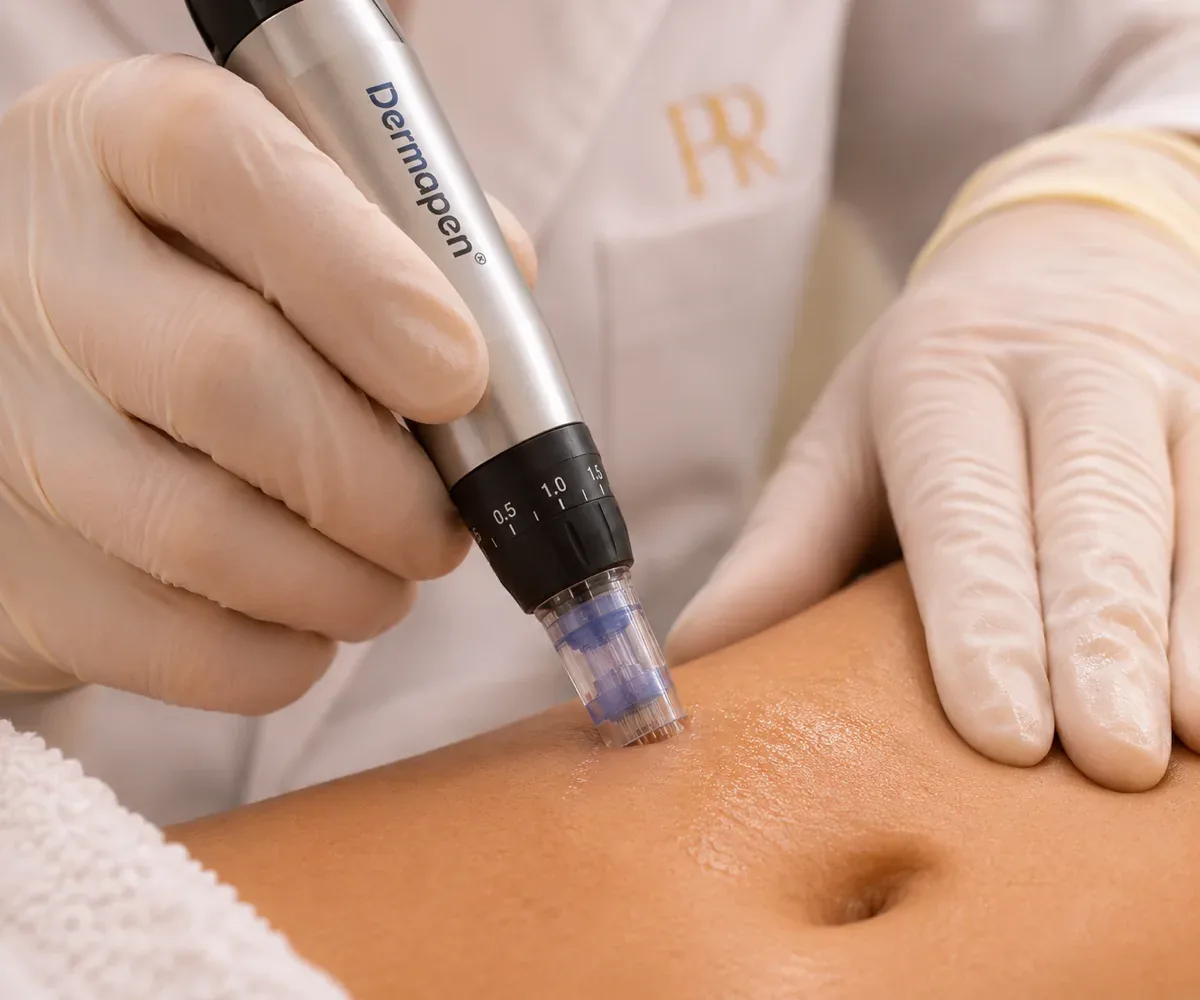
| Microneedling | Small studies showing consistent improvement | Red and white stretch marks, all skin types |
| Fractional lasers | Improvements of 50 to 75% reported with non-ablative lasers | Red and white |
| Radiofrequency microneedling | Good results in small studies | White stretch marks and associated skin laxity |
What to expect
- Improvement in colour, texture and width, more marked in recent stretch marks.
- Several sessions, usually 3 to 6, depending on the treatment.
- Gradual results over several months.
- Older white stretch marks improve less and more slowly.
At Luxmed Clinic
At Luxmed in Algés, near Lisbon, the postnatal consultation is used to assess the stage of the stretch marks, breastfeeding and the condition of the skin, and to plan treatment for the most appropriate time.
Talk to us
The assessment is a conversation, with no obligation. Tell us what concerns you and our team will reply.
This article is for information only and does not replace a medical consultation.
Frequently asked questions
Is there a cream that prevents stretch marks during pregnancy?
No cream guarantees prevention. Some ingredients have shown a slight benefit in small studies.
Can I have microneedling while breastfeeding?
It may be possible, following an individual assessment. Retinoids and extensive use of anaesthetics are avoided, and the breast area is not treated.
How long after childbirth should I start?
It depends on breastfeeding and recovery. Because red stretch marks respond better, it is worth having an assessment within the first few months.
Will the stretch marks disappear on their own?
They tend to fade over time, but they do not disappear.
Scientific references 4
- Farahnik B, Park K, Kroumpouzos G, Murase J. Striae gravidarum: risk factors, prevention, and management. Int J Womens Dermatol. 2017;3(2):77-85. Artigo
- Korgavkar K, Wang F. Stretch marks during pregnancy: a review of topical prevention. Br J Dermatol. 2015;172(3):606-615. Artigo
- Al-Himdani S, Ud-Din S, Gilmore S, Bayat A. Striae distensae: a comprehensive review and evidence-based evaluation of prophylaxis and treatment. Br J Dermatol. 2014;170(3):527-547. Artigo
- Bozzo P, Chua-Gocheco A, Einarson A. Safety of skin care products during pregnancy. Can Fam Physician. 2011;57(6):665-667. Artigo
Editing and development: Rúben Brito · Operial Development
Keep exploring