


- Home
- Facial aesthetics
- Dry, dehydrated skin
- Injectable hydration
Injectable hydration: how it works and how long it lasts
When creams are not enough, there are treatments that take hydration into the skin: skinboosters and mesotherapies, injected in microdroplets into the dermis.
 Luxmed TeamAuthor
 Dr Michelle CampagnoliClinical review · OM no. 69467
In this article
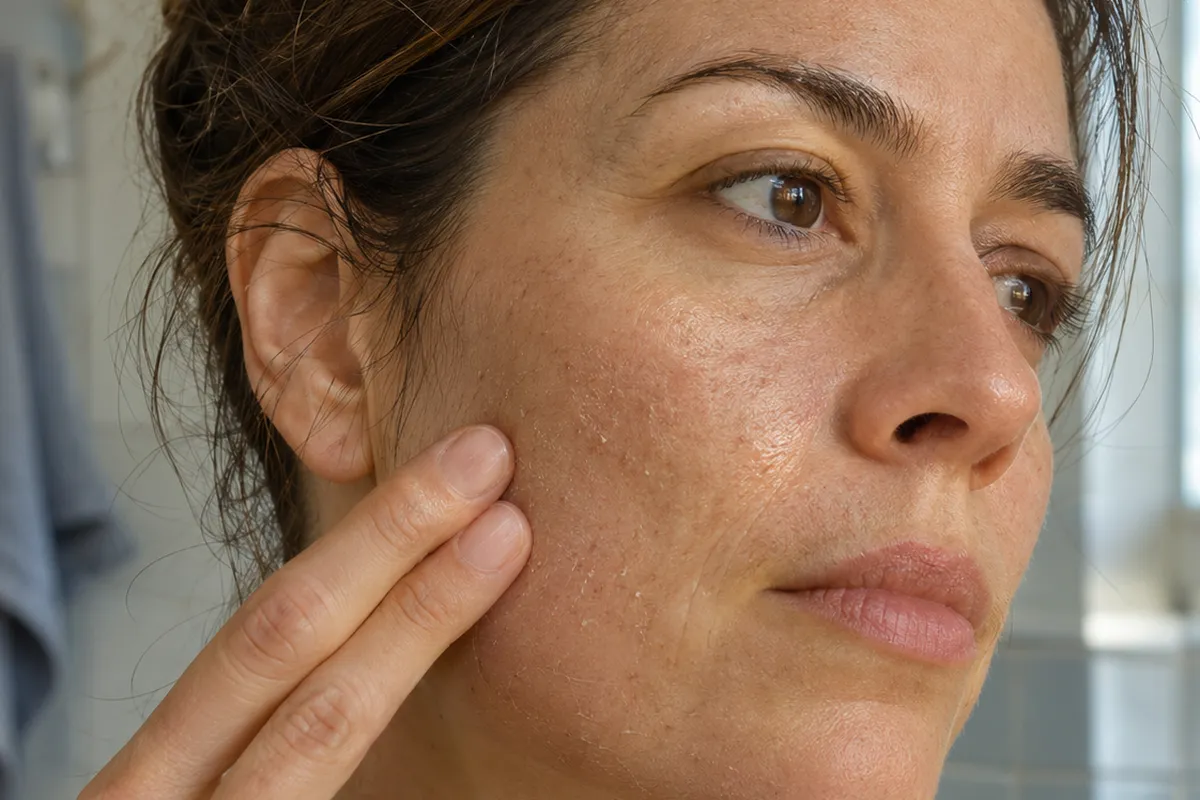
When creams are not enough to restore the skin’s hydration and radiance, there are treatments that take hydration into the skin. The most widely used are skinboosters, based on lightly cross-linked hyaluronic acid, and mesotherapies with combinations of hyaluronic acid, vitamins and other actives. Injected in microdroplets into the dermis, they help the skin retain water and stimulate it to produce more collagen and elastin.
Three ideas to remember.
How it works
Hyaluronic acid is a natural molecule in the skin that retains large amounts of water. With age and sun, the skin loses some of this capacity. When lightly cross-linked hyaluronic acid is injected into the dermis:
- the skin gains the capacity to retain water;
- the product spreads diffusely, without creating volume;
- fibroblasts, the cells that produce collagen, are stimulated.
What the studies say
A 2023 systematic review included 13 studies of injectable hyaluronic acid for skin quality. All formulations improved hydration, firmness, texture, radiance and elasticity, and hyaluronic acid alone had better results than combinations with other actives. The authors called for larger randomised trials (Ghatge and Ghatge, 2023). Studies with objective measurements showed improvement in the elasticity of ageing skin over several months (Kerscher et al., 2008).
Who it suits
- Dehydrated skin that does not improve with appropriate care at home.
- Dull skin, lacking radiance, with fine lines.
- Thin skin on the neck, décolletage and hands.
- As a complement to other treatments.
What the treatment is like
| Stage | What happens |
|---|---|
| Preparation | Cleansing and topical anaesthesia |
| Application | Microdroplets with a fine needle or cannula, 20 to 30 minutes |
| Straight afterwards | Small bumps that disappear within hours to 1 or 2 days |
| Protocol | 2 to 3 sessions, about 4 weeks apart |
| Maintenance | In general every 6 to 12 months |
Risks
- Frequent and mild: small bumps, redness, bruising.
- Uncommon: nodules or inflammatory reactions.
- Rare: infection or vascular complications.
Like any hyaluronic acid, it can be dissolved with hyaluronidase if necessary (Signorini et al., 2016).
When to postpone: pregnancy, breastfeeding, infection or active herpes in the area, inflammatory acne and autoimmune diseases in an active phase.
At Luxmed Clinic
At Luxmed, we suggest injectable hydration when the skin needs more than care at home, always after making sure the skin barrier is healthy. We adjust the product and the protocol to each skin.
Talk to us
The assessment is a conversation, with no obligation. Tell us what concerns you and our team will reply.
This article is for information purposes and does not replace a consultation. The results of any treatment vary from person to person.
Frequently asked questions
Is it the same as a filler?
No. A filler uses more cross-linked hyaluronic acid to add volume. Injectable hydration improves skin quality without changing the shape of the face.
When are the results noticeable?
Some people notice more radiance within a few days; the full effect appears after the second or third session.
Does it hurt?
With topical anaesthesia, most people tolerate it well. Mostly you feel pricking.
Can I wear make-up on the same day?
It is best to wait until the following day.
How long does it last?
In general 6 to 12 months, depending on the product, the skin and home care.
Scientific references 3
- Ghatge AS, Ghatge SB. The effectiveness of injectable hyaluronic acid in the improvement of the facial skin quality: a systematic review. Clin Cosmet Investig Dermatol. 2023;16:891-899. Artigo
- Kerscher M, Bayrhammer J, Reuther T. Rejuvenating influence of a stabilized hyaluronic acid-based gel of nonanimal origin on facial skin aging. Dermatol Surg. 2008;34(5):720-726. Artigo
- Signorini M, Liew S, Sundaram H, et al. Global Aesthetics Consensus: avoidance and management of complications from hyaluronic acid fillers. Evidence- and opinion-based review and consensus recommendations. Plast Reconstr Surg. 2016;137(6):961e-971e. Guideline
Editing and development: Rúben Brito · Operial Development
Keep exploring