


- Home
- Facial aesthetics
- Rough, uneven skin
- Rough skin
Rough skin: the most common causes
Skin that feels rough to the touch is a common complaint. In most cases the cause is simple, but there are situations that deserve medical attention. Knowing how to tell them apart helps in choosing the right care.
 Luxmed TeamAuthor
 Dr Michelle CampagnoliClinical review · OM no. 69467
In this article
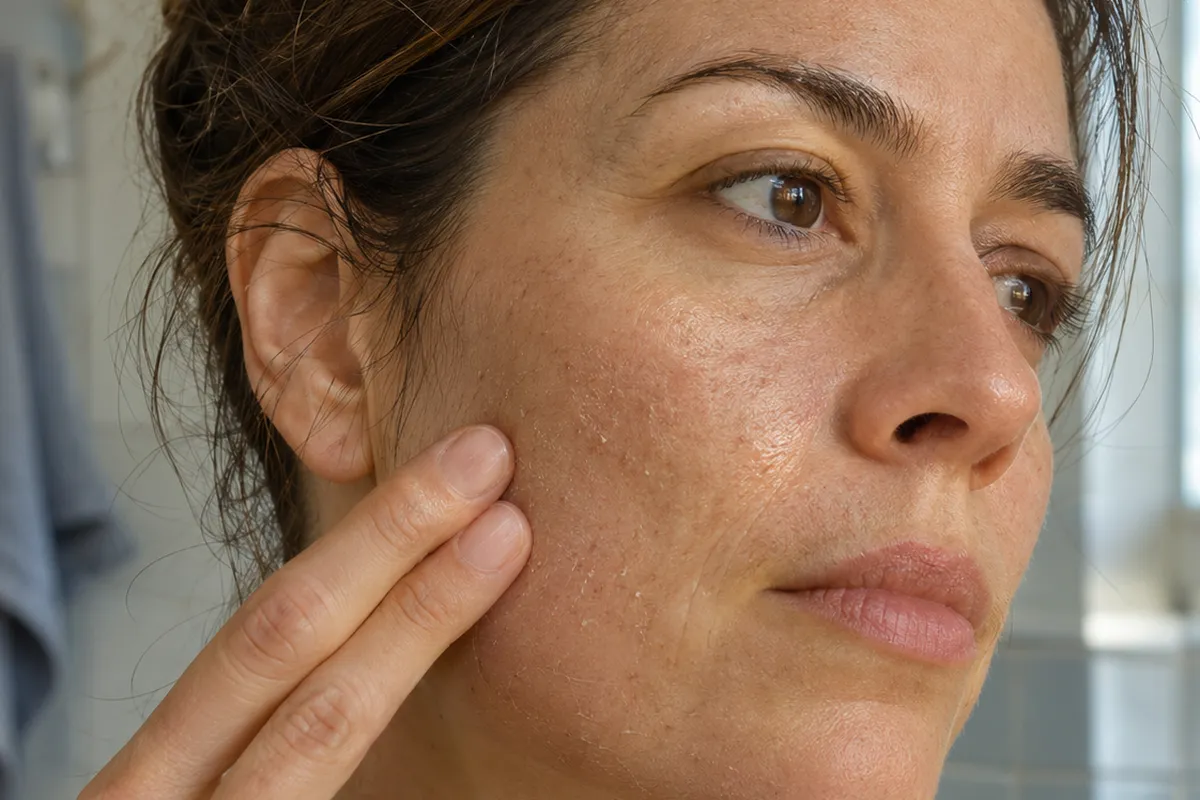
Skin that feels rough to the touch, with small bumps or areas that feel like sandpaper, is a common complaint. In most cases, the cause is simple: a weakened skin barrier, build-up of dead cells or sun damage. But there are situations in which roughness is a sign that deserves medical attention, such as actinic keratoses. Knowing how to tell them apart helps in choosing the right care.
Three ideas to remember.
Most common causes
| Cause | How to recognise it | Usual approach |
|---|---|---|
| Dry skin or weakened barrier | Diffuse roughness, a feeling of tightness, sometimes fine flaking | Gentle cleansing, moisturiser with ceramides and humectants |
| Build-up of dead cells | Dull skin, uneven to the touch, especially after the age of 35 | Gentle chemical exfoliants, retinoids, peels |
| Sun damage | Uneven texture, more visible pores, spots | Sunscreen, retinoids, peels, laser |
| Comedones | Small skin-coloured bumps or blackheads, on the forehead, nose and chin | Salicylic acid, retinoids, facial cleansing |
| Keratosis pilaris | Small rough bumps, sometimes reddish, on the cheeks | Urea, gentle acids, retinoids |
| Actinic keratoses | Sandpaper-like rough patches in exposed areas, easier to feel than to see | Assessment and treatment by a dermatologist |
| Seborrheic dermatitis | Yellowish flaking and redness on the eyebrows, sides of the nose and scalp | Medical treatment |
| Contact dermatitis | Redness, itching and roughness after a new product | Stop the product, medical assessment if it persists |
When roughness deserves attention
Actinic keratoses are lesions caused by accumulated sun exposure. They are small rough areas, often easier to feel with a finger than to see, on the forehead, temples, nose, bald scalp or hands. They are very common in adults with fair skin and a history of sun exposure, and a small proportion may progress to squamous cell carcinoma, a type of skin cancer (Siegel et al., 2017).
See a dermatologist if you have:
- a rough area that does not improve with moisturising in 4 to 6 weeks;
- a lesion that bleeds, grows, hurts or repeatedly forms a crust;
- several rough patches in sun-exposed areas.
These lesions should be diagnosed before any aesthetic treatment.
What helps at home
- Gentle cleansing, without harsh soaps.
- A suitable moisturiser, with ceramides, glycerin or low-concentration urea.
- Gentle chemical exfoliation, two to three times a week, with acids such as glycolic, lactic or salicylic acid, depending on skin type. Scrubs with grains or harsh brushes tend to irritate.
- Retinoids, on medical advice, which renew the surface and improve texture in sun-damaged skin (Kligman et al., 1986).
- Sunscreen every day.
What is done in the clinic
- Chemical peels: they renew the superficial layers of the skin in a controlled way. Superficial ones have little recovery; medium ones treat more marked texture and sun damage (Soleymani et al., 2018).
- Microneedling: it stimulates repair and collagen, with good results for texture and scars.
- Fractional CO2 laser: the most effective for uneven texture and marked sun damage, with a few days of recovery.
There is a dedicated article comparing these options: Uneven texture: peel, microneedling or laser.
At Luxmed Clinic
At Luxmed, we start by identifying the cause of the roughness. If there are suspicious lesions, we refer to dermatology. If it is texture, sun damage or a weakened barrier, we propose home care and, when it makes sense, treatments in the clinic.
Talk to us
The assessment is a conversation, with no obligation. Tell us what concerns you and our team will reply.
This article is for information purposes and does not replace a consultation. The results of any treatment vary from person to person.
Frequently asked questions
Does exfoliating every day make the skin smoother?
Generally, no. Over-exfoliating weakens the barrier and may worsen roughness.
Is rough skin a sign of dehydration?
It is often a sign of a weakened barrier. Suitable moisturisers help more than drinking more water.
Are retinoids suitable for all skin types?
They are suitable for many, but should be introduced gradually. In very sensitive skin or with active dermatitis, they may not be the best choice.
Can a rough area that does not go away be serious?
It may be an actinic keratosis, which should be seen by a dermatologist. Most are benign, but some may progress.
Do peels thin the skin?
Well-indicated peels stimulate renewal and, over time, improve skin quality. Excess, without adequate intervals, may irritate and sensitise.
Scientific references 4
- Siegel JA, Korgavkar K, Weinstock MA. Current perspective on actinic keratosis: a review. Br J Dermatol. 2017;177(2):350-358. doi:10.1111/bjd.14852 Artigo
- Kligman AM, Grove GL, Hirose R, Leyden JJ. Topical tretinoin for photoaged skin. J Am Acad Dermatol. 1986;15(4 Pt 2):836-859. doi:10.1016/s0190-9622(86)70242-9 Artigo
- Soleymani T, Lanoue J, Rahman Z. A practical approach to chemical peels: a review of fundamentals and step-by-step algorithmic protocol for treatment. J Clin Aesthet Dermatol. 2018;11(8):21-28. Artigo
- Rawlings AV, Harding CR. Moisturization and skin barrier function. Dermatol Ther. 2004;17(Suppl 1):43-48. doi:10.1111/j.1396-0296.2004.04s1005.x Artigo
Editing and development: Rúben Brito · Operial Development
Keep exploring