


Blackheads: what they really are
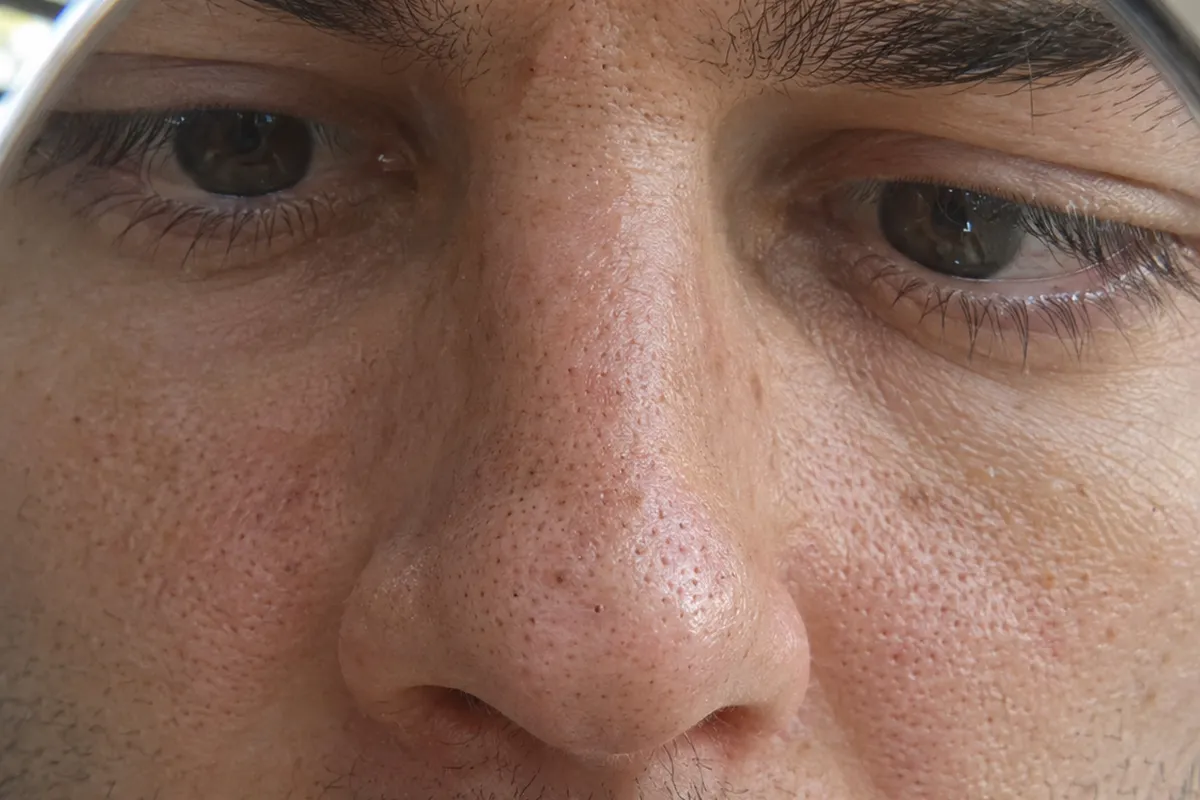
Blackheads are not dirt: they are pores blocked by a mixture of sebum and dead cells, whose surface darkens on contact with air.
 Luxmed TeamAuthor
 Dr Michelle CampagnoliClinical review · OM no. 69467
In this article
Blackheads are not dirt. It is one of the most common ideas, and one of those that most often leads people to scrub their skin hard. In fact, they are pores blocked by a mixture of sebum and dead cells, whose surface darkens on contact with air. Understanding what they are helps to treat them effectively, and to tell them apart from similar things, such as sebaceous filaments.
Three ideas to remember.
What happens in the pore
Each pore is the opening of a hair follicle, into which a sebaceous gland opens. Normally, sebum rises to the surface and the cells lining the follicle are shed regularly. When there is excess sebum and the cells build up instead of being shed, a plug forms. This plug is called a comedone.
| Type of comedone | What it looks like |
|---|---|
| Open (blackhead) | Dark dot on the surface, open pore |
| Closed (whitehead) | Small skin-coloured or whitish bump, closed pore |
Comedones are the initial lesions of acne and can progress to inflammatory spots. That is why treatments that reduce comedones, such as topical retinoids, have a central place in acne treatment (Reynolds et al., 2024).
Why they are dark
The dark colour results mainly from oxidation of the components of sebum and from the melanin present in the accumulated cells, when the contents of the pore are exposed to air. It is not dirt, so washing more does not remove them.
Blackheads or sebaceous filaments?
| Blackheads | Sebaceous filaments | |
|---|---|---|
| What they are | Open comedones, blockage of the pore | Sebum that normally fills the pore |
| Colour | Dark, well defined | Greyish or yellowish, less marked |
| Where | Nose, forehead, chin, cheeks | Mainly on the nose and the central part of the face |
| When squeezed | A firm plug comes out | A thin, soft filament comes out |
| Do they come back? | They can come back | They fill up again within a few days, which is normal |
Sebaceous filaments are part of normal skin physiology. They can become less visible with salicylic acid and retinoids, but they do not disappear for good.
Why they appear
- Oily skin, with higher sebum production (Roh et al., 2006).
- Hormones, which stimulate the sebaceous glands.
- Comedogenic products, such as some very oily creams and make-up.
- Handling the skin, which irritates and inflames the pore.
- Enlarged pores, which collect more easily (Lee et al., 2016).
How they are treated
- Salicylic acid, which penetrates the pore and helps to unblock it.
- Topical retinoids, which normalise the renewal of the follicle cells and prevent new comedones.
- Professional facial cleansing, for safe extraction.
- Superficial chemical peels, as a complement.
There are dedicated articles on the comparison of these treatments and on the risks of squeezing at home.
At Luxmed Clinic
At Luxmed, we tell blackheads apart from sebaceous filaments before suggesting any treatment. We combine facial cleansings, peels and a simple routine at home, which is what makes the most difference in the long run.
Talk to us
The assessment is a conversation, with no obligation. Tell us what concerns you and our team will reply.
This article is for information purposes and does not replace a consultation. The results of any treatment vary from person to person.
Frequently asked questions
Are blackheads dirt?
No. They are blocked pores whose contents darken on contact with air.
Do nose strips work?
They remove some of the surface contents temporarily. The dots come back quickly and the strips can irritate the skin.
Do blackheads lead to spots?
They can progress to inflammatory spots, especially if they are handled.
Why are there always dots on my nose?
They are often sebaceous filaments, which are normal and fill up again.
Do men have more blackheads?
They tend to have oilier skin, which increases the likelihood, but it is common in both sexes.
Scientific references 3
- Reynolds RV, Yeung H, Cheng CE, et al. Guidelines of care for the management of acne vulgaris. J Am Acad Dermatol. 2024;90(5):1006.e1-1006.e30. Guideline
- Roh M, Han M, Kim D, Chung K. Sebum output as a factor contributing to the size of facial pores. Br J Dermatol. 2006;155(5):890-894. Artigo
- Lee SJ, Seok J, Jeong SY, Park KY, Li K, Seo SJ. Facial pores: definition, causes, and treatment options. Dermatol Surg. 2016;42(3):277-285. Artigo
Editing and development: Rúben Brito · Operial Development
Keep exploring