


- Home
- Facial aesthetics
- Forehead and frown lines
- Forehead wrinkles
Forehead wrinkles: why they appear and how they are treated
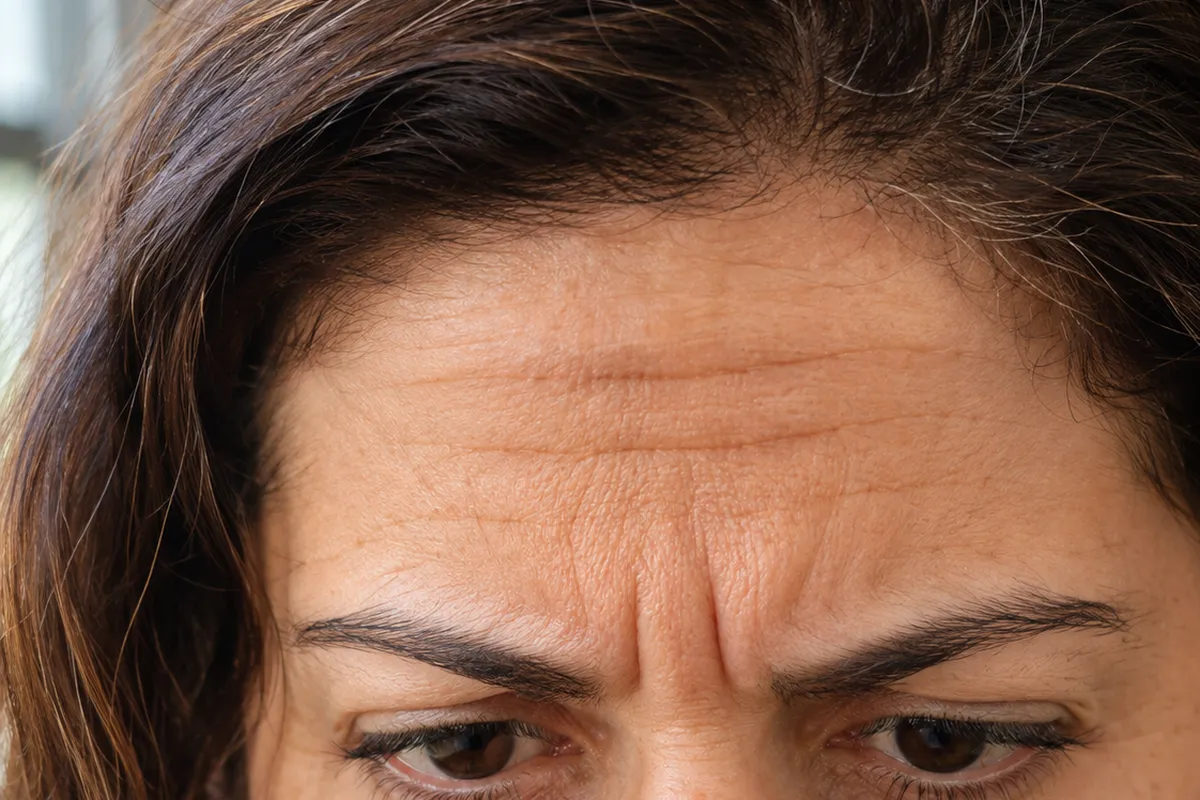
Forehead wrinkles form because we raise our eyebrows many times a day. The muscle that makes them is the only one that lifts them, and treating the forehead well requires understanding that balance.
 Luxmed TeamAuthor
 Dr Michelle CampagnoliClinical review · OM no. 69467
In this article
Horizontal forehead wrinkles are among the first to appear and among those that bother people most. They form because we raise our eyebrows many times a day, to speak, to show surprise or, often without realising it, to open our eyes better. The most effective treatment is botulinum toxin, but the forehead has a particularity: the muscle that makes the wrinkles is also the only one that lifts the eyebrows. Treating the forehead well requires understanding that balance.
Three ideas to remember.
Why they appear
The frontalis muscle
The frontalis muscle covers the forehead and is attached to the skin. When it contracts, it pulls the eyebrows up and the forehead skin folds into horizontal lines. With the years, and with the loss of collagen, these lines stop disappearing at rest.
The forehead as “compensation”
With age, the eyebrows and upper eyelids tend to descend. Many people compensate without knowing it, raising their eyebrows to open their eyes. The forehead is always slightly contracted, and the wrinkles deepen. This detail matters: relaxing the forehead too much in these people makes the eyes look “droopy”.
Other factors
- Accumulated sun exposure, which breaks down collagen (Fisher et al., 2002).
- Smoking (Morita, 2007).
- Very active expressions and habits such as raising the eyebrows when speaking.
- Uncorrected vision problems.
How they are treated
Botulinum toxin
It is the treatment with the most evidence. A 2021 Cochrane review of 65 randomised trials confirmed that the toxin reduces facial wrinkles more than placebo (Camargo et al., 2021). In a phase 3 trial dedicated to forehead wrinkles, treated together with the area between the eyebrows and the crow’s feet, 46% to 53% of patients, depending on the dose, improved by at least two grades on the forehead wrinkle scale after 30 days, compared with 0.6% in the placebo group (De Boulle et al., 2018).
A few important points:
- Treating the forehead together with the area between the eyebrows helps balance the forces and reduces the risk of the eyebrows descending.
- Doses adjusted to the person. A narrow forehead, low eyebrows or heavy eyelids call for lower doses and higher injection points.
- Keeping some movement gives a more natural result than a completely immobile forehead.
- The effect begins in 3 to 5 days, stabilises in about two weeks and generally lasts 3 to 4 months.
Skin treatments
When the wrinkles are already visible at rest, the toxin stops them from deepening, but the marked line needs more time or some help:
- Skinbooster: lightly cross-linked hyaluronic acid, applied superficially, which improves hydration and elasticity.
- Mesotherapy with cocktails of vitamins and hyaluronic acid: improves radiance and skin quality; the evidence for wrinkles is more limited.
- Fractional CO2 laser or peels: when there are many fine lines and sun damage.
Hyaluronic acid on the forehead
It can be used in small amounts for very marked wrinkles, but the forehead is an area with important vessels that communicate with the circulation of the eyes (Cotofana and Lachman, 2019). For this reason, forehead filler requires careful technique and is not the first option.
Side effects of toxin on the forehead
| Effect | What it is | What to do |
|---|---|---|
| Heavy or lowered eyebrows | Excessive relaxation of the muscle that lifts them | Improves with time; can be reduced with adjustments |
| “Peaked” eyebrow (circumflex shape) | The lateral part of the muscle becomes more active | Small correction dose at the review |
| Mild headache | Common in the first days | Simple analgesic, if necessary |
| Drooping eyelid | Rare; spread to the eyelid muscle | Medical assessment. There is a dedicated article: Drooping eyelid after botulinum toxin: why it happens |
The Cochrane review identified eyelid drooping as the most frequent relevant adverse effect of toxin in the upper third of the face (Camargo et al., 2021).
At Luxmed Clinic
At Luxmed, we assess the position of the eyebrows and eyelids before treating the forehead. If the forehead is compensating for heavy eyelids, we adjust the dose so as not to “close” the eyes, and we always do a review after about two weeks.
Talk to us
The assessment is a conversation, with no obligation. Tell us what concerns you and our team will reply.
This article is for information only and does not replace a consultation. The results of any treatment vary from person to person. Botulinum toxin is a prescription-only medicine and should only be administered by doctors.
Frequently asked questions
Will my forehead end up “frozen”?
It does not have to. With adjusted doses, it is possible to soften the wrinkles while keeping some movement.
Why do my eyebrows feel heavy after the treatment?
Because the muscle that lifts them became more relaxed. It is more common in people who use the forehead to compensate for heavy eyelids. It improves with time and can be prevented with appropriate doses.
Can I treat only the forehead?
You can, but also treating the area between the eyebrows usually gives a more balanced result and reduces the risk of the eyebrows descending.
How long does it last?
Generally 3 to 4 months. With regular treatments, some people notice that the effect lasts longer.
And if the wrinkles are already visible at rest?
The toxin is still useful, but the result is more gradual. Combining it with skin treatments helps.
Scientific references 5
- Camargo CP, Xia J, Costa CS, et al. Botulinum toxin type A for facial wrinkles. Cochrane Database Syst Rev. 2021;7:CD011301. Revisão Cochrane
- De Boulle K, Werschler WP, Gold MH, et al. Phase 3 study of onabotulinumtoxinA distributed between frontalis, glabellar complex, and lateral canthal areas for treatment of upper facial lines. Dermatol Surg. 2018;44(11):1437-1448. Artigo
- Fisher GJ, Kang S, Varani J, et al. Mechanisms of photoaging and chronological skin aging. Arch Dermatol. 2002;138(11):1462-1470. Artigo
- Morita A. Tobacco smoke causes premature skin aging. J Dermatol Sci. 2007;48(3):169-175. Artigo
- Cotofana S, Lachman N. Arteries of the face and their relevance for minimally invasive facial procedures: an anatomical review. Plast Reconstr Surg. 2019;143(2):416-426. Artigo
Editing and development: Rúben Brito · Operial Development
Keep exploring