


- Home
- Facial aesthetics
- Freckles and sun spots
- Freckles or sun spots
Freckles or sun spots: the difference
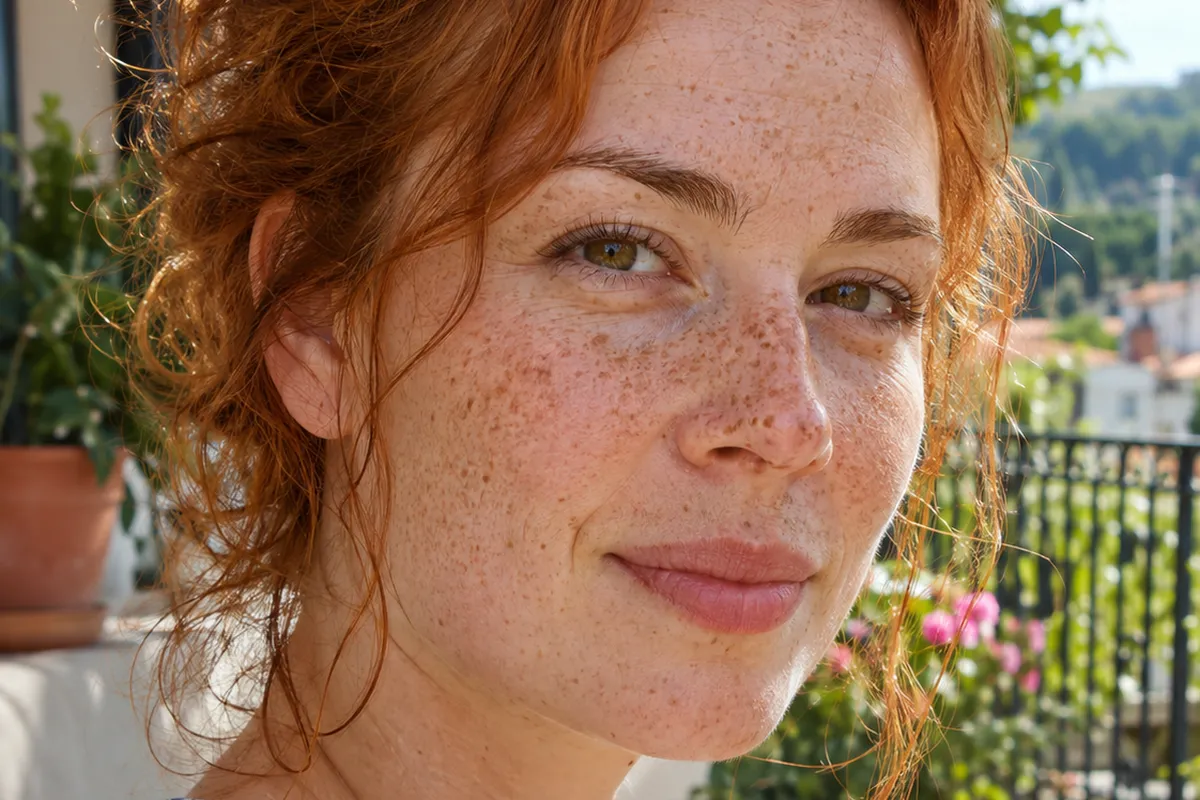
Freckles and sun spots are both small brown marks linked to the sun, which is why they are confused. But they differ in origin, in how they behave across the year and in treatment.
 Luxmed TeamAuthor
 Dr Michelle CampagnoliClinical review · OM no. 69467
In this article
Freckles and sun spots are both small brown marks linked to the sun, which is why they are often confused. But they differ in origin, in how they behave across the year and in how they respond to treatment. Understanding the difference helps in choosing what to do, and in knowing when a mark deserves other attention.
Three ideas to remember.
The differences
| Freckles | Sun spots (solar lentigines) | |
|---|---|---|
| When they appear | Childhood | Adulthood, especially after the age of 40 |
| Who it affects | Fair skin, red or blond hair, genetic tendency | People who have had a lot of sun exposure throughout life |
| Size | Small, a few millimetres | From a few millimetres to over a centimetre |
| Variation with the seasons | Darken in summer, fade in winter | Stable |
| Where | Nose, cheekbones, shoulders | Face, backs of the hands, décolletage |
| Meaning | A sign of sun-sensitive skin | A sign of accumulated sun damage (Yaar and Gilchrest, 2007) |
What they have in common
- They are benign.
- They indicate sensitivity to the sun or exposure to it, and therefore a higher lifetime risk of skin cancer.
- They worsen without sun protection.
When it is neither a freckle nor a sun spot
Some pigmented lesions can be skin cancer. Warning signs include asymmetry, irregular borders, several colours, larger diameter and change over time (Abbasi et al., 2004). A new mark after the age of 40, or one that looks different from the others, should be assessed.
To treat or not to treat?
For many people, freckles are part of the face and need no treatment. Sun spots can be lightened with peels, lightening creams or laser, always with sun protection to stop them coming back.
At Luxmed Clinic
At Luxmed, we assess pigmentation marks before any treatment and refer to dermatology when a lesion raises doubts.
Talk to us
The assessment is a conversation, with no obligation. Tell us what concerns you and our team will reply.
This article is for information purposes and does not replace a consultation. The results of any treatment vary from person to person.
Frequently asked questions
Do freckles disappear with age?
They often fade in adulthood, especially with less exposure.
Are sun spots the same as age spots?
Yes, it is the same problem. The correct name points to the cause: the sun.
Can I prevent new marks?
Yes. Daily sun protection is the most effective measure (Hughes et al., 2013).
Can sun spots become cancer?
Sun spots themselves are benign, but they indicate sun damage, which increases the risk of skin cancer in other lesions.
Scientific references 3
- Yaar M, Gilchrest BA. Photoageing: mechanism, prevention and therapy. Br J Dermatol. 2007;157(5):874-887. doi:10.1111/j.1365-2133.2007.08108.x Artigo
- Abbasi NR, Shaw HM, Rigel DS, et al. Early diagnosis of cutaneous melanoma: revisiting the ABCD criteria. JAMA. 2004;292(22):2771-2776. doi:10.1001/jama.292.22.2771 Artigo
- Hughes MCB, Williams GM, Baker P, Green AC. Sunscreen and prevention of skin aging: a randomized trial. Ann Intern Med. 2013;158(11):781-790. doi:10.7326/0003-4819-158-11-201306040-00002 Artigo
Editing and development: Rúben Brito · Operial Development
Keep exploring