Algés, Oeiras Mon to Fri · 09:00 to 13:00 and 14:00 to 19:00 · Sat · 09:00 to 14:00
WhatsApp Book a consultation

Facial aesthetics

Freckles and sun spotsWhen little brown spots appear on your face and you want to understand what they are, whether they are treated and whether you need to see a doctor

Freckles and sun spots look like the same thing, but they are not. Freckles (ephelides) are small, appear early, darken in summer and fade in winter. Sun spots (solar lentigines) appear later, stay all year and are a record of many years of sun. They are almost always benign, but a brown patch can also be something else, and the only way to know is an examination by a doctor. Here we explain how to tell them apart, why they come back after treatment, what the evidence says about chemical peel and fractional CO2 laser, and when a patch calls for dermatological assessment before any treatment, at Clínica Luxmed, in Algés.

Reviewed by Dr Michelle Campagnoli, clinical director

  • 3clinic options for this topic
  • 1assessment, always first
  • Nocommitment
Fotografia · sardas-e-manchas-do-sol-hero800 × 1000 px · vertical 4:5Mulher de uns 45 anos, de costas três quartos, a ajustar um chapéu de palha de abas largas num terraço ao ar livre com luz de fim de tarde, com um frasco de protetor solar numa mesa ao lado; enquadramento a meio corpo, sem close do rosto nem da pele com manchas

How to recognise it

Are they freckles or sun spots?

The distinction matters: freckles and sun spots have different origins, behave differently and, in both cases, it is necessary to rule out that the patch is something else. These signs help you understand what is going on before the assessment.

Tick what you recognise0/7

Tick the signs you recognise in your case. This is not a diagnosis, it is only meant to give you an idea.

Is there a patch that has changed in size, shape or colour, that has an irregular outline, several shades of brown or black, that grows, flakes, bleeds, crusts or itches, or that is different from all the others? You need a dermatological assessment before any treatment: a suspicious patch is not “lightened” or treated to see whether it goes away. Out of hours, call SNS 24: 808 24 24 24.

Fotografia · sardas-e-manchas-do-sol-consulta1083 × 1300 px · vertical 5:6Médica de bata branca sentada à secretária de frente para uma mulher de uns 45 anos, numa sala de consulta de luz natural, com um dermatoscópio e um bloco de notas em cima da mesa; enquadramento a meio corpo, sem close do rosto nem da pele com manchas
Frame for the consultation photograph. The dots mark what the doctor assesses; the image does not show skin patches in detail.

Why it happens

What lies behind freckles and sun spots

There is rarely a single cause: genetics determines who has a tendency, and sun accumulated over the years does the rest. Choose a situation to see how it fits into the picture and what usually helps.

Genetics and skin type

Freckles depend heavily on genetic variants, in particular in a pigment gene (MC1R), and are seen more in fair skin and in red or blond hair. People who have them have inherited the tendency for the sun to stimulate pigment in small spots, instead of tanning the skin evenly.

What weighs on it

Thinking that freckles are “caught” through poor care or that they disappear on their own for good.

What helps

Accepting that part of the tendency is inherited and concentrating on what you can control: the sun and monitoring the skin.

Normal or to be assessed

Ordinary benign patch or something to assess

Most freckles and sun spots are benign. But a brown patch on the face can also be something else, and some need assessment before any procedure.

  • What it looks like. Small, light brown dots (freckles) or flat patches with a regular outline and uniform colour (lentigines), in sun-exposed areas, without relief and without recent changes.

  • When it is noticed. Freckles darken in summer and fade in winter, and lentigines persist all year and slowly increase over years.

  • What the clinic does. The doctor examines each patch, confirms that they are benign lesions and explains what can be treated, what can be expected and what is only cosmetic.

  • At home. Sunscreen every day, shade and a hat, and an occasional examination of the skin, with photographs to compare.

Do you have a patch that has changed, bleeds, hurts or is growing quickly? Book a dermatology consultation without waiting. If in doubt out of hours, you can call SNS 24: 808 24 24 24. 112 is for serious emergencies, such as bleeding that does not stop.

Book an assessment

What the clinic may consider

Options for freckles and sun spots

Freckles and solar lentigines are benign and do not need treatment, except for cosmetic reasons, and in any case only after the doctor has examined each patch. The basis is strict, daily sun protection, without which any treatment is wasted and the patches come back. For this topic, the clinic’s catalogue includes chemical peel and fractional CO2 laser, which the doctor may consider in selected cases, and intradermotherapy, which remains in the background because the evidence for sun spots is weak. The most cited systematic review on the treatment of lentigines shows that the methods compare poorly with one another: lasers and combinations had better complete-response rates than peels, but all methods had adverse effects, and changes in skin colour weigh more in darker skin. There are also other methods used by dermatologists, such as cryotherapy and lasers designed for pigment, which are not among the options the clinic lists for this topic. Results vary from person to person, are generally temporary and patches may come back with new sun.

Book an assessment
Dr Michelle Campagnoli, clinical director of Clínica Luxmed

First step

Assessment consultation

The doctor listens to what you are experiencing, examines your case and explains the suitable options. No treatment begins without this consultation.

May be considered when

you want to understand the cause and decide on the best path, with time and without commitment.

Book an assessment
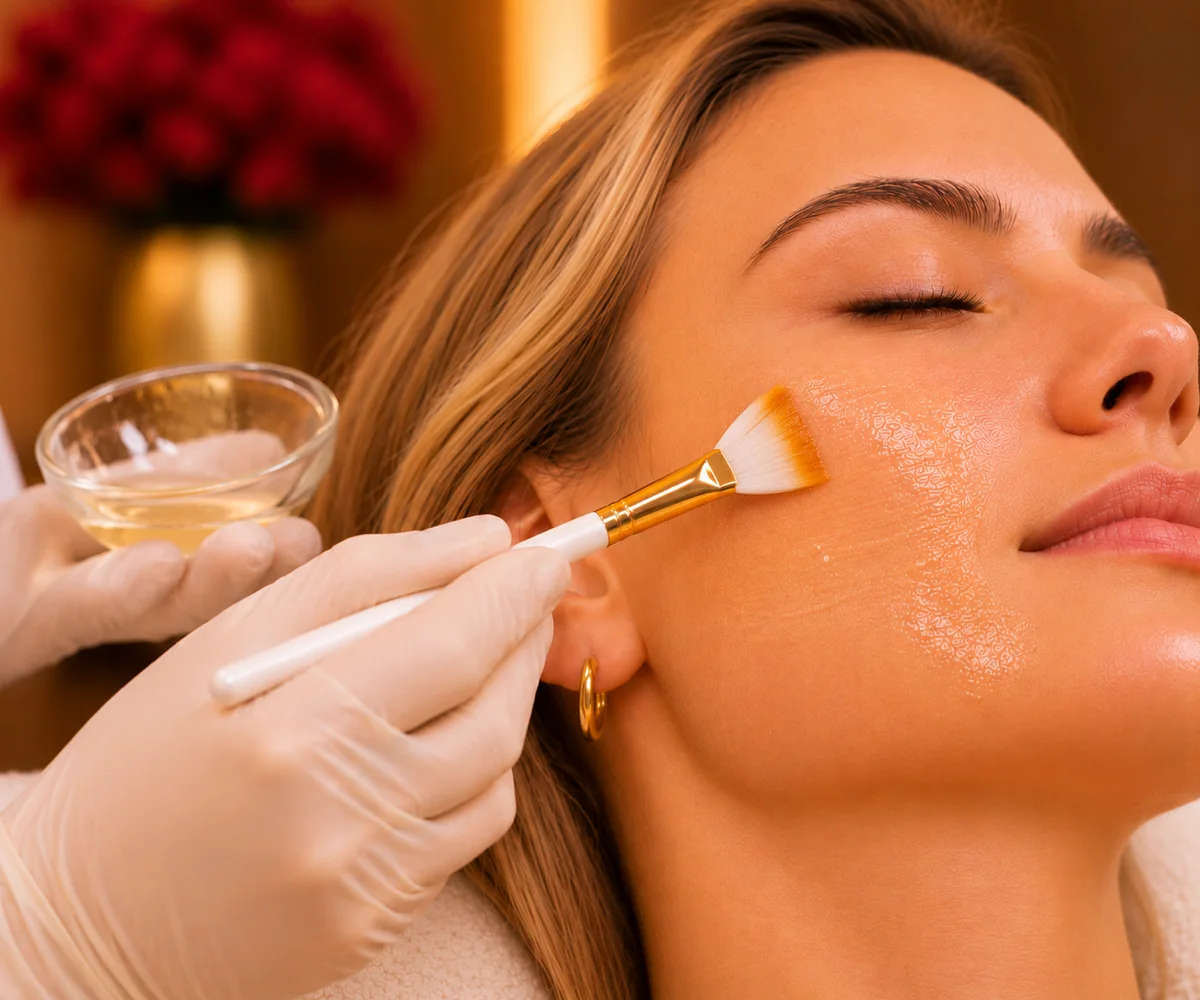
A gloved hand applying a layer of peel solution with a brush to the face of a patient lying down, in a consulting-room setting

Skin renewal

Chemical peel

Application of an acid to the skin to exfoliate it in a controlled way, helping to even out tone and fade superficial patches. For solar lentigines, peels have variable results and, in the systematic review, were among the methods with the lowest complete response. In darker skin there is a risk of altering skin colour, and the acid and concentration are chosen case by case.

May be considered when

the patches have been examined and considered benign, the skin is not irritated or sunburnt, you are not pregnant or breastfeeding, you have not taken isotretinoin in recent months, and the doctor has explained the risks and what is realistic to expect.

Find out more
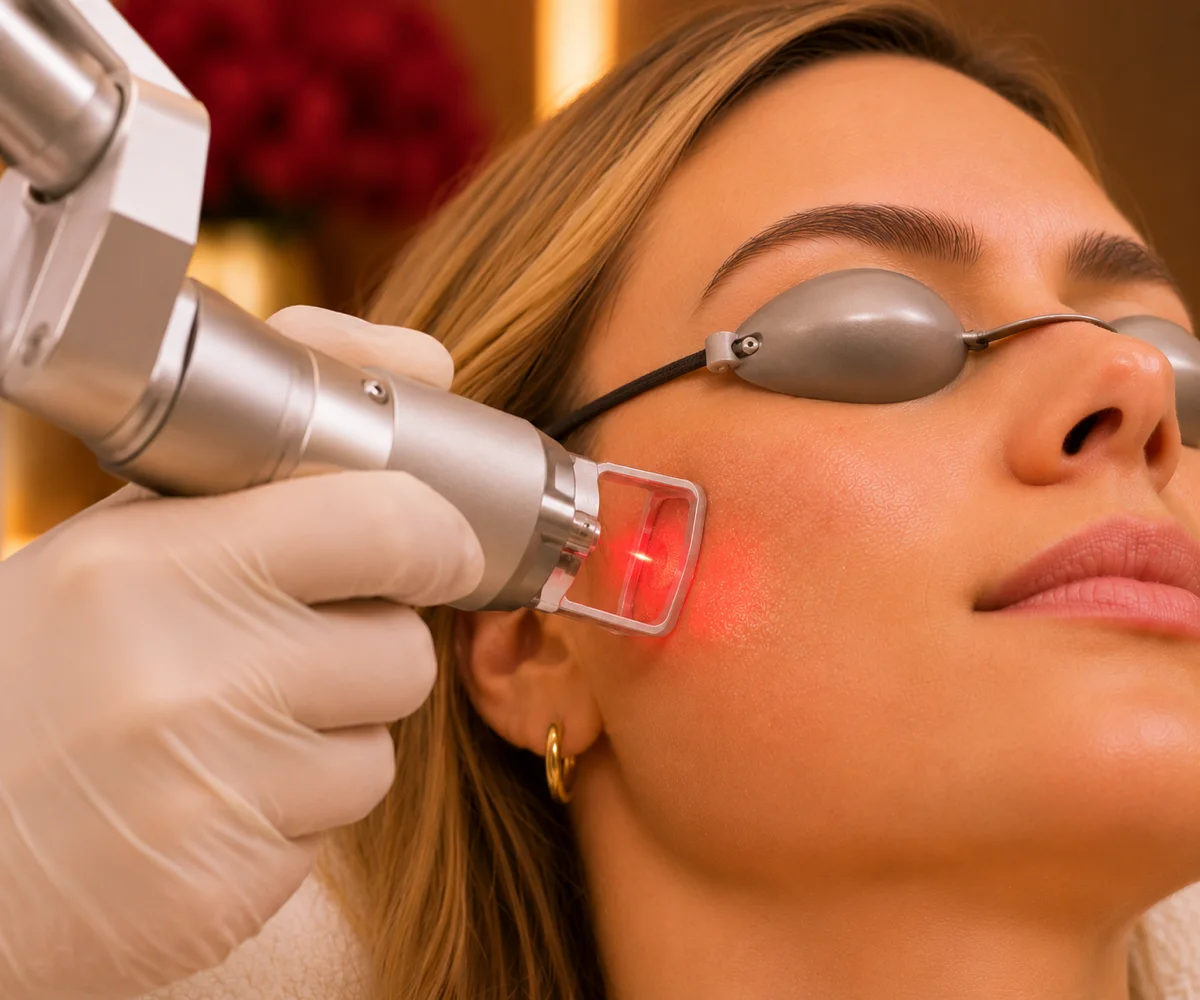
Laser equipment in use on a patient, with eye protection, in a treatment room with soft light

Deep renewal

Fractional CO2 laser

A laser that creates microcolumns of controlled injury in the skin to renew it in depth and stimulate collagen, treating patches, texture and fine wrinkles in a single session. It has a recovery time, with redness and peeling, and there is a risk of post-inflammatory patches, especially in darker skin. It is not the most specific laser for pigment: whether it is worthwhile is assessed.

May be considered when

the patches have been examined and considered benign, there are also signs of photoageing to treat, the person accepts the recovery time and strict sun protection afterwards, and the doctor has explained the risks and what is realistic to expect.

Find out more

What the journey looks like

From the first conversation to a plan tailored to you

No procedure begins without an assessment by the doctor. Most people start with the simplest approach, and only then is anything further considered.

  1. 01At the clinic

    Telling your story

    The doctor asks since when the patches have been there, whether they have changed, how much sun you have had over your lifetime, whether you have had sunburn, whether there is skin cancer in the family and which creams or treatments you have already used.

  2. 02At the clinic

    Examine each patch

    The colour, outline, relief and texture of each patch are observed, by eye and with the dermatoscope. If any raises doubts, the doctor refers to dermatology, where a biopsy can be carried out, before thinking about treatment.

  3. 03At home

    Protect and care for the skin

    The first step is a sunscreen used every day and reapplied, shade, a hat and clothing, and gentle care. Without this, patches darken and return, whatever the treatment.

  4. 04Over time

    Decide and follow up

    If the skin is ready, the doctor explains whether a procedure makes sense, what can be expected and how many sessions will be needed, without promising results. The examination is repeated from time to time and the plan adjusted.

Day to day

What helps at home

Daily care matters more than any procedure. These measures are helpful while you wait for your consultation and alongside the clinic’s treatment plan.

The golden rule

First protect, then treat

Skin that continues to get sun without protection will have patches again, however good the treatment. And a patch that changes should be seen by a doctor instead of being “lightened”. Protecting and monitoring the skin is worth more than any cream.

Using sunscreen every day

Everyday sun, even without the beach, is what weighs most, and a randomised trial showed less skin ageing with daily use.

In practice: a sunscreen of suitable factor on the face and hands, every morning, reapplied every two hours outdoors.

Seek shade, a hat and glasses

Clothing and a hat protect where cream fails and do not “wear off” after two hours.

In practice: a wide-brimmed hat, sunglasses and shade in the hottest hours, especially in summer.

Monitor the skin and photograph it

Patches that change are easy to see when there is something to compare them with.

In practice: a photograph of each area every six months, in the same light, and book a consultation if any changes.

Say in the consultation what you use

Some medicines and products make the skin more sensitive to the sun.

In practice: bring the list of medicines, creams and acids you use, and say whether you are pregnant, breastfeeding or planning a pregnancy.

Dr Michelle Campagnoli, clinical director of Clínica Luxmed

Who will look after you

An assessment carried out by the doctor

At Luxmed, in Algés, the first step is always an assessment with Dr Michelle Campagnoli. She is the one who examines the skin, works out whether the patches are benign or whether any needs to be seen by dermatology and decides with you what makes sense, before any procedure.

  • Physical examination and medical historyA conversation about sun, habits and medication, and an examination of each patch, with a dermatoscope when needed.
  • A plan tailored to youA clear plan, without promises, with sun protection first and follow-up over time.
  • No obligationThe cost of any treatment is confirmed only after the assessment.
Book an assessment

Articles on freckles and sun spots

From our blog
Fotografia · sardas-e-manchas-do-sol-blog-11200 × 800 px · horizontal 3:2Mãos de uma pessoa a segurar uma lupa de dermatologia sobre o dorso da outra mão, sobre uma mesa clara de consultório com luz natural; enquadramento só das mãos, sem rosto

Facial aesthetics

Freckles or sun spots: the difference

How freckles are distinguished from solar lentigines, why they appear at different times of life and when a brown patch deserves to be seen by a doctor.

Fotografia · sardas-e-manchas-do-sol-blog-21200 × 800 px · horizontal 3:2Natureza-morta com um frasco de protetor solar, um chapéu de palha de abas largas e óculos de sol sobre uma toalha clara à luz do sol, sem pessoas

Facial aesthetics

Sun spots: treatments and why they come back

What the evidence says about peels, lasers and other methods for sun spots, what can be expected and why sun protection decides whether the patches come back.

Fotografia · sardas-e-manchas-do-sol-blog-31200 × 800 px · horizontal 3:2Mãos de uma médica de bata branca a segurar um dermatoscópio numa sala de consulta de luz natural, com um bloco de notas ao lado; enquadramento só das mãos e do aparelho, sem rostos

Facial aesthetics

A patch that changes shape or colour: when to go to the dermatologist

The signs of a patch that should be seen without waiting, what the ABCDE rule is and what happens in a dermatology consultation.

Book a consultation

Book your consultation

Choose how you prefer to get in touch. We will arrange the assessment consultation with Dr Michelle Campagnoli.

Booking through the websiteAssessment consultationTalk to our assistant on WhatsApp and ask for the current price of the assessment.

New Life Miraflores, Algés · Office Center, R. Santa Teresa do Menino Jesus n.º 6, 9.º C, 1495-048

Your details are used only for this contact. Any treatment depends on a prior medical assessment.

Request an appointmentIt takes less than a minute.
Speciality
You do not need to go into detail. The doctor will talk to you during the consultation.
Request received. Our team will contact you as soon as possible.
What is the difference between freckles and sun spots?

Freckles (ephelides) are small, light brown, appear in childhood in fair-skinned people, darken in summer and fade in winter. Sun spots (solar lentigines) are larger, with a defined outline and uniform colour, generally appear after the age of 40 in heavily sun-exposed areas, persist all year and do not fade on their own. Freckles depend mainly on genetics, and lentigines are related to age and accumulated sun. Both are generally benign, but only a medical examination confirms it.

Are freckles and sun spots dangerous?

Freckles and solar lentigines themselves are benign. But a brown patch can be something else, such as an actinic keratosis or a lentigo maligna (melanoma in situ), which can look like a solar lentigo. What distinguishes the worrying patch is change, especially in size, shape or colour, asymmetry, an irregular outline, several shades, relief, itching or bleeding. In case of doubt, the dermatologist examines with the dermatoscope and, if necessary, carries out a biopsy.

How do I know whether a brown patch is serious? Does the ABCDE rule apply?

The ABCDE rule helps: asymmetry, irregular border, colour with several shades, diameter (greater than 6 mm, although melanomas can be smaller) and evolution, that is, change over time. One study showed that using this rule alone can miss early melanomas, so a patch that changes or that is different from the others should be seen even if it does not meet all the criteria. When there is doubt, dermoscopy is used and, if necessary, biopsy, and the patch is never treated beforehand.

Do sun spots go away on their own?

No. Freckles fade in winter and return in summer, but solar lentigines do not disappear on their own and tend to increase in number and size over the years, as long as there is sun without protection. Daily sunscreen does not erase them, but helps them not to darken or multiply. Treatments can fade them, but the patches may come back with new sun.

How are sun spots removed from the face?

First it is confirmed that they are benign and the skin is protected from the sun. Only then is a procedure considered, and the systematic review on lentigines shows that the evidence comes from small studies that differ greatly from one another, and that lasers and combinations had better complete-response rates than peels, although all methods had adverse effects. There are also other methods, such as cryotherapy and lasers designed for pigment, which are not among the clinic’s options for this topic. Results vary, are generally temporary and are not guaranteed.

Why do sun spots come back after treatment?

Because the cause, the sun, continues. The treatment fades the patches that exist, but does not stop the sun from stimulating pigment again, and skin that already has sun damage reacts more. Without daily sunscreen, shade and a hat, it is common for patches to come back within months or years. So maintenance and protection count as much as the procedure.

Does chemical peel lighten sun spots?

It can help to even out tone and fade superficial patches, and it is one of the options in the clinic’s catalogue. But the evidence is limited: in the systematic review of lentigines, peels were among the methods with the lowest complete response, and reviews of peels note that darker skin has a higher risk of colour changes. It is only decided after the doctor has assessed the patches, and it is not carried out on irritated skin, during pregnancy or breastfeeding.

Does fractional CO2 laser treat sun spots?

It may be considered when, as well as patches, there is also uneven texture and fine wrinkles from photoageing, because it renews the skin in depth. It is not a laser specific for pigment, has a recovery time with redness and peeling, and there is a risk of post-inflammatory patches in darker skin. Strict sun protection, before the procedure and in the following weeks, is essential, and the doctor tells you whether it is worthwhile in your case.

Does intradermotherapy help with patches?

Intradermotherapy (micro-injections of vitamins and other active ingredients into the dermis) is in the clinic’s catalogue for patches, but for sun spots the evidence is weak. For that reason it remains in the background: the doctor may propose it to revitalise the skin, and not as a way to erase lentigines. Ask what can realistically be expected.

When should I go to the dermatologist about a patch?

Book a consultation if a patch has changed in size, shape or colour, if it is darker or different from the others, if it has an irregular outline, several shades or relief, if it bleeds, flakes, crusts or itches, or if a new patch has not gone away in a few weeks. Also if you have many patches, a history of sunburn or skin cancer in the family. Out of hours, if in doubt, call SNS 24 (808 24 24 24). 112 is only for serious emergencies, such as bleeding that does not stop.

We could not find that question. Ask us on WhatsApp

Scientific references

This page is based on the sources below and was reviewed by Dr. Michelle Campagnoli. Last updated on .

  1. Praetorius C, Sturm RA, Steingrimsson E. Sun-induced freckling: ephelides and solar lentigines. Pigment Cell Melanoma Res, 2014.
  2. Ezzedine K, Mauger E, Latreille J, et al. Freckles and solar lentigines have different risk factors in Caucasian women. J Eur Acad Dermatol Venereol, 2013.
  3. DermNet NZ. Solar lentigo. (DermNet, acedido 2026-11-11)
  4. Mukovozov I, Roesler J, Kashetsky N, et al. Treatment of lentigines: a systematic review. Dermatol Surg, 2023.
  5. Soleymani T, Lanoue J, Rahman Z. A practical approach to chemical peels: a review of fundamentals and step-by-step algorithmic protocol for treatment. J Clin Aesthet Dermatol, 2018.
  6. DermNet NZ. Chemical peels (face peels). (DermNet, acedido 2026-11-11)
  7. Borges J, Manela-Azulay M, Cuzzi T. Photoaging and the clinical utility of fractional laser. Clin Cosmet Investig Dermatol, 2016.
  8. Hughes MCB, Williams GM, Baker P, Green AC. Sunscreen and prevention of skin aging: a randomized trial. Ann Intern Med, 2013.
  9. NHS. Sunscreen and sun safety. (NHS, acedido 2026-11-11)
  10. NHS. Symptoms of melanoma skin cancer. (NHS, acedido 2026-11-11)
  11. American Academy of Dermatology. What to look for: ABCDEs of melanoma. (aad.org, acedido 2026-11-11)
  12. Duarte AF, Sousa-Pinto B, Azevedo LF, et al. Clinical ABCDE rule for early melanoma detection. Eur J Dermatol, 2021.
  13. Iznardo H, Garcia-Melendo C, Yélamos O. Lentigo maligna: clinical presentation and appropriate management. Clin Cosmet Investig Dermatol, 2020.
CallAssistantAvailableBook