


- Home
- Facial aesthetics
- Rosacea
- Thread veins on the face
Visible blood vessels on the face: what they are and what can be done
Creams do not make thread veins on the face disappear. See what they are, where they come from, what laser and pulsed light can do and when to ask for an assessment.
 Rúben BritoAuthor
 Dr Michelle CampagnoliClinical review · OM no. 69467
In this article
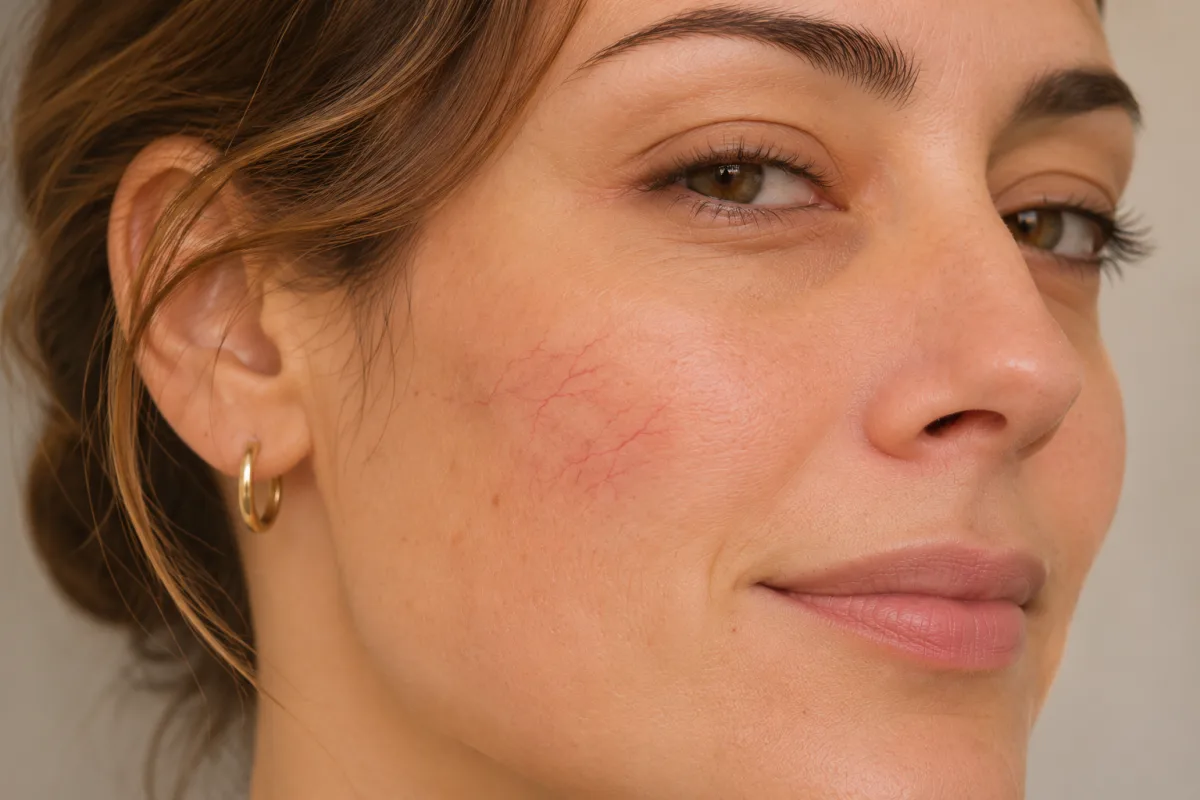
Thread veins on the face, which many people call "burst veins", are small dilated blood vessels that become visible at the surface of the skin. In medical terms they are called telangiectasias. In the vast majority of cases they are benign and result from the sun, genetics or rosacea.
The essentials in three points: creams do not make them disappear; vascular laser and pulsed light have good evidence, usually with 1 to 3 sessions; and, without sun protection and control of the cause, they tend to come back. We explain what they are, where they come from and when an assessment is worthwhile.
Three ideas to remember.
Fica por baixo do resumo, se existir uma segunda foto.
What they are and where they appear
Telangiectasias are vessels roughly 0.1 to 1 mm in diameter. They look like fine red or purplish lines, straight or branching. On the face they appear mainly:
- on the sides of the nose and the tip of the nose;
- on the cheeks and cheekbones;
- on the chin.
There is also the spider angioma ("vascular spider"): a central red dot from which several small vessels radiate, like legs. When you press the centre, the spot disappears and refills from the middle. It is common in children and in pregnancy and is generally harmless.
Thread veins on the nose and cheeks are very common in healthy people, especially those with fair skin and from the age of 30 to 40.
Why they appear
| Cause | How it contributes | Clues |
|---|---|---|
| Accumulated sun exposure | UV radiation weakens the collagen that supports the vessels and the skin becomes thinner | Fair skin, sun spots, fine wrinkles |
| Rosacea | Inflammation and repeated flushing dilate the vessels permanently | Central redness, easy flushing, spots without blackheads |
| Genetics | Family tendency and thin skin | Relatives with the same pattern |
| Age | The skin thins and the vessels become more visible | Gradual onset |
| Corticosteroid creams on the face | Prolonged use thins the skin and dilates vessels | History of self-treatment |
| Pregnancy and hormones | Oestrogens favour spider angiomas | They appear in pregnancy, many regress afterwards |
| Trauma and temperature variations | Cold, wind, alcohol and rubbing the skin hard make it worse | Worse in winter |
More rarely, thread veins are linked to diseases that affect the whole body: liver disease (multiple spider angiomas), scleroderma, lupus or dermatomyositis, and a hereditary disease called hereditary haemorrhagic telangiectasia, which comes with frequent nosebleeds. In scleroderma, thread veins also appear on the hands and mucous membranes and are often associated with Raynaud's phenomenon (HSS, n.d.).
Rosacea is the most common cause when there is also background redness. Find out more in Rosacea: what it is, causes and treatments.
Treatments: what studies show
Thread veins are treated with light energy that is absorbed by the haemoglobin in the blood. The vessel heats up, closes and is reabsorbed by the body over a few weeks, without cutting the skin.
| Technique | What is known | Particularities |
|---|---|---|
| Pulsed dye laser (PDL, 585 to 595 nm) | In a randomised half-face trial with 39 patients, 46% had excellent clearance (75% to 100%) after 3 sessions, versus 28% with pulsed light (Nymann et al., 2010) | Less painful than pulsed light in that trial; some settings leave small bruises for 1 to 2 weeks |
| KTP laser (532 nm) | In a half-face study, it cleared 85% of vessels three weeks after the third session, versus 75% with PDL (Uebelhoer et al., 2007) | More swelling and redness in the following days; indicated mainly for fine vessels on fair skin |
| Nd:YAG laser (1064 nm) | 73% moderate to significant improvement after 2 sessions (Sarradet et al., 2003) | Penetrates deeper; useful for larger, purplish vessels and safer on olive or brown skin |
| Intense pulsed light (IPL) | Good response in 30 of 39 patients in the Nymann trial; also reduces diffuse redness | Treats thread veins and redness at the same time; less effective than PDL on isolated vessels |
| Electrocoagulation | An old technique for isolated vessels | Higher risk of small scars and marks; less used on the face today |
Sources: Nymann et al., 2010; Uebelhoer et al., 2007; Sarradet et al., 2003.
The Cochrane review on rosacea rates the evidence for light-based treatments as low quality, because the trials are small (van Zuuren et al., 2015). Even so, the studies are consistent and these treatments are the reference in clinical practice.
What to expect
- Number of sessions: 1 to 3, as a rule, 4 to 6 weeks apart.
- Sensation: a warm snap, like a rubber band on the skin. Anaesthesia is not usually needed.
- Afterwards: redness and some swelling for 1 to 3 days. You can carry on as normal.
- Risks: rare when the technique is well chosen. Tanned or darker skin increases the risk of dark spots, which is why treatment is normally done in autumn and winter.
- Results: the treated vessels do not return, but new thread veins may appear over the years. An occasional maintenance session is common.
What does not work and how to prevent it
Promises to be wary of
- "Anti-thread-vein" creams. They may calm redness, but do not close vessels that are already dilated.
- Brimonidine gel. It reduces the diffuse redness of rosacea for around 12 hours, but does not eliminate thread veins.
- Concealing with a green corrector. It disguises well, but it is make-up, not treatment.
- "Removing" vessels with needles or devices without medical supervision. Risk of scars and marks.
Preventing new thread veins
- SPF 50 sunscreen every day, in winter too. See Tinted sunscreen: how to choose and how to apply.
- Treat the rosacea, if present. Without controlling the inflammation, the vessels dilate again.
- Avoid corticosteroids on the face without medical advice.
- Moderate flushing triggers: alcohol, very hot drinks, saunas and sudden changes in temperature.
- Treat the skin gently: lukewarm water, no rubbing. More in Sensitive skin and redness: everyday care.
When to seek a medical assessment
Isolated thread veins on the nose and cheeks are rarely a cause for concern. Seek assessment if:
At Luxmed, the Facial Aesthetics consultation assesses the type of vessels, the probable cause and your skin type, and recommends the most suitable approach.
Talk to us
The assessment is a conversation, with no obligation. Tell us what concerns you and our team will reply.
Telephone 214 044 241 · info@luxmed.pt
This article is for information only and does not replace a medical consultation.
Frequently asked questions
Are facial thread veins dangerous?
In the vast majority of cases, no. It is an aesthetic matter. Only rarely do they indicate a general illness, usually accompanied by other signs.
Are thread veins and couperose the same thing?
"Couperose" is the cosmetic name for thread veins and redness on the face. It often corresponds to rosacea or sun damage.
How many sessions are needed?
As a rule 1 to 3, 4 to 6 weeks apart. It depends on the number and calibre of the vessels and the technique used.
Do thread veins come back after laser?
The treated vessels do not, but the tendency remains. With sun protection and control of rosacea, new ones appear more slowly.
Can I be treated in summer?
It is not ideal. Tanned skin absorbs more energy and increases the risk of dark spots. Autumn and winter are the best times.
Do pregnancy thread veins go away?
Spider angiomas in pregnancy often regress in the months after the birth. If they persist, they can be treated later.
Scientific references 6
- Nymann P, Hedelund L, Haedersdal M. Long-pulsed dye laser vs. intense pulsed light for the treatment of facial telangiectasias: a randomized controlled trial. J Eur Acad Dermatol Venereol. 2010;24(2):143-146. Registo
- Uebelhoer NS et al. Comparison of KTP laser and pulsed dye laser for facial telangiectasia (estudo em meia face). Br J Dermatol. 2007. Citado em: Devices and topical agents for rosacea management Artigo
- Sarradet DM et al. Nd:YAG 1064 nm para telangiectasias faciais. Dermatol Surg. 2003. Citado em: Devices and topical agents for rosacea management Artigo
- Papageorgiou P et al. Treatment of rosacea with intense pulsed light. J Eur Acad Dermatol Venereol. 2008. Citado em: Devices and topical agents for rosacea management Artigo
- van Zuuren EJ et al. Interventions for rosacea. Cochrane Database Syst Rev. 2015; (4):CD003262. Guideline
- Hospital for Special Surgery. Telangiectasia and autoimmune disease. Artigo
Keep exploring