Algés, Oeiras Mon to Sat · 09:00 to 13:00 and 14:00 to 19:00
WhatsApp Book a consultation
  1. Home
  2. Blog
  3. Tinted sunscreen

Tinted sunscreen: how to choose and how to apply it

Iron oxides block the visible light that ordinary filters let through. See what the studies say, how to read the label and how much product to apply.

Rúben BritoAuthor
Dr Michelle CampagnoliClinical review · OM no. 69467
11 min read
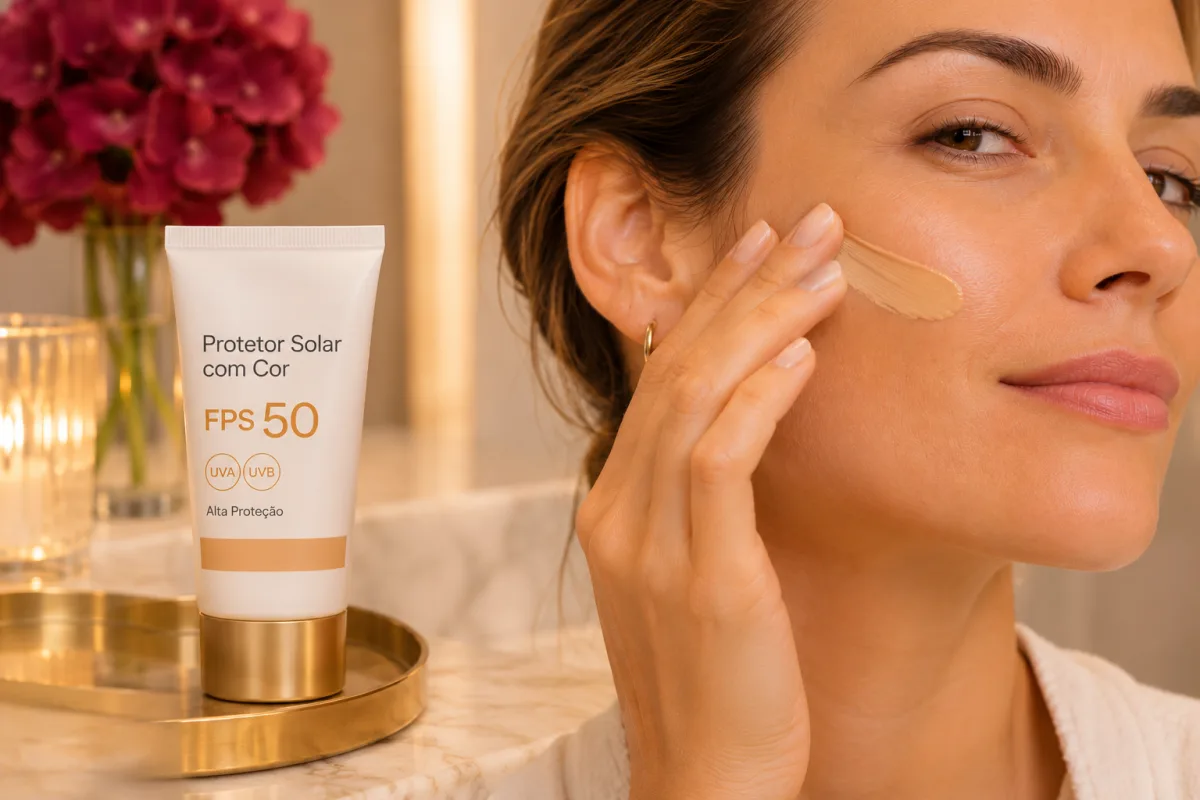
Woman applying tinted sunscreen to her face, next to a tube of SPF 50 sunscreen
In this article
  1. In short
  2. Why colour makes a difference
  3. What the trials show
  4. How to choose
  5. How to apply
  6. Common mistakes and myths
  7. When to ask for a medical assessment
  8. Frequently asked questions

A tinted sunscreen is not just for evening out skin tone. The pigments that give it colour, the iron oxides, also block part of the visible light that ordinary sunscreen filters let through. For anyone with melasma or a tendency to dark patches, that difference matters: in clinical studies, sunscreen with iron oxides reduced pigmentation more and held back relapses better than a sunscreen with UV protection alone.

The rule comes down to three points: SPF 50 or 50+ with UVA protection, iron oxides in the formula, and a generous amount, renewed through the day. In this article we explain why, how to choose the right product for your skin and how to apply it well.

In 30 seconds

Three decisions that change the result.

1SPF 50 or 50+ with the UVA symbolBecause in practice people always apply less than needed.
2Iron oxides in the ingredient listCI 77491, 77492 or 77499: this is what blocks visible light.
3A generous amount, in two layersAnd reapplied every 2 hours outdoors.
Imagem opcional · abertura1200 × 800 px
Fica por baixo do resumo, se existir uma segunda foto.

Why colour makes a difference

Sunlight is not just ultraviolet radiation. About half of the energy that reaches the skin is visible light, the same light that lets us see. UV filters, even at SPF 50+, were designed for UVB and UVA radiation and offer little protection against visible light.

Visible light can also cause dark patches

In skin of phototype IV to VI, visible light caused more intense and longer-lasting pigmentation than UVA1 radiation: the darkening was still there after two weeks, whereas the UVA1 darkening had already gone (Mahmoud et al., 2010).

When a little long-wave UVA is added to visible light, the effect is greater than the sum of the parts (Kohli et al., 2018). That is exactly the combination we receive in the sun.

Blue light activates a receptor called opsin-3 in melanocytes, which stimulates melanin production (Grimes et al., 2018). It is one of the explanations for melasma returning even in people who use UV sunscreen rigorously.

Imagem opcional · luz visível1200 × 800 px
Fica depois da explicação da luz visível, se existir uma foto.

What the clinical trials show

Three studies answer the question consistently. The bars show the comparison in each one.

Castanedo-Cázares et al., 2014

68 patients with melasma, 8 weeks · hydroquinone 4% + sunscreen with iron oxides vs. hydroquinone 4% + UV-only sunscreen (both SPF 50+)

With iron oxides77.8%
UV protection only61.9%

Reduction in the MASI score. The same hydroquinone worked better with the sunscreen that also blocks visible light.

Boukari et al., 2015

40 patients, 6 months, after treatment · the same sunscreen with and without iron oxides, to prevent relapses

With visible light protection+0.45
Without visible light protection+2.43

Rise in MASI (the lower, the better). Relapses were far greater without visible light protection, precisely in the maintenance phase.

Lakhdar et al., 2007

200 pregnant women, during pregnancy · broad-spectrum SPF 50+ sunscreen, daily use

With daily sunscreen2.7%
Expected from earlier studies53%

Melasma appeared in 2.7% of pregnant women, against 53% expected from earlier studies.

See the full table of studies
StudyParticipantsWhat was comparedResult
Castanedo-Cázares et al., 201468 patients with melasma, 8 weeksHydroquinone 4% + sunscreen with iron oxides vs. hydroquinone 4% + UV-only sunscreen (both SPF 50+)MASI reduction of 77.8% vs. 61.9%
Boukari et al., 201540 patients, 6 months, after treatmentThe same sunscreen with and without iron oxides, to prevent relapsesMASI rose by 0.45 with visible light protection vs. 2.43 without it
Lakhdar et al., 2007200 pregnant women, during pregnancyBroad-spectrum SPF 50+ sunscreen, daily useMelasma appeared in 2.7%, against 53% expected from earlier studies

The picture is consistent: tinted sunscreen boosts treatment and reduces relapses. It does not replace medical treatment, but without it any melasma treatment loses effectiveness.

What about screens?

Phones and computers emit blue light, but in very small amounts. One study in patients with melasma found no worsening after screen exposure (Duteil et al., 2020), and recent measurements confirm small doses (Charoenpipatsin et al., 2025). The priority is sunlight, including the light that comes through windows.

How to choose a tinted sunscreen

The label tells you almost everything you need to know, if you know where to look. Tick what you have already confirmed on the product you have at home.

Label checklist0 of 4
Label checked. All that is left is to confirm the right texture for your skin, just below.

Texture suited to your skin type

Choose your skin type to see the line that matches it.

Skin typeWhat to look for
Oily or acne-proneFluid or gel-cream, matte finish, "non-comedogenic"
DryCream with moisturising agents, satin finish
Sensitive or with rosaceaMineral filters, fragrance-free
CombinationLight fluid; you can boost hydration only in the dry areas

There is no established ideal concentration of iron oxides: studies found no significant differences between concentrations (Gan and Rodrigues, 2024). A product you enjoy using every day is worth more than the "strongest" one that stays in the drawer.

How to apply: amount, timing and reapplication

The SPF on the label is measured with 2 mg of product per cm² of skin. Almost nobody applies that much. At the beach, people apply on average 0.57 mg/cm², less than a third (Heerfordt et al., 2018). Because protection does not fall in the same proportion but exponentially, an SPF 20 applied this way protects like an SPF of about 2.

Try it

How much does your sunscreen really protect?

Choose the SPF on the label and the amount you apply. The calculator estimates the real SPF.

little0.57 mg/cm²as in the trial
Effective protection–
UVB blocked (estimate)–

Simplified estimate (protection falls exponentially with the amount), only to illustrate the idea. It is not a measurement and does not replace a doctor's advice.

Step by step

  1. AmountFor the face and neck, a practical guide is to draw two lines of product along the index and middle fingers. It is not an exact measure, but it comes close to what is needed.
  2. Two layersApply half, spread it and repeat with the other half. In studies, double application increased the amount applied and reduced the missed areas from about 20% to 9% of the skin.
  3. TimingAt the end of the morning routine, after moisturiser and before make-up. Apply before going out, without waiting for exposure.
  4. Missed areasEye contour, eyelids, sides of the nose, upper lip, ears and neck. In melasma, the upper lip and cheekbones are critical areas.
  5. ReapplicationEvery 2 hours of outdoor exposure and always after sweating, swimming or drying with a towel. On an office day, renew at least at midday, especially if you are near a window.
Imagem opcional · aplicação1200 × 800 px
Fica entre o passo a passo e o mapa do rosto (as duas linhas de protetor nos dedos).

Where we usually fall short

1 2 3 4 5 6 7

Tap an area

With make-up on top

To reapply without removing make-up, there are three options: a tinted sunscreen in compact form, a powder with SPF or a facial spray with protection. They serve to top up, not to replace the morning layer. Foundation with SPF is not enough on its own either: it is applied in thin layers, far below 2 mg/cm².

Common mistakes and myths

Tap each card to see what is a myth and what is fact.

When to seek a medical assessment

Tinted sunscreen is the foundation of any melasma plan, but it rarely does enough on its own to lighten patches that are already established. Book a consultation if:

Signs not to put off

Tick what applies to you.

At Luxmed, the Facial Aesthetics consultation begins with a diagnosis of the type of patch and sets out a plan that combines daily protection with the treatment suited to your case.

Talk to us

The assessment is a conversation, with no obligation. Tell us what concerns you and our team will reply.

Telephone 214 044 241 · info@luxmed.pt

This article is for information only and does not replace a medical consultation.

Frequently asked questions

Does tinted sunscreen replace foundation?

For many people, yes. It has light to medium coverage and evens out the tone. If you prefer more coverage, apply foundation over it, once the sunscreen has set.

Can I use tinted sunscreen during pregnancy?

Yes. Iron oxides and mineral filters are a well-tolerated option, and daily protection greatly reduced the appearance of melasma in pregnant women (Lakhdar et al., 2007). Always check the other products in your routine with your doctor.

Can men use it too?

Yes. Melasma is more common in women, but it also affects men. Lighter shades and matte finishes go unnoticed.

Does tinted sunscreen clog pores?

Iron oxides are not comedogenic. What can weigh on the skin is the product's base. On oily skin, choose fluids labelled "non-comedogenic".

Do I need sunscreen in winter?

Yes. UVA stays relatively constant throughout the year, and so does visible light. With melasma, stopping in winter is one of the most common causes of relapse in spring.

Scientific references 11
  1. Castanedo-Cázares JP et al. Near-visible light and UV photoprotection in the treatment of melasma: a double-blind randomized trial. Photodermatol Photoimmunol Photomed. 2014;30(1):35-42. PubMed
  2. Boukari F et al. Prevention of melasma relapses with sunscreen combining protection against UV and short wavelengths of visible light: a prospective randomized comparative trial. J Am Acad Dermatol. 2015;72(1):189-190. PubMed
  3. Lakhdar H et al. Evaluation of the effectiveness of a broad-spectrum sunscreen in the prevention of chloasma in pregnant women. J Eur Acad Dermatol Venereol. 2007;21(6):738-742. PubMed
  4. Mahmoud BH et al. Impact of long-wavelength UVA and visible light on melanocompetent skin. J Invest Dermatol. 2010;130(8):2092-2097. PubMed
  5. Bardhi R, … Kohli I. Evaluating hyperpigmentation: is invasion of the skin necessary? Front Photobiol. 2024;2:1346921 (inclui a síntese de Kohli et al., 2018, sobre a sinergia luz visível + UVA1). Artigo
  6. Grimes PE et al. New oral and topical approaches for the treatment of melasma. Int J Womens Dermatol. 2018;5(1):30-36 (opsina-3 e luz azul). PMC
  7. Gan C, Rodrigues M. An update on new and existing treatments for the management of melasma. Am J Clin Dermatol. 2024. Artigo
  8. Duteil L et al. Short-term exposure to blue light emitted by electronic devices does not worsen melasma. J Am Acad Dermatol. 2020;83(3):913-914. Registo
  9. Charoenpipatsin N et al. Dosimetry assessment of potential hazard from visible light, especially blue light, emitted by screen of devices in daily use. Clin Cosmet Investig Dermatol. 2025;18:169-176. PDF
  10. Heerfordt IM. Sunscreen use at Danish beaches and how to improve coverage. Dan Med J. 2018;65(4):B5476. PDF
  11. Comissão Europeia. Recomendação 2006/647/CE, de 22 de setembro de 2006, relativa à eficácia dos produtos de proteção solar. PDF
Written byRúben BritoOperial Development
Clinical reviewDr Michelle CampagnoliOM no. 69467 · Doctor with Competence in Aesthetic Medicine.View profile →

Book a consultation

Book your consultation

Choose how you prefer to get in touch. We will arrange the assessment consultation with Dr Michelle Campagnoli.

Booking through the websiteAssessment consultationTalk to our assistant on WhatsApp and ask for the current price of the assessment.

New Life Miraflores, Algés · Office Center, R. Santa Teresa do Menino Jesus n.º 6, 9.º C, 1495-048

Your details are used only for this contact. Any treatment depends on a prior medical assessment.

Request an appointmentIt takes less than a minute.
Speciality
You do not need to go into detail. The doctor will talk to you during the consultation.
Request received. Our team will contact you as soon as possible.
CallAssistantAvailableBook